


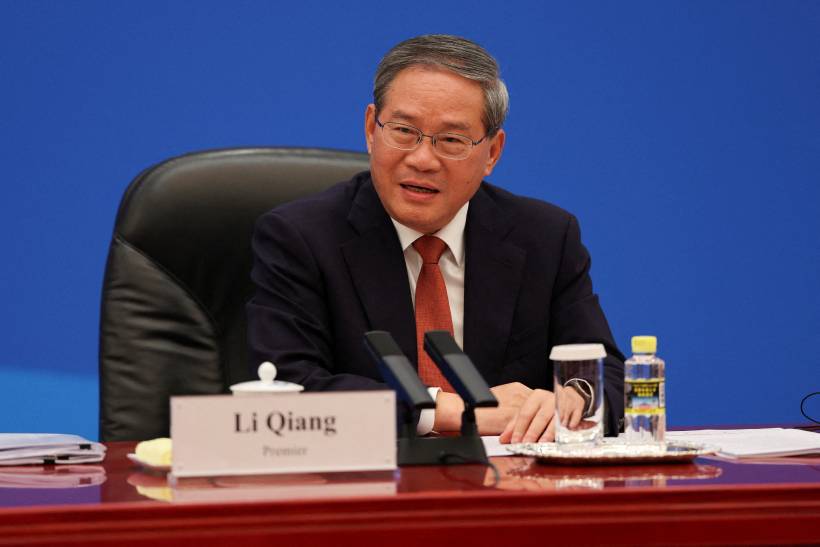
Chinese Premier Li Qiang defended China’s rapid advances in artificial intelligence, electric vehicles, semiconductors, quantum technology, and other frontier industries, rejecting claims that the country’s technological success is primarily driven by government subsidies. Speaking at the World Economic Forum’s Summer Davos gathering in Dalian, Li argued that Chinese firms have achieved global competitiveness through heavy investment in research, innovation, and talent rather than state support.
Li specifically highlighted Huawei, saying the company had endured years of foreign restrictions while continuing to innovate. His remarks come as China faces growing scrutiny from Western governments over alleged state backing for strategic industries and concerns about the security implications of Chinese technology.
Li’s comments reflect China’s determination to defend its economic model and technological ambitions at a time of intensifying competition with the United States and Europe. The debate over subsidies, market access, and technology leadership is increasingly shaping trade relations, investment flows, and global supply chains.
The remarks also signal that Beijing intends to push ahead with its drive for self sufficiency in advanced technologies despite export controls, sanctions, and restrictions imposed by Western governments.
Stay ahead of the geopolitical week.
MD Briefing delivers expert analysis across five global fronts — the Indo-Pacific, energy, geoeconomics, European security, and the Middle East — every Monday morning. Free.
China Pushes Back Against Western Criticism of Its Technology Sector
Li rejected claims that Chinese companies owe their success primarily to government assistance, arguing that innovation stems from massive corporate investment and a highly competitive domestic market. He pointed to achievements in advanced manufacturing, artificial intelligence, semiconductors, quantum computing, and aerospace technologies as evidence of China’s growing innovation capacity.
His defense comes amid increasing pressure from both Washington and Brussels. Western policymakers argue that state support gives Chinese firms unfair advantages in emerging industries, enabling them to outcompete rivals and potentially dominate critical technologies of the future.
China, however, maintains that its technological gains are the result of decades of investment in education, infrastructure, research, and industrial development rather than direct subsidies alone.
Huawei Remains Symbol of China’s Technology Ambitions
By singling out Huawei, Li highlighted a company that has become central to the broader technology rivalry between China and the West. Huawei has faced years of restrictions from the United States and several allies over security concerns, including limits on its role in telecommunications infrastructure and access to advanced semiconductor technology.
Despite those challenges, Huawei has continued developing products across telecommunications, cloud computing, artificial intelligence, and consumer electronics. Beijing often cites the company’s resilience as evidence that Chinese innovation can withstand external pressure.
Li’s comments suggest China sees Huawei not only as a major technology company but also as a symbol of national technological advancement and self reliance.
AI and Advanced Technologies Become New Battleground
Li emphasized China’s commitment to advancing artificial intelligence and other frontier technologies, highlighting the rapid pace of research and development within the country. He also pledged that China would participate in global discussions on the governance of AI and emerging technologies with what he described as a responsible and constructive approach.
The debate is becoming increasingly important as governments seek to establish rules governing the development and use of AI in both civilian and military settings. Concerns about national security, data control, economic competitiveness, and military applications are driving greater scrutiny of technology companies worldwide.
At the same time, the United States has expanded restrictions on Chinese entities it believes may contribute to military modernization, underscoring the growing overlap between technology competition and geopolitical rivalry.
Stakeholders
- Chinese government
- Premier Li Qiang
- Huawei
- United States government
- European Union
- Chinese technology companies
- Global semiconductor industry
- Artificial intelligence developers
- International investors
- World Economic Forum
- Chinese research institutions
- Global manufacturers
Future Outlook
China is expected to continue investing heavily in artificial intelligence, semiconductors, advanced manufacturing, quantum computing, and other strategic sectors despite growing Western restrictions. Meanwhile, the United States and Europe are likely to increase scrutiny of Chinese firms and industrial policies, raising the risk of further trade and technology disputes.
The battle over technological leadership is increasingly shifting beyond tariffs and trade toward control of critical technologies, standards, supply chains, and AI governance. As competition intensifies, global businesses may face greater pressure to navigate competing regulatory systems and geopolitical tensions.
With information from Reuters.
