


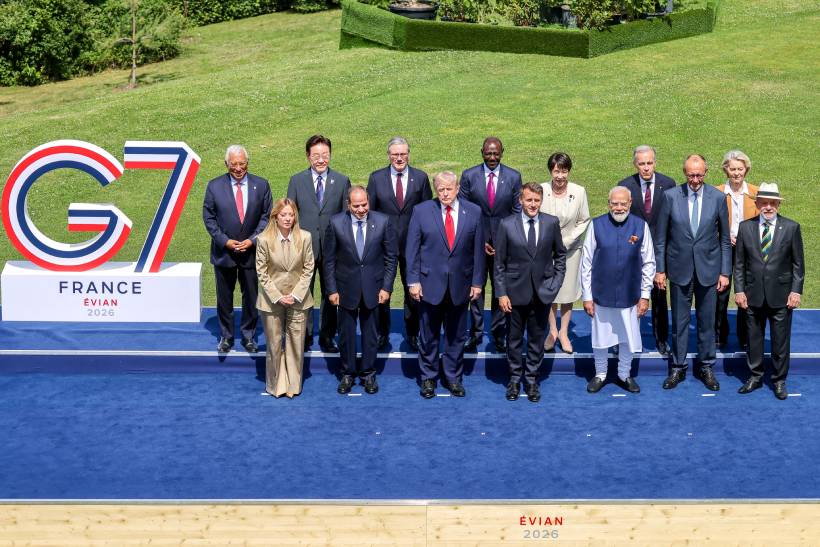
Italian Prime Minister Giorgia Meloni has strongly rejected comments made by U.S. President Donald Trump, after he claimed she had “begged” him for a photo during a recent G7 summit.
Trump made the remarks in an interview with an Italian television channel, suggesting that Meloni was overly eager to take a picture with him. Video from the summit in France showed the two leaders in conversation, but did not support his account of events.
Meloni responded by calling the comments “completely made up” and said she was astonished by what she described as inaccurate and disrespectful statements about a close ally.
Why It Matters
The dispute highlights growing strains in transatlantic relations at a time when both the United States and European allies are already navigating disagreements over security, diplomacy, and the war in Ukraine and the Middle East.
Stay ahead of the geopolitical week.
MD Briefing delivers expert analysis across five global fronts — the Indo-Pacific, energy, geoeconomics, European security, and the Middle East — every Monday morning. Free.
Italy is one of Washington’s key partners in Europe and a leading member of the European Union and NATO. Public friction between its prime minister and the U.S. president risks adding further tension to already delicate diplomatic coordination between Europe and the United States.
The incident also underscores how personal dynamics between leaders can spill into broader geopolitical relationships, especially when political messaging is amplified through media interviews and social platforms.
Key Developments
Meloni said she was “astonished” by Trump’s remarks and criticized him for what she described as inconsistent treatment of allies compared to adversaries of the West.
Italian Foreign Minister Antonio Tajani escalated the response by cancelling a planned visit to the United States, describing Trump’s comments as offensive to Italy as a whole.
A senior Italian official, Giovanbattista Fazzolari, went further, accusing Trump of damaging long standing U.S. European relations through repeated public outbursts.
The controversy comes despite earlier signs of improving relations between the two leaders during the G7 summit, where they were seen speaking closely and informally.
What Happens Next
Diplomatic attention will now focus on whether the dispute remains a rhetorical clash or develops into a more serious strain in U.S. Italy relations.
Italy is likely to seek clarification or private reassurance through diplomatic channels, while avoiding a prolonged public confrontation that could complicate cooperation on security and economic issues.
The United States and Italy are expected to continue working together within NATO and the G7, but the episode may affect the tone of future interactions between the two governments.
Personal take
This incident illustrates how quickly personal remarks by world leaders can escalate into diplomatic friction, even among close allies.
While the disagreement does not appear to affect formal policy cooperation, it exposes underlying sensitivity in European capitals about how they are perceived by Washington under Trump’s leadership style.
For Meloni, responding firmly helps reinforce her domestic and European political standing by projecting strength in the face of perceived disrespect. For Trump, such comments fit a broader pattern of confrontational rhetoric that can strain relationships even with ideologically aligned leaders.
The broader risk is not immediate policy disruption but cumulative erosion of trust between allies. In an era where coordination on security, trade, and global crises is essential, repeated public disputes can make cooperation more politically complicated, even when strategic interests remain aligned.
With information from Reuters.
