


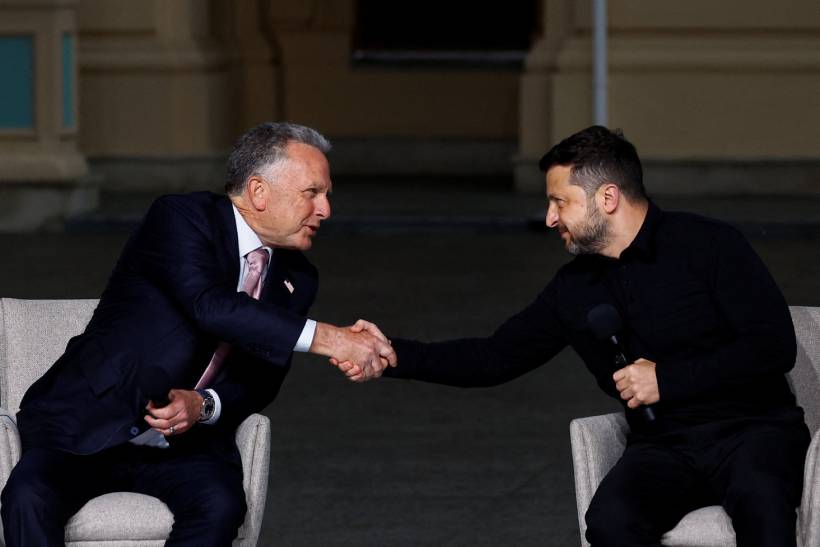
Ukrainian President Volodymyr Zelenskiy said U.S. peace envoys Steve Witkoff and Jared Kushner presented several “decent” and potentially worthwhile ideas during weekend discussions aimed at ending Russia’s war in Ukraine.
The U.S. envoys travelled to both Russia and Ukraine, holding several hours of talks with Russian President Vladimir Putin and Zelenskiy. However, the meetings failed to produce a breakthrough, with Moscow and Kyiv remaining deeply divided over the terms of a possible settlement.
A central dispute remains the territory in Ukraine’s eastern Donbas region that Russia claims as its own but has not fully captured. Zelenskiy did not disclose the substance of the new U.S. proposals, saying Kyiv had agreed with Washington to work on the ideas before discussing them publicly.
Stay ahead of the geopolitical week.
MD Briefing delivers expert analysis across five global fronts — the Indo-Pacific, energy, geoeconomics, European security, and the Middle East — every Monday morning. Free.
Why It Matters
The comments suggest that U.S. diplomatic efforts may be creating limited space for renewed negotiations, despite months of stalled talks. Zelenskiy’s positive characterization of the proposals indicates that Kyiv sees at least some elements as worth pursuing, although there is no indication that Ukraine has accepted a broader peace framework.
The next stage could involve a wider diplomatic process bringing together Ukraine, the United States and European countries. Zelenskiy said preparations were underway for another trilateral meeting, potentially hosted by Turkey, the United Arab Emirates, Switzerland or another neutral venue.
The discussions could initially focus on areas where compromise may be easier, including grain exports, energy infrastructure and prisoner exchanges, rather than immediately resolving the most contentious territorial questions.
Key Stakeholders
Ukraine: Kyiv is seeking a settlement that protects its sovereignty and territorial interests while securing continued Western military and economic support.
Russia: Moscow remains focused on its territorial claims and broader security demands, making a comprehensive agreement difficult to achieve.
United States: Washington is attempting to revive negotiations and bridge the gap between the two sides through direct engagement with both Moscow and Kyiv.
European countries: European governments are expected to play an important role in any sustainable peace arrangement, particularly regarding security guarantees and post-war reconstruction.
Turkey, UAE and Switzerland: These countries are among the potential hosts for future negotiations and could provide diplomatic venues acceptable to the parties.
What’s Next
Zelenskiy expects to meet President Donald Trump later in September, with winter air defence support expected to be an important part of the discussions.
The immediate priority appears to be building confidence through practical agreements rather than attempting to resolve the entire war at once. Prisoner exchanges, grain shipments and protection of energy infrastructure could provide opportunities for tangible progress.
However, the territorial dispute remains the biggest obstacle. Until Moscow and Kyiv narrow their differences over the future of Russian-claimed Ukrainian territory, the new U.S. ideas are unlikely to translate quickly into a comprehensive peace agreement.
Zelenskiy’s message was therefore cautiously optimistic: diplomacy has produced ideas worth exploring, but Kyiv now wants measurable results rather than another round of negotiations without concrete outcomes.
With information from Reuters.
