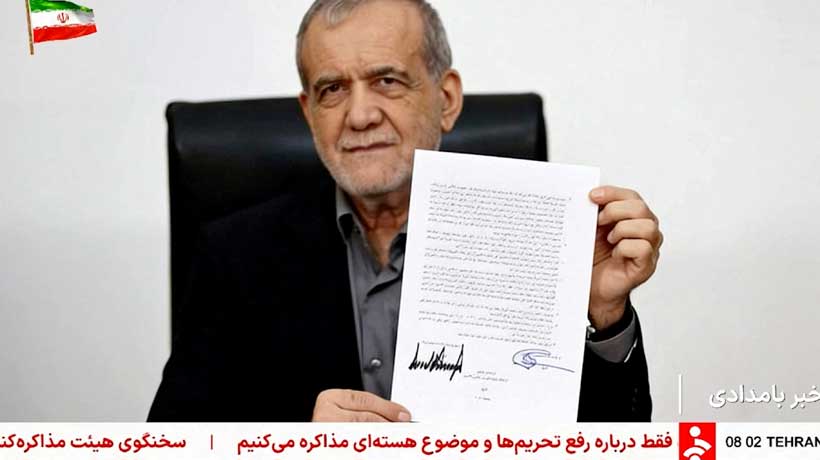
On 17 June, at a dinner hosted by Emmanuel Macron at the Palace of Versailles, Donald Trump put his signature to a memorandum of understanding with Iran, days after JD Vance and Iran’s lead negotiator had signed it digitally, a text the parties kept from view until this week and still describe in conflicting terms. Brokered mainly through Pakistan, it has been dubbed the Islamabad Memorandum. It runs to fourteen short points. The version finally made public, and now signed, is one Washington still hedges as merely political, while Tehran calls it formally finalised. Its announced terms are plain enough. The Strait of Hormuz reopens in both directions, the American naval blockade lifts, billions in frozen Iranian funds are promised, and sixty days of negotiation begin. After more than three months of war, both capitals will claim they won. Only one of them, having claimed it, can afford to call the matter closed. Pressure worked, and having worked, it gives way to diplomacy. So runs the reading in Washington, and it is wrong in the part the stronger party has least reason to examine.
Two facts sit outside it. The text settles nothing, leaving both governments free to narrate a document each reads in its own favour, with Washington advertising Iranian concessions on enrichment and Tehran advertising the relief and the unfreezing of its money. And the three carrier strike groups assembled around Iran, the heaviest American concentration in the region since 2003, are not going anywhere yet. The deal promises their drawdown but defers it, and promises a ceasefire on all fronts that one of the combatants, Israel, says does not bind it and that it does not intend to honour in Lebanon. The force is to draw down only once a final agreement is reached, sixty days off and not assured. A settlement that had truly ended a war would not usually need to keep the fleet on station against the day it fails, nor leave its real commitments off the page. This one does both.
There is a prior reason to doubt the war has ended at all. Its declared aim was never the strait or the enrichment figures. Announcing the strikes in late February, the President told the Iranian people to take over their government, that it would be theirs to take, that the hour of their freedom was at hand. The opening strike killed the supreme leader himself, and his son was installed in his place. The man changed, the system did not. The people did not take the government, and the Islamic Republic closed over the wound and went on. By the measure the United States set for itself, the thing is unfinished, and a document that reopens a strait and schedules more talks does not deliver what the war was launched to take. None of which makes Iran the innocent party, its nuclear programme being the provocation the campaign was launched to answer. And one could read the operative aim more narrowly, as the programme and the passage, the passage reopened now and the nuclear question pushed into talks whose timing Washington controls. But a government is fairly held to the war it announced to the world, not the quieter one it would rather be judged by. That is the first sign that what was signed is not the end of the war but a change in its instrument.
The conventional frame treats coercion and agreement as a sequence, first the war, then the deal that closes it. It is more useful to assume the deal stores the coercion instead of closing it. A ceasefire stops the fighting. A settlement of this shape does something else. It converts a temporary application of force into a standing arrangement, banking not the war’s gains, which are slight, but the asymmetry it left behind, the blockade re-armable, the funds withheld, the fleet in place, in a form that no longer requires the war to be fought. The blockade is lifted, but not relinquished. It is set down where it can be picked up again.
Stay ahead of the geopolitical week.
MD Briefing delivers expert analysis across five global fronts — the Indo-Pacific, energy, geoeconomics, European security, and the Middle East — every Monday morning. Free.
Force is a poor instrument for holding what it takes. It is expensive, because it must be maintained at sea every day the gain is to persist. It is continuous, because the moment it relaxes the gain begins to drain away. And it is illegitimate, because it never quite sheds the appearance of domination, which is costly at home and abroad in a way that compounds over time. An agreement has none of these properties. It is cheap, signed once and photographed well. It is episodic, not continuous, surviving in the intervals between enforcement. And it carries the presumption of mutual consent, which launders the relation of force that produced it into something that looks like order.
What the memorandum does, then, is change the posture of American power from active to latent. The coercive apparatus is not dismantled. It is repositioned. The blockade that for two months strangled Iranian ports, by Washington’s own accounting costing Tehran something on the order of half a billion dollars a day, is lifted but not surrendered. Its removal is a concession the deal can take back, not a capacity Washington has given up. The carriers do not sail home either. Their departure is promised against a final agreement that does not yet exist, which keeps them on station as the surety that Iran will reach one. A ceasefire would have stopped the fighting. This does more, turning a battlefield outcome into a lasting premise without keeping the force switched on. The war aim goes unmet, and the means of reaching it survive in cheaper form. The pressure that was meant to bring a government down becomes a standing pressure the government must keep buying off, sixty days at a time.
This requires no one to have schemed it. The claim concerns the shape of the instrument, not anyone’s cunning, and it holds whether or not intent is read into the White House. The official account runs the same way. One American voice called the deal a dial, turning relief up as Iran complies and down when it does not. A settlement of this design does this work whoever signs it, because the work is structural, a fact about what the arrangement is, not only about what its authors wanted. The old idea of victory, the one this displaces, was always the harder thing to hold. Occupation is expensive to garrison and impossible to make respectable, and regime change has to be administered. A memorandum is neither garrisoned nor administered. It is simply kept, or made to be kept, which is a cheaper proposition by an order of magnitude.
None of this is the story of force succeeding. Force applied past a certain point tends to invert, hardening the target and bending the outcome away from the one intended. The campaign meant to topple a government consolidated it instead, under the dead leader’s son. The strait the campaign meant to reopen stayed shut for months. Conversion is what a coercer reaches for precisely because the maximal aim has slipped beyond what force can take. Unable to win the thing outright, it banks the partial result, the favourable position instead of the prize, in a form that holds. The settlement is not the reward of a force that worked. It is the salvage of a force that reached its limit.
Three features of the deal mark it as conversion and not retirement. The first is where the blockade sits in the bargain. It is lifted not as a precondition of good faith but as a concession inside the agreement, one of the things Washington gives in return for what Iran gives. That placement is the whole point. A blockade ended before talks begin is gone, spent, no longer available. A blockade ended as a deliverable within talks remains in the bargaining set, re-imposable the moment the other party is judged to have failed an obligation. Far from surrendered, it has been repriced as a reward, one that can be withdrawn again as a punishment.
The second is the hollow text. For days both sides agreed to a document and declined to publish it, an odd way to treat an instrument whose authority is supposed to rest on its terms. The text has now been read out in public and signed, and it has settled less than the signing suggests. The version the White House first called fake and the one it later released do not match, and even with both presidents’ names on it Washington still calls the memorandum a political document that leaves out the real commitments. A paper its authors call merely political even as they sign it takes its operative content not from its wording but from the balance of force that produced it, to which the signing merely gives a date and a venue. The secrecy, and then the disowning, is less an administrative delay than a confession that the document works as a relationship, not a rule, and that the relationship is what both parties are actually relying on. And the text is not only hedged. Even signed, it binds no one to much, an instrument its own authors say either party may walk away from before the final deal is reached. The emptiness is the same confession seen from another angle. A document that commits its signatories to little is one the stronger of them can reread or let lapse at no cost. It is reversible, and reversibility favours the party that can act on it at least cost to itself, which here is Washington, since re-arming the blockade costs it far less than re-closing the strait costs Tehran.
The third is the asymmetry of sequencing. Tehran has been careful to say that its entry into the sixty-day negotiating window is conditional on Washington performing first, lifting the blockade, ending operations, releasing the funds. Read quickly, this is Iranian leverage. The United States must move before Iran is bound. Read against the inventory of who holds what, it is the reverse. The frozen assets are American to release. The blockade is American to lift. The fleet is American to keep on station. The conditionality does not distribute power between the parties. It specifies the order in which the stronger party will hand back what it took. Presenting the order of one’s own concessions as proof of the other side’s leverage is exactly what a settlement of this kind does.
The strait is where the whole arrangement compresses, and also where it is least settled. Washington has so far insisted that the passage reopen toll-free and under no one’s control, and the released text has Iran undertaking to restart commercial transit. But the pricing of the strait, the question the endgame came to turn on, is precisely the dispute the memorandum leaves to the sixty days to come. Iran has not conceded the principle that a chokepoint along its coast can be charged for, and the lines on this question have moved repeatedly before and during the fighting. What can safely be said is narrower than the headlines. Iran is to perform the reopening. Whether it will be permitted to price it stays open, put off to the talks to come. On its face the reopening is Tehran’s own act, a littoral state restoring movement through the water along its coast. But it is not a decision Iran arrived at freely. It is the deliverable extracted under blockade, the thing Iran does because the alternative was the indefinite closure of its own ports to its own trade. The grammar of the clause performs sovereignty. The substance delivers compliance. This is the same chokepoint where the coercion was applied, now made the site of a sovereign-looking reopening that launders that coercion into a settled fact of regional order. The state that was forced to concede everything is left to administer the reopening of a passage it is told, for the moment, that it may not price.
Oman is the thread no one can pin down. Every Iranian proposal for managing the strait has named it as co-administrator, which is what one would expect of the one Gulf state with standing ties to both sides at once. But whether Oman is actually a party to the reopening is exactly what the rival accounts dispute. Iranian sources say the draft codifies joint Iranian and Omani management of the fees to come, Washington says the passage stays toll-free, and Muscat itself has reportedly signalled it wants no such role. That the question cannot be settled from outside is not a gap in the reporting. It is the same hollowness at work, each capital narrating the strait to fit its own account of who conceded.
This is the part the conventional account of war termination misses. The harder problem for the stronger party is not to win the fighting but to make the weaker one keep accepting the outcome after the force has relaxed. The acceptance has to be manufactured, and it has to be made to look like the weaker party’s own act. A settlement that lets it perform the gesture of its own subordination, reopening the strait, restarting the traffic it was made to halt, signing the page, as though it were the exercise of a sovereign prerogative, is far more durable than one that names the subordination outright. The dignity is not a courtesy. It is what the mechanism offers, which is not the same as the mechanism working. A party still contesting how the terms apply, as Iran loudly is, polices nothing yet. The claim is only that the settlement makes self-policing the cheaper option, and that a party for whom defiance costs more than compliance tends, in time, to settle into the role. Iran may be the hard case. The incentive runs that way regardless.
The strongest objection should be met head-on, before a reader raises it. Iran, it runs, extracted real terms. Washington has agreed to move first, the funds are to be released, the blockade is to lift, and Tehran is openly asserting that the sequence binds the United States and not merely itself. In form, this is a bilateral bargain between two states each conceding something, not one side dictating terms to the other. The concession is fair, and it should be made without hedging. But a bargain can be balanced at the level of its form and one-sided at the level of its structure. Residual power is settled not by who concedes what on paper but by what is reversible and what is not. The conditional commitments are all reversible. Funds can be re-frozen, a blockade re-imposed, a negotiating window allowed to lapse at day sixty with nothing owed. The standing fleet is the exception, the term that survives every renegotiation, the constant against which all the variables are priced. And consider what Iran actually receives as its side of the bargain. Not the lifting of a blockade that can be reimposed, nor funds that can be refrozen, but the memorandum itself, a thin and now-public paper that binds Washington to little. The stronger party gives a document, the weaker gives a posture. That is the asymmetry entire, beneath a surface that looks like an exchange. The conditional language is real, and it is also exactly the form that compliance takes when the weaker party needs to be able to describe its compliance as sovereignty. That the weaker side is permitted to speak in the grammar of leverage is not evidence against the structure. It is the structure working as designed. This is also where the reading could be wrong, and it is worth saying how. If, inside the window, the fleet is withdrawn without condition, or the funds returned with no lever left attached, or the blockade capacity given up instead of repriced, or the pricing of the strait settled in Iran’s favour, then to that extent the coercion will have been retired, not stored. Any one of these counts against the reading, and enough of them together would sink it. Conversion is a claim about which of those occurs, not a frame that survives them.
None of which makes this Washington’s instrument alone. Iran banked too. It kept its system of government, which survived the killing of its leader and continued under his son. It walked away asserting sovereignty over the strait and a future right to charge for it, with a promised three hundred billion dollars in reconstruction riding on a final deal it does not yet have, and it is broadcasting the whole arrangement at home as a victory, which by its own war aims it can fairly do. A settlement both sides can sell as a win is not one party’s machine. It is a mutual hedge that each will narrate to its own people, and what separates this from mere stalemate is not that the United States won but that, of the two, only Washington holds the means to reopen the question on its own terms. The asymmetry is in the leverage retained, not in the spoils carried off.
What the week discloses runs well beyond this deal. The end-state a coercive campaign increasingly reaches for is not victory in the old sense, not occupation, not regime change, not the adversary’s collapse, but a legitimated settlement that keeps the weaker party inside the structure the coercion built. That an imposed peace can write asymmetry into law is old news. Versailles did it, and harsher settlements before it. What is worth marking is the mechanism on display here. Where a punitive treaty would name the subordination outright, this latent one stores the force, launders it as consent, and leaves the weaker side to administer its own constraint. Victory of the old kind is costly to hold and impossible to make respectable. A memorandum is neither. The document now signed is best understood as a template, an apparatus set to latent that can be returned to active, a sixty-day clock that can be wound again, an asymmetry converted from the contingent outcome of a war into the fixed starting point of everything that follows between them. Each renewal re-banks the same asymmetry.
It is the same clause I traced in the Oman case, read now at a different point in the system. There the vassal clause named the limit an ally may not cross, the sovereignty that was only ever conditional on never being exercised. Here the same architecture appears at the level of a former adversary, not the limit a partner may not cross, but the settlement the weaker party is made to keep, and to keep as though keeping it were its own choice. One face of the structure governs the allies who must not reprice their position. The other governs the enemy who has just been taught the price of his.
Clausewitz made war the continuation of politics by other means, which assumes a war answers to a political object and stops when that object is won or given up. This one answers to an object it did not win and has not given up. The formula does not break so much as reverse. The settlement becomes the continuation of the war by other means, the place where the politics the fighting failed to deliver is carried on by cheaper instruments. What could not be taken by force is now to be held by paper, and pursued at leisure under its cover.
Whether the deal holds is the question every analyst will ask, and it is close to the wrong one. The war set out to take the regime, and the regime, under a new leader, is still there, which by the war’s own declared aim leaves the thing unfinished. The ceasefire may fray and the negotiations may fail. The conversion has already happened, in the gap between the signed text and a fleet that will leave only once Iran has paid for its leaving. The question worth asking is not whether Iran will keep the agreement. It is what any state can now expect a settlement to be, once the strongest party has learned that the cheapest way to make a war it did not win look like one it chose to end, while keeping the unwon remainder within reach, is to write it down as peace.