


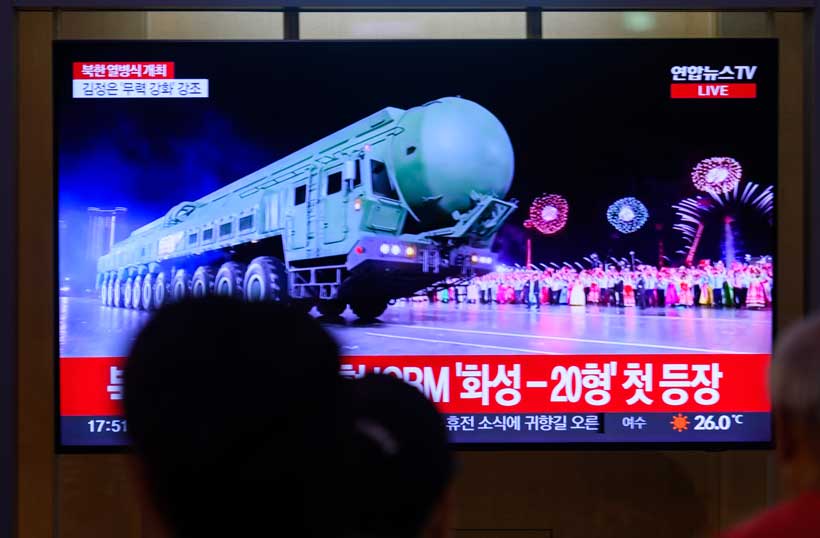
In October 2025, North Korea unveiled what its state media called its “most powerful nuclear strategic weapon,” the Hwasong-20, a solid-fueled, road-mobile intercontinental ballistic missile (ICBM) with an estimated operational range of 15,000 kilometers. That range is sufficient to place every major city in the continental United States, including Washington and New York, within reach. Six months later, in April 2026, Pyongyang followed up with three days of weapons tests near Wonsan, combining short-range ballistic missiles, a cluster munition warhead, and an electromagnetic pulse (EMP) strike package designed to blind and disable allied air defenses in the opening hours of a conflict.
Neither of these developments occurred in isolation. Together they mark a shift that the international community has been reluctant to absorb. North Korea is no longer simply a regional nuisance to be managed through sanctions and statements of condemnation. It is rapidly becoming a state with the demonstrated intent, and increasingly the demonstrated means, to hold the continental United States at direct risk while simultaneously building the tactical tools to paralyse South Korean and American forces on the peninsula itself. The question this raises is not whether North Korea will give up its nuclear arsenal. The empirical record of the last three decades already answers that. The real question is what the United States and its allies are prepared to offer instead of repeating a strategy that has consistently failed.
A capability gap that has just closed
It is worth being precise about what has and has not been demonstrated. The Hwasong-20 has been shown publicly on a parade launcher, but as of this writing it has not undergone a publicly confirmed flight test, and independent analysts caution that questions remain about its reentry vehicle and guidance accuracy under operational conditions. The April 2026 Wonsan tests, by contrast, were real and tracked in real time by Japanese and South Korean defense ministries, with missiles traveling roughly 240 kilometers and, in at least one case, more than 700 kilometers, alongside a cluster warhead test on the Hwasongpho 11 system designed to blanket several hectares with submunitions.
Stay ahead of the geopolitical week.
MD Briefing delivers expert analysis across five global fronts — the Indo-Pacific, energy, geoeconomics, European security, and the Middle East — every Monday morning. Free.
Read separately, these two events might seem to belong to different conversations, one about long-range deterrence theory and the other about tactical escalation on the peninsula. Read together, they describe a single strategic posture. North Korea is simultaneously signaling that it can reach the American homeland and that it can disable the conventional and early warning systems that the United States and South Korea would rely on in the first hours of any conflict. The Hwasong-20 raises the cost of any external intervention against the regime, while the Wonsan tests raise the cost of any conventional response on the ground. The two halves are designed to work together, and they substantially narrow the range of options available to Washington and Seoul.
The logic Pyongyang learned, and when it learned it
To understand why North Korea has invested so heavily in this combination of capabilities, it helps to recall the lessons its leadership appears to have drawn from two very different post-Cold War cases. Iraq under Saddam Hussein had no functioning nuclear weapons program by the time of the 2003 invasion, a fact later confirmed by the very inspections regime the war was supposedly meant to enforce. Libya under Muammar Gaddafi voluntarily dismantled its nuclear program in 2003 in exchange for normalized relations with Western governments. Both regimes were removed by force within less than a decade of those decisions, the second with direct air support from NATO members.
Whatever one’s view of either intervention on its own terms, the pattern they jointly establish is unambiguous, and this is widely understood to be the logic behind Pyongyang’s posture. A state without a credible nuclear deterrent has historically had no durable guarantee against regime change, and surrendering an existing program has provided no such guarantee either. This is the backdrop against which three decades of negotiation have to be assessed.
Three decades, three collapses
The 1994 Agreed Framework between the United States and North Korea froze Pyongyang’s plutonium program in exchange for energy assistance and a path towards normalized relations. It collapsed by 2002 amid mutual accusations of noncompliance. The Six-Party Talks, launched in 2003, produced a joint statement in 2005 in which North Korea agreed in principle to abandon its nuclear programs in return for security assurances and economic cooperation, yet implementation never materialized. The 2018 Singapore summit between President Trump and Chairman Kim produced a broad declaration of intent but no verification mechanism, and the follow-up summit in Hanoi in 2019 ended without an agreement at all.
Three frameworks, three different American administrations, three different sets of incentives offered, and the same outcome each time. This record matters not because it excuses North Korea’s conduct, but because any new approach that simply repeats the structure of these earlier efforts, denuclearization first, security guarantees, and sanctions relief to follow, will be evaluated by Pyongyang against a fairly consistent history of unmet commitments on both sides. The Hwasong-20 and the Wonsan tests are, among other things, a statement that North Korea does not intend to enter a fourth round of that particular sequence.
What realistic options remain?
For Washington, Seoul, and Tokyo, the menu of responses tends to fall into three categories, and each carries costs that policymakers should weigh honestly rather than rhetorically.
The first option is to continue the current approach, namely sanctions enforcement, periodic condemnations at the United Nations, and joint military exercises intended to reassure allies. This carries the lowest immediate political cost, but the trajectory of the last decade suggests it has not slowed North Korea’s program and may have reinforced the regime’s conviction that deterrence, not negotiation, is the only currency that matters.
The second option is to accelerate deterrence and defense investment, including expanded missile defense, closer trilateral coordination between the United States, South Korea, and Japan, and continued development of systems such as South Korea’s Hyunmoo-5, which Seoul has indicated it intends to deploy as a conventional deterrent against North Korean provocations. This is a defensible hedge against the capabilities North Korea has now demonstrated, but it does not by itself change Pyongyang’s calculus about why it needs those capabilities in the first place, and it risks an open-ended arms race on the peninsula at a moment when North Korea has shown it can match escalation with escalation.
The third option is the one that the historical record suggests has never genuinely been tried in full. It would mean offering binding, verifiable security guarantees, not as a reward for denuclearization, but as the starting point of a longer process in which arms control, rather than disarmament, is the immediate objective. This would mean treating North Korea less like Libya in 2003 and more like a nuclear-armed state whose arsenal is a fact to be managed, in the way that arms control agreements managed Soviet and American arsenals during the Cold War without requiring either side to disarm first. Such an approach is politically difficult, particularly because it appears to reward proliferation. But the alternative, continuing to demand an outcome that North Korea has now spent over three decades and an increasingly sophisticated weapons program demonstrating it will not accept, has its own cost. It is a peninsula that becomes more dangerous with each passing year and an arsenal that, on current trends, will only become harder to constrain the longer the impasse continues.
Conclusion
The Hwasong-20 and the April 2026 Wonsan tests are not isolated provocations to be filed alongside the dozens of similar headlines from previous years. They represent the maturation of a strategy that North Korea has pursued with remarkable consistency since the early 1990s, one premised on the lesson that nuclear weapons, not negotiated promises, are what determine a regime’s survival. The international community can continue to respond to this strategy with the same tools that have failed for thirty years, or it can begin the harder conversation about what an arms control relationship with a nuclear armed North Korea would actually require. The capability gap that the Hwasong-20 represents has already closed. The policy gap, unfortunately, remains wide open.
