


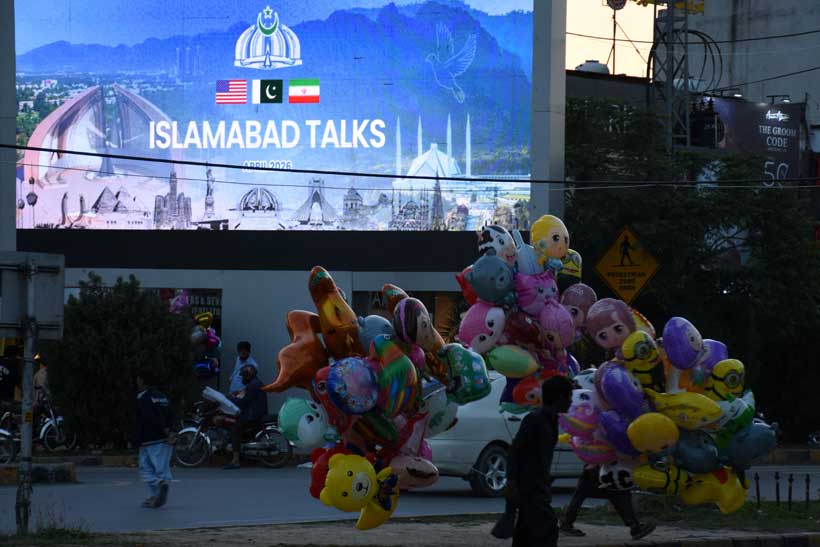
A U.S.-Iran interim agreement aimed at ending the Middle East war has been announced, marking the most significant diplomatic breakthrough since the conflict began after U.S.-Israeli strikes on Iran in February. The deal is intended to extend a fragile ceasefire and gradually reopen the Strait of Hormuz, a critical passageway for global oil and liquefied natural gas (LNG) shipments.
U.S. President Donald Trump said the agreement had been signed and would be formally presented at a ceremony in Geneva. However, both U.S. and Iranian officials have confirmed that it remains an interim framework rather than a final peace settlement, with key issues still unresolved.
What the Deal Includes
The agreement reportedly outlines a 60-day window for further negotiations and a partial restoration of maritime traffic through the Strait of Hormuz. It also signals the possibility of sanctions relief for Iran, alongside broader economic provisions that could include unfreezing assets and establishing a reconstruction support mechanism backed by regional stakeholders.
However, critical issues remain outside the scope of the current framework, including:
Stay ahead of the geopolitical week.
MD Briefing delivers expert analysis across five global fronts — the Indo-Pacific, energy, geoeconomics, European security, and the Middle East — every Monday morning. Free.
- Iran’s nuclear programme
- Restrictions on missile development
- Iran’s support for regional armed groups such as Hezbollah
Iranian officials maintain that the deal primarily restarts diplomatic talks rather than delivering substantive concessions, while U.S. officials argue that more stringent conditions will be required for full economic normalization.
Strait of Hormuz: Confidence Gap Remains
Despite the diplomatic progress, shipping and energy markets remain cautious. The Strait of Hormuz, which handles roughly one-fifth of global oil and LNG flows, has been effectively disrupted since the conflict escalated.
Even with the agreement, maritime operators are signaling that trade will not fully normalize immediately. The chief executive of Mitsui O.S.K. Lines noted that shipowners require clear evidence that conditions are stable and “material” before resuming regular transit.
Industry expectations suggest that restoring confidence could take several weeks, even if political agreements are in place. Insurance costs, security risks, and uncertainty over enforcement remain key barriers to immediate recovery.
Political Tensions and Remaining Flashpoints
The deal also leaves several regional security issues unresolved. Fighting involving Israel and Hezbollah in Lebanon continues to complicate the broader settlement, with disagreements over troop deployments and ceasefire enforcement.
Israeli officials have indicated they will maintain military positions in southern Lebanon, while Iranian representatives insist that any durable agreement must include a full cessation of hostilities in the region.
This divergence highlights a broader limitation of the current framework: it addresses maritime and nuclear issues at a high level, but leaves many ground-level conflicts and security arrangements unsettled.
Analysis: A Fragile Deal, Not a Final Settlement
The U.S.-Iran agreement represents a significant de-escalation step, particularly for global energy markets. However, it is best understood as a transitional framework rather than a comprehensive peace deal.
For markets, the key constraint is not just political agreement but operational trust. Even if the Strait of Hormuz is formally reopened, shipping flows depend on insurers, fleet operators, and cargo owners being convinced that risks have genuinely subsided.
This creates a lag between diplomacy and real-world normalization. Historically, energy markets have responded faster to announcements than to actual physical and financial reassurance.
The current situation reflects that pattern: prices are reacting to expectations of reopening, but structural confidence in the region’s stability remains incomplete. Until that gap closes, volatility in shipping flows and energy pricing is likely to persist—even under a formal ceasefire framework.
With information from Reuters.
