


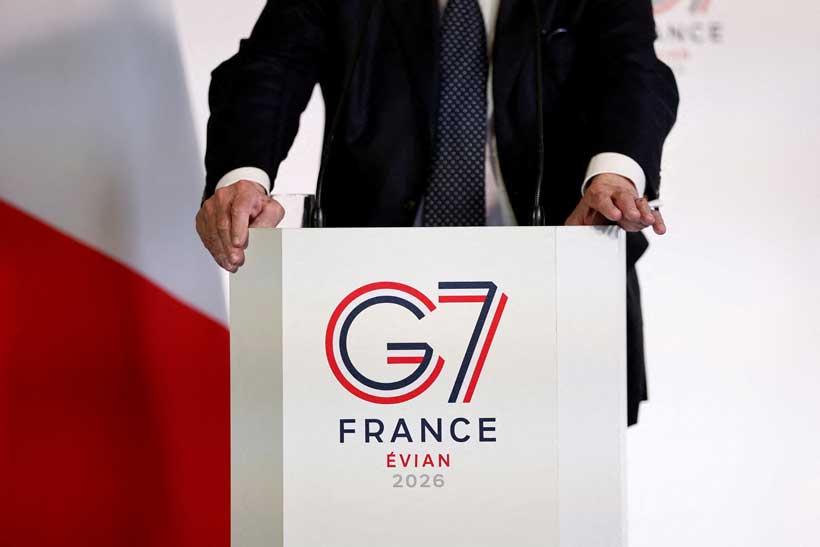
Leaders of the Group of Seven (G7) major industrialized democracies are gathering in France at a pivotal moment for global politics.
The summit takes place against the backdrop of a preliminary U.S.-Iran peace agreement that could reshape Middle Eastern security and energy markets. At the same time, leaders must address the ongoing war in Ukraine, concerns over China’s economic influence, and growing debates about the future of globalization.
The meeting represents one of the first major opportunities for world leaders to collectively assess the implications of the Iran deal and determine how it affects broader international stability.
Why This Summit Matters
Unlike previous G7 meetings focused primarily on economic coordination, this year’s summit is being driven by security crises.
Stay ahead of the geopolitical week.
MD Briefing delivers expert analysis across five global fronts — the Indo-Pacific, energy, geoeconomics, European security, and the Middle East — every Monday morning. Free.
The Iran conflict exposed divisions among Western allies, raised questions about U.S. decision-making, and created economic disruptions through higher energy prices. Meanwhile, the war in Ukraine continues to test Western unity and long-term military commitments.
The summit therefore serves as a test of whether the G7 can still function as an effective steering committee for global crises or whether international power is increasingly shifting toward a more fragmented and multipolar system.
The Iran Deal Becomes the Immediate Test
The newly announced U.S.-Iran framework agreement is expected to dominate discussions.
While many leaders will welcome reduced risks of a wider Middle East war, questions remain over enforcement mechanisms, sanctions relief, Iran’s nuclear program, and freedom of navigation through the Strait of Hormuz.
European governments are particularly interested in whether the agreement can produce lasting stability or simply delay future confrontation.
The G7’s response could also influence how quickly international confidence returns to energy markets and global trade routes.
Ukraine Risks Losing the Spotlight
For much of the past several years, Ukraine has dominated G7 summits. This year, however, the Iran conflict threatens to divert diplomatic attention.
President Volodymyr Zelenskiy arrives seeking additional military and financial support at a time when battlefield momentum appears more balanced than in previous phases of the war.
Yet Western governments are increasingly stretched by multiple crises. The challenge for Kyiv is ensuring that support for Ukraine remains a strategic priority despite growing focus on the Middle East and economic concerns.
The Bigger Economic Debate
Beyond immediate conflicts, the summit reflects growing concerns about structural weaknesses in the global economy.
France has placed global economic imbalances high on the agenda, arguing that:
- China continues to rely heavily on production and exports.
- The United States remains dependent on consumption and debt-driven growth.
- Europe continues to struggle with weak investment and competitiveness.
These debates go beyond trade disputes. They touch on the future balance of economic power and the sustainability of global growth models.
The inclusion of countries such as India, Brazil, Kenya, and South Korea highlights recognition that major economic challenges can no longer be addressed by Western powers alone.
Macron’s Last Major Global Stage
For French President Emmanuel Macron, the summit carries particular significance.
With his presidency entering its final phase, the gathering represents one of his last opportunities to shape international debates and cement his legacy as a leader who championed multilateral diplomacy.
Macron has consistently argued for greater European strategic autonomy and stronger international cooperation. The summit provides an opportunity to demonstrate whether those ideas can still influence global decision-making amid growing geopolitical rivalry.
Key Stakeholders
- The United States and President Trump.
- European G7 members seeking greater policy coordination.
- Ukraine and President Volodymyr Zelenskiy.
- Iran and regional Middle Eastern powers.
- China, despite not being a member, due to trade and industrial policy concerns.
- Emerging economies including India, Brazil, Kenya, and South Korea.
- Global energy markets dependent on stability in the Strait of Hormuz.
- International investors monitoring geopolitical risks.
What to Watch Next
- Whether G7 leaders issue a unified statement on the U.S.-Iran agreement.
- Discussions between Trump and Zelenskiy regarding future support for Ukraine.
- New proposals addressing global trade and economic imbalances.
- Efforts to diversify critical mineral supply chains away from China.
- Signs of unity—or disagreement—among Western allies on major security issues.
Future Outlook
The summit is unlikely to produce dramatic breakthroughs, but it may provide important clues about the direction of Western leadership in an increasingly unstable world.
If the Iran agreement holds and energy markets stabilize, leaders may gain breathing room to focus on longer-term economic and strategic challenges. However, unresolved disputes over Ukraine, China, and global trade suggest that geopolitical uncertainty will remain a defining feature of international affairs.
Analysis
The most important story emerging from this G7 summit is not the Iran deal itself but what the agreement reveals about the changing nature of global leadership.
For decades, the G7 operated on the assumption that the United States would lead, Europe would support, and the broader international system would largely adapt. That model is increasingly under strain. Trump’s decision to launch and then negotiate an end to the Iran conflict largely outside traditional allied frameworks has reinforced concerns among partners about unpredictability in U.S. foreign policy.
The summit therefore reflects a broader transition in international politics. The agenda spans Iran, Ukraine, China, trade, energy security, and critical minerals because no single issue now dominates the global order. Instead, leaders face overlapping crises that require cooperation at a time when strategic trust is declining.
For Trump, the Iran agreement may strengthen his position heading into difficult domestic political battles. For Europe, however, the episode reinforces concerns about dependence on Washington for security and crisis management. This tension is likely to shape discussions far beyond the Middle East.
The deeper challenge for the G7 is relevance. While it remains a powerful forum, the world’s economic and geopolitical center of gravity is becoming more dispersed. The participation of countries such as India, Brazil, and South Korea reflects recognition that solutions increasingly require broader coalitions rather than purely Western leadership.
Ultimately, this summit may be remembered less for any single policy announcement and more for illustrating the evolution of a global order in which power is more fragmented, alliances are more fluid, and international crises are increasingly interconnected. The success of the G7 will depend not on whether it can solve every challenge but on whether it can adapt to this new reality.
With information from Reuters.
