


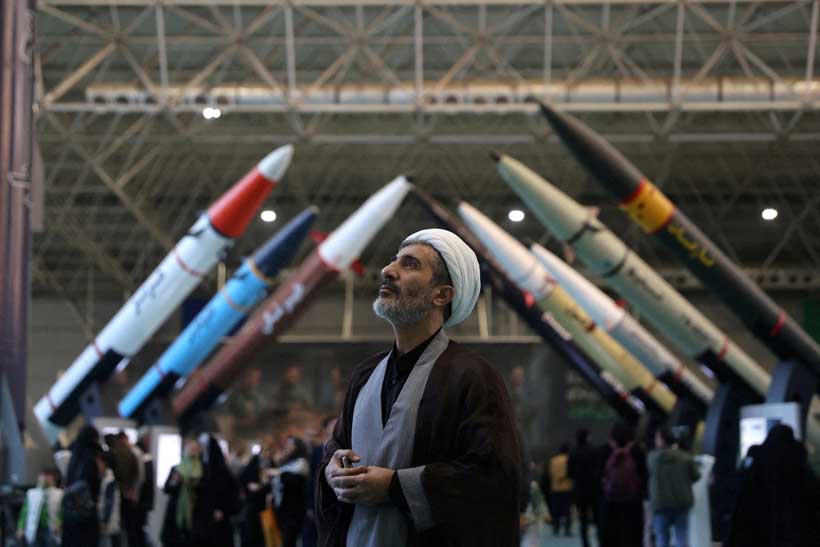
Behind a veil of good-natured diplomacy, American adversaries are exploiting the conflict in Iran by gaining insights, strategic lessons, and geopolitical power while the United States wages feckless war against the Middle Eastern theocracy. Beyond the bombings, the blockade, and the oil prices, Russia and China keenly watch how America struggles, succeeds, and scrambles. In doing so, these adversaries are leveraging the conflict to challenge America’s readiness, aid its adversaries, and gain invaluable intel on America’s successes and failures.
The concept of observing a conflict to acquire critical intelligence on how to best conduct combat is not unique to the war in Iran. For example, in the Russo-Ukrainian War, America has gained indispensable knowledge on the most and least effective tools of 21st-century warfare, including information on the power of unmanned aerial systems. With the war in Iran, though, Russia and China are the scientists, and America is the experiment. The Middle East is now a testing ground for cutting-edge drone swarm technologies and a catalyst for how smaller powers can effectively deny their adversaries from accomplishing their objectives—a lesson that China is certainly eager to learn about for a possible conflict over Taiwan. Therefore, when America wages war against Iran, there are consequences that are crucial to recognize, and one of those consequences is that the United States is inadvertently empowering and informing its adversaries.
Maintaining its signaled commitment of multipolarity and geopolitical neutrality, China’s Foreign Ministry spokeswoman Mao Ning commented, “…China…has been making active efforts to promote ceasefire and peace…we will continue playing an active role in restoring…tranquility to the Middle East…” Reality demonstrates that this is false. China is discreetly gaining intelligence on the U.S. military’s readiness, pacing, and warfighting strategies. Furthermore, China has directly supported Iran, providing anti-missile weaponry, building blocks for ballistic missiles, and invaluable military intelligence to the Iranian Revolutionary Guard Corps. Instead of promoting peace and tranquility, these actions are designed to empower Iran and keep America locked in the struggle, weakening the country and allowing China to acquire more intelligence on U.S. readiness. Despite China’s claimed intentions, it’s clear that the nation is bolstering Iran’s strength and sustaining its defenses. Even from a domestic point of view, these actions are increasing domestic American division and the depletion of America’s defense resources. The conflict with Iran is not limited to Iran; by proxy, it’s with America’s foremost adversaries, too.
Similarly, Russia has provided critical support to Iran in the form of targeting intelligence, which Iran couldn’t have otherwise acquired. Shahed drones, assets that have proven to be exceptionally effective against western defenses, are manufactured in Russia’s Alabuga Special Economic Zone and are being provided to Iran by Russia. Contradicting these actions, a statement by the Russian Ministry of Foreign Affairs declared that the country “…stands ready to assist in advancing peaceful solutions grounded in international law, mutual respect, and a balanced consideration of interests.” But equipping Iran with efficacious tools of war is not a peaceful solution. Giving the nation targeting information cannot be construed as a neutral or geopolitically insignificant act. In reality, America’s adversaries are taking an active, hands-on approach to the war in Iran, indirectly but clearly aiding the nation and actively working against U.S. goals.
Stay ahead of the geopolitical week.
MD Briefing delivers expert analysis across five global fronts — the Indo-Pacific, energy, geoeconomics, European security, and the Middle East — every Monday morning. Free.
In response to this tacit yet significant aid to Iran, the natural response for America should be to publicly highlight the hostile actions of its adversaries. But the United States has been hesitant, if not downright unwilling, to do so. For example, Matthew Whitaker, the U.S. Permanent Representative to NATO, commented that “China certainly is not participating and is not aiding and abetting the Iranian demise…” Separately, he claimed, “There’s no indication that we can talk about publicly that the Russians are participating with the Iranians.” Public investigations, though, have proven both those assertions false. The trepidation of the United States to clearly and confidently condemn its adversaries’ belligerence in the region is an enormous blunder of strategic communications. Contrasting this, Russia and China have simultaneously and aggressively pursued campaigns of condemnation to weaken America’s global power. For example, Russia has often claimed that certain U.S. support to Ukraine may constitute an act of war; China strongly condemned recent American intervention in Venezuela as violating the international laws by which America claims to be guided. U.S. adversaries are eager and willing to strategically undermine and criticize U.S. actions, yet America is unwisely unwilling to do the same.
Russia’s and China’s cooperative aid to Iran demonstrates that the conflict is, in many senses, between world powers. A new ‘axis of resistance’ against Western liberalism is developing, and allowing American adversaries to act without denunciation is a failure of strategic communications and allows these nations to act with undeserved impunity. As the United States continues to wage war against Iran, it’s crucial to recognize that every bomb America drops, every mission American soldiers complete, and every destroyed military asset is a datapoint that U.S. adversaries will exploit. Russia’s and China’s critical support to Iran is hostile and counter to American goals; ignoring this is strategically imprudent. Beyond the explosions, America’s adversaries are watching—and acting. It’s the responsibility of the United States to expose those actions for what they really are.
