


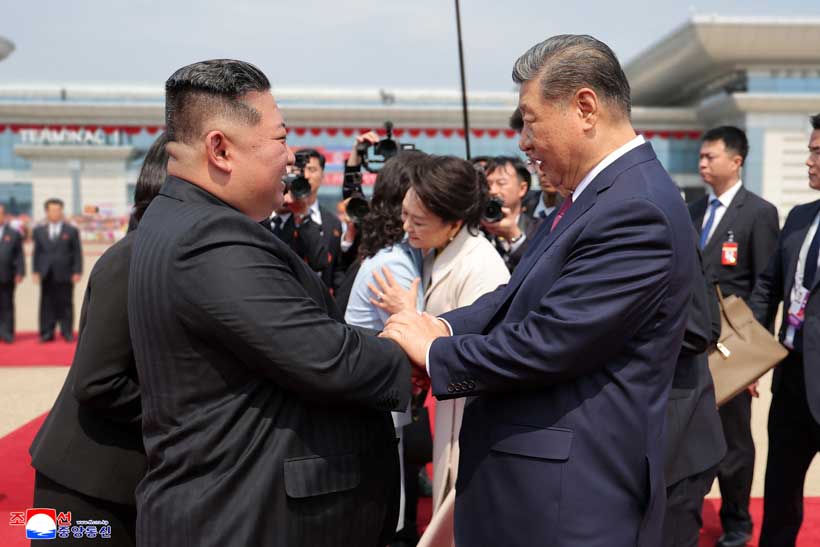
Chinese President Xi Jinping’s historic two-day visit to North Korea (June 8-9, 2026) is linked to the ongoing conflict in their ally Iran and the current conflicts in the Middle East between the United States and Iran, reflecting a global power struggle and the exchange of geopolitical pressure tactics between the superpowers. While Washington is preoccupied militarily and politically with the escalating conflicts in Iran and the Middle East, Beijing seized the opportunity to reshuffle the cards in East Asia and bolster its influence. President Xi Jinping concluded his historic two-day state visit to North Korea, his first to Pyongyang in seven years (specifically since 2019). Following his talks with North Korean leader Kim Jong-un, the Chinese president declared that relations between the two countries had entered a new historical phase, emphasizing the achievement of important strategic agreements to enhance bilateral cooperation and maintain regional stability. The highlight of the visit and the official reception for Chinese President Xi Jinping was a grand welcome that included a 21-gun salute in Kim Il Sung Square and thousands of citizens lining the streets. In an exceptional scene rarely witnessed in North Korea, a rare gesture of honor occurred: the Chinese presidential car was allowed direct access to the official banquet hall inside the Mukran Palace, where Kim Jong-un awaited him. Among the most prominent activities and field visits by the Chinese and North Korean leaders was their visit to the China-Korea Friendship Tower to honor Chinese soldiers who died in the Korean War. They also visited the higher cadre training school of the ruling party and planted a tree symbolizing lasting friendship. The two leaders also participated in several cultural events. President Xi Jinping, accompanied by his wife Peng Liyuan, attended a large-scale artistic and musical performance held at the Pyongyang Gymnasium in celebration of the visit.
The summit’s most prominent issues and strategic objectives included expanding economic cooperation. Both sides agreed to broaden areas of joint work to encompass trade, agriculture, construction, science, and technology. They also discussed border and aviation matters, emphasizing the importance of maximizing the benefits of the full reopening of border crossings and the resumption of civilian flights and international passenger train services between the two countries. Chinese President Xi Jinping and his North Korean counterpart Kim Jong-un stressed the importance of maintaining regional balance and countering hegemony. Xi Jinping called for strengthening strategic communication and confronting hegemony, tyranny, and all attempts to revive militarism that threaten regional security. China also sought to reaffirm its strong influence over North Korea in the face of Russian influence. The timing of the visit (the Chinese president’s first foreign trip of 2026) can be interpreted as reflecting Beijing’s desire to reassert its strong influence over Pyongyang, especially after the recent rapid rapprochement between North Korea and Russia.
Regarding the connection between Chinese President Xi Jinping’s visit to North Korea at this time, it is also related to China’s attempt to alleviate the pressure exerted by the United States. China is capitalizing on Washington’s preoccupation with several external fronts and its complete focus on the Iran conflict, which grants China greater diplomatic space to maneuver more freely in its Pacific region without significant American intervention. Beijing is also attempting to secure its eastern flank, as China seeks, through the summit with Kim Jong-un, to ensure the stability of its northern borders and prevent Washington from using the North Korean issue as a bargaining chip during the Middle East crisis. With China keen to maintain its energy security and economy and stop the threat to oil supplies, the US-Iran war and the ignition of the Strait of Hormuz directly threaten China’s energy security, as Beijing depends on Iranian oil for nearly 12% of its imports. Hence, Beijing is looking for a strategic alternative, as deepening the alliance with Pyongyang represents part of Beijing’s strategy to build a safety net with its regional allies to confront the economic repercussions, customs pressures, and US sanctions resulting from the Middle East crises. Xi Jinping’s visit to North Korea at this time aims to reaffirm Beijing’s position as a major power mediator and to demonstrate China’s diplomatic strength. Xi’s visit, following separate meetings with Donald Trump and Vladimir Putin, serves as a direct message to Washington. Through this visit, China is sending a clear message to the White House: Beijing alone holds the keys to resolving issues in Northeast Asia, and any comprehensive settlement of international crises (whether in the Middle East or elsewhere) requires direct coordination with it as a power equal to the United States.
Regarding North Korea’s complex calculations (its distance from Iran) and its diplomatic maneuvering within the context of the current conflict with Iran, Chinese intelligence and military reports indicate that North Korea is deliberately adopting a calming and gradual stance toward the war with Iran. It has refrained from sending direct military support to Tehran or offering excessive condolences for the deaths of its leaders. North Korea is also attempting to play a strategic game by seeking to open a window with Trump. Pyongyang exploited Chinese President Xi Jinping’s visit as a diplomatic cover, aiming, through Chinese mediation, to secure a seat at the table in future negotiations with the Trump administration after the end of the Iran war, in order to extract economic gains and international recognition as a nuclear power. The dynamics and timing of this strategic visit are linked to the Iranian issue through several points, most notably diplomatic and negotiating cover. Pyongyang seeks to use China as a mediator and strategic ally to convey its messages to the administration of US President Donald Trump, especially after the visit demonstrated Beijing’s efforts to strengthen ties with North Korea and capitalize on Washington’s preoccupation. North Korea is exploiting the state of attrition and tension resulting from the Iran-Iraq War to impose a fait accompli, as Kim Jong-un’s nuclear arsenal is seen as a bargaining chip that can be used to secure direct negotiations with the US in the future. Furthermore, North Korea is attempting to achieve several economic gains. Under international isolation and sanctions, Pyongyang aims to leverage its relationship with China—its primary economic lifeline—to improve its domestic situation through potential aid packages and substantial Chinese investments.
Stay ahead of the geopolitical week.
MD Briefing delivers expert analysis across five global fronts — the Indo-Pacific, energy, geoeconomics, European security, and the Middle East — every Monday morning. Free.
Based on the preceding understanding and analysis, North Korea’s attempt to leverage Chinese President Xi Jinping’s visit to gain international recognition of its nuclear program can be analyzed. North Korea is capitalizing on Washington’s focus and engagement with Middle Eastern crises to solidify its nuclear program as a non-negotiable and irreversible reality, hoping for a settlement similar to those proposed at previous summits. Xi Jinping’s agenda prioritizes revitalizing relations with North Korea, viewing this rapprochement as a strategic repositioning by Beijing and Pyongyang to regain leverage against the United States and monitor developments in Middle Eastern conflicts, particularly the potential conflict with Iran.
