


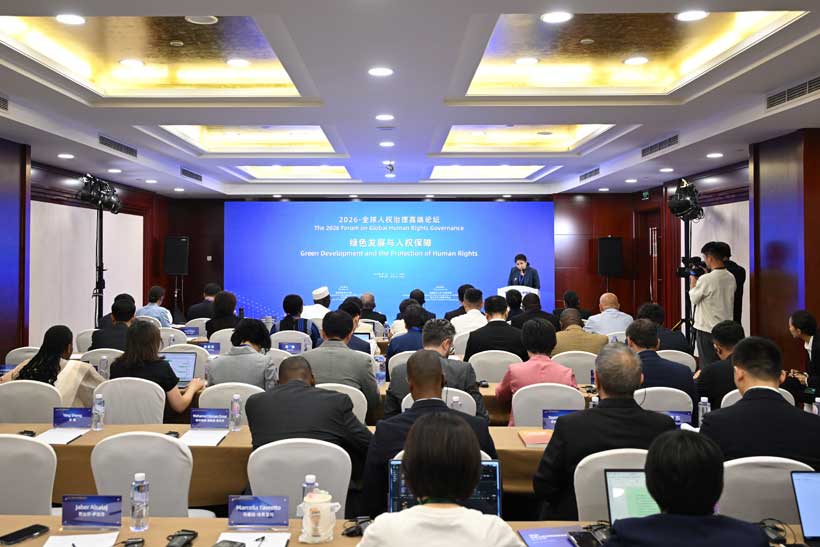
The 2026 Global Human Rights Governance Forum was launched in Beijing, China, and ran for two days (June 11 and 12, 2026), coinciding with the 40th anniversary of the adoption of the United Nations Declaration on the Right to Development. China’s hosting of this global forum underscores Beijing’s commitment to supporting developing countries and building a multipolar world order that transcends Western shortcomings and the double standards of the United States and the West regarding human rights. China also highlighted the humanitarian crises in Gaza and the Middle East. This prominent event was organized by the State Council Information Office in cooperation with the Chinese Ministry of Foreign Affairs, under the central theme “Shared Development, Shared Human Rights: The 40th Anniversary of the Declaration on the Right to Development and a New Vision for Global Human Rights Governance.” The detailed structure of the forum’s proceedings and its guiding principles reflect its role as a complement to the United Nations and the international community in defending the core human rights issues of the developing world and advocating for its interests and just causes. This was reflected in the participation statistics and the number of guests, with more than 400 international and local participants and figures, and a broad scope of participation to include representatives from nearly 100 countries and regions around the world. There was also significant participation and attendance from international organizations, with a prominent presence of representatives from the United Nations and regional organizations.
The most prominent themes and sub-forums of the Global Governance Forum for Human Rights in Beijing, held in five main sessions, focused on five thematic areas designed to link sustainable development with emerging human rights; discuss the implications of China’s Global Governance Initiative on the human rights system; explore the role and importance of the right to development in the global evolution of human rights; protect the right to development in the age of artificial intelligence and discuss the opportunities and challenges arising from it; understand the role of green development and its direct relationship to the protection of human rights; and examine the role of modernization and free and inclusive development for all peoples. The strategic goals and vision of the Global Human Rights Governance Forum in Beijing were embodied in realism, meaning translating the theoretical vision of the UN Declaration on the Right to Development into a tangible reality for individuals and calling for reform of the international system through the establishment of a global human rights governance system characterized by justice, logic, mutual benefit, and inclusiveness, free from politicization. This necessitated the launch of China’s National Human Rights Initiatives to defend multilateralism and the issues and interests of the Global South. The opening ceremony also witnessed China’s announcement of its National Action Plan for Human Rights Protection (2026-2030), linking domestic economic and social modernization with human rights development standards.
The hosting of the Global Human Rights Governance Forum in Beijing, jointly organized by the State Council Information Office and the Chinese Ministry of Foreign Affairs, is of paramount importance in promoting China’s new vision for human rights, especially after the repercussions of the Gaza war and the escalation with Iran. Its significance lies in several key and strategic issues, including presenting an alternative to hegemonic policies; rejecting the West’s use of human rights as a political tool or to interfere in the internal affairs of developing countries and advance strategic agendas; and China’s defense and support of the principle of the right to development priority. China emphasizes that the right to development, embodied in poverty eradication, economic growth, and improved living standards, is the cornerstone of human rights for the peoples of the Global South, preceding individualistic Western interpretations of civil and political rights.
Here, China’s hosting of the Global Human Rights Governance Forum is of particular importance due to the geopolitical repercussions following the Middle East crises, the Gaza war, and the military escalation against Iran. During the Global Human Rights Governance Forum, China highlighted the catastrophic humanitarian crisis in Gaza and the tensions with Iran to emphasize the shortcomings of the current international system and called for the adoption of the principles of global governance that guarantee the sovereignty of states, prioritize diplomacy and peace over sanctions and military interventions, and establish the principle of multipolarity. This was achieved by China uniting the ranks of the Global South to build a fair global system that rejects the double standards of the US and the West regarding human rights and seeks to strengthen the Global Human Rights Governance Forum as an independent platform for exchanging views away from the dictates of the major powers.
Stay ahead of the geopolitical week.
MD Briefing delivers expert analysis across five global fronts — the Indo-Pacific, energy, geoeconomics, European security, and the Middle East — every Monday morning. Free.
Herein lies the significance of China’s geopolitical objectives in hosting the Global Human Rights Governance Forum in Beijing. China aims to highlight the shortcomings of the current international system, using the forum to condemn the double standards and deficiencies of the US and the West regarding human rights. It also seeks to emphasize the inability of international institutions to address the humanitarian crisis in Gaza and the military tensions in the Middle East. China is proposing an alternative to global governance, advocating for the adoption of principles that prioritize state sovereignty and the right to self-determination; favor diplomatic and peaceful solutions over military interventions and sanctions policies; and unite the Global South. The Global Human Rights Governance Forum in China thus serves as a key Chinese platform for mobilizing developing countries to build a just and equitable global system that guarantees their participation in global decision-making.
Based on the preceding understanding and analysis, we can conclude that the convening of this Global Human Rights Governance Forum in Beijing is part of China’s National Human Rights Plan for the period 2026-2030, designed to promote international cooperation based on the principles of equality and mutual respect. The forum coincides with the 40th anniversary of the UN Declaration on the Right to Development, during which China issued its National Action Plan for Human Rights Protection for the next five years. China’s focus during the Global Forum on Human Rights Governance is on human rights issues in the Global South, with particular emphasis on the crises in the Middle East, Gaza, and the Iran War. China is advocating for its national principles of human rights protection, independent of Western and American human rights agendas and narrow, politicized understandings of human rights, presenting a new and independent vision based on its own principles.
