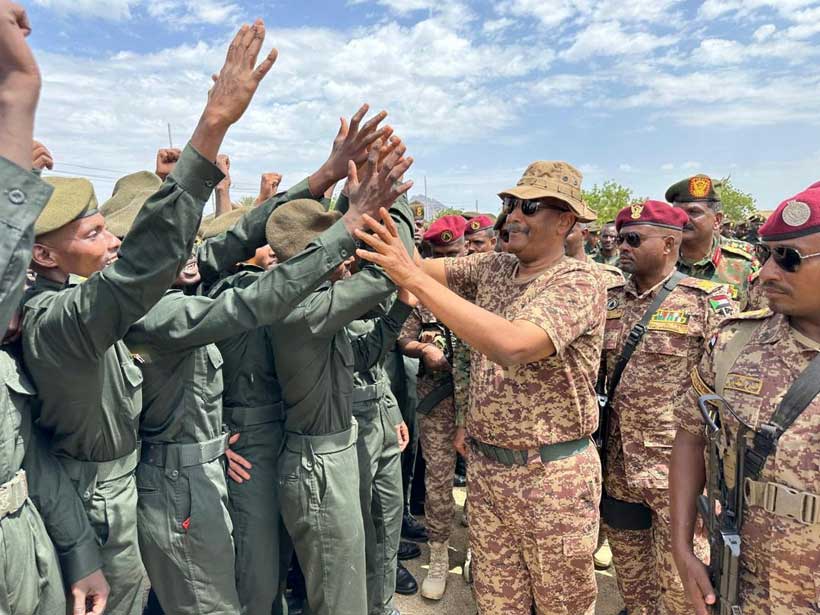
Sudan’s army leader, General Abdel Fattah al-Burhan, has no plans for peace in Sudan, let alone a civilian‑led, internationally supported settlement. Instead, he is digging in for a war of attrition because the one thing more unthinkable to him than an unwinnable war is what might follow if he stopped fighting.
Everything about Burhan’s diplomatic calendar over the past year points in that direction. He has moved methodically through Cairo, the Gulf, and neighboring capitals, not to explore a political settlement, but to secure aircraft, drones, ammunition, fuel, and friendly rear bases. Public communiqués stress “regional stability” and “coordination on Sudan,” but the accompanying entourages and subsequent reporting tell a blunter story: defense‑industry chiefs, intelligence bosses, and security advisers sitting across the table from counterparts whose main leverage lies in arms, logistics, and money. His backers range from Qatar to Saudi Arabia to Iran. The priority is to harden military supply lines and diversify external sponsors. He is not looking to widen the space for compromise.
Take his high‑profile visits to Egypt and other regional partners. Besides conferring a specious legitimacy on him as the (unelected) representative of a ‘sovereign government,’ these trips are presented as consultations on ceasefires and humanitarian access. Yet Burhan’s red lines have never shifted: he demands the dismantling of the Rapid Support Forces and restoration of full army primacy as a precondition, even though he has repeatedly failed to impose that outcome on the battlefield. In practice, he uses the symbolism of summits and joint statements as cover for a narrower agenda—securing the political protection and military hardware that allow the army–Islamist bloc around him to survive a grinding stalemate.
His outreach to newer security patrons follows the same logic. Courtship of Iran, Russia, and Turkey and quiet understandings with smaller neighbors are less about repositioning Sudan diplomatically than about locking in alternative pipelines for weapons and fuel. When one route comes under scrutiny, another quietly ramps up. This is not crisis diplomacy in search of an off‑ramp; it is sanctions‑proofing and war‑proofing a regime that expects to be fighting, in some form, for years. Multilateral forums, when he attends them, are treated as necessary theater rather than venues for genuine bargaining.
Stay ahead of the geopolitical week.
MD Briefing delivers expert analysis across five global fronts — the Indo-Pacific, energy, geoeconomics, European security, and the Middle East — every Monday morning. Free.
Even his periodic gestures towards talks in Geneva, Jeddah, or elsewhere have more served the war of attrition than undercut it. Burhan agrees to processes once international pressure becomes intense, then attaches maximalist conditions he knows the RSF will reject, or he simply fails to send senior decision-makers with room to maneuver. The result is a cycle of announcements, photo opportunities, and inconclusive rounds that buy time, blunt criticism, and reassure his backers that he remains the indispensable man in Khartoum. Diplomacy becomes another front in the war, not a way to end it.
Underlying all this is a cold strategic calculation. Burhan almost certainly understands that neither side can reconquer the whole country under current conditions. But he also knows what defeat would mean for his own movement and coalition: the loss of the state, the purging or prosecution of senior officers, and the eclipse of the Islamist and security networks that have dominated Sudan for decades. In that light, his external engagements are best read as an insurance policy against collapse. As long as he can keep enough weapons and money flowing, he can prevent any settlement that looks like a defeat, however catastrophic the cost for the country.
This is why there is no serious sign of a Burhan‑led peace plan and still less of an agenda for transferring power back to civilians. His diplomatic initiatives show a man digging in, not backing down: shoring up patrons, hardening supply lines, and wrapping an endless war of attrition in the language of sovereignty and stability. For now, the only strategy he appears willing to contemplate is to keep Sudan fighting a war he cannot win in order to postpone the reckoning he fears will come the moment he stops.