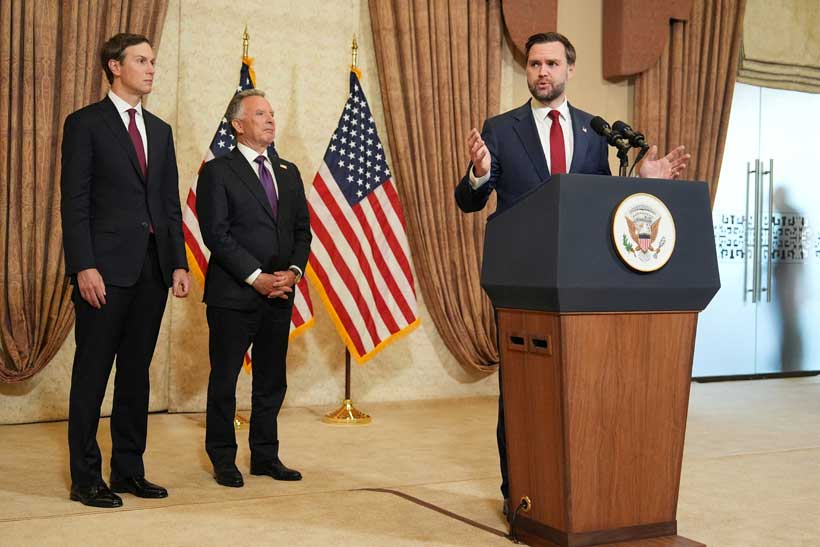
Out of the raging war in the Middle East and its geopolitical reverberations, a new geopolitical actor is rising. While major states like India and China often capture the spotlight, Pakistan has emerged as a key mediator between Iran and the United States (US), acting as an intermediary messenger, persuading Trump to stop escorting ships through the Strait of Hormuz in defiance of the Iranian blockade, and hosting the first direct, high-level meetings between the US and Iran in nearly 50 years in April 2026. This is a notable development not only considering Pakistan’s modest share of the global economy, but also against the backdrop of the past few years, where Pakistan has been marginalised as a pariah state due to its authoritarian, militaristic rule, nuclear weapons, support for the Afghan Taliban regime, and its sheltering of Osama Bin Laden in the wake of 9/11. So, what changed?
A geopolitical pendulum
Pakistan has long held a pendular geopolitical position. While an important US ally during the Cold War, facilitating US President Nixon’s rapprochement with China in 1971, and the War on Terror, relations have soured in more recent times with US condemnations of Pakistani human rights abuses and laxity toward Islamic terrorism. Pakistan remains an ambiguous geopolitical actor. Notably, while hosting peace negotiations between Iran and the US earlier this spring, the country was simultaneously waging war against neighboring Afghanistan, and has ongoing territorial tensions with neighboring India. Thus, Pakistan’s diplomatic change must be placed in the context of the seismic foreign policy shift enacted by US President Trump, rejecting traditional US foreign policy commitments to human rights, breaching existing agreements such as the Iran nuclear deal of 2015 (JCPOA), and basing diplomacy on personal relations, circumventing multilateral organisations and treaties.
Pakistan’s MAGA links
Stay ahead of the geopolitical week.
MD Briefing delivers expert analysis across five global fronts — the Indo-Pacific, energy, geoeconomics, European security, and the Middle East — every Monday morning. Free.
This creates a geopolitical landscape of uncertainty, undermining the role of traditional US allies and other major geopolitical players, while offering new opportunities for emerging states. For example, Pakistan nominated Trump to the Nobel Peace Prize, giving the President credit for brokering a ceasefire in the Indo-Pakistani war in May 2025 and joined the President’s ‘Board of Peace’ in 2025, in order to get on the good side of the US President. These efforts appear to have paid off, with Trump inviting Pakistani Chief General Asim Munir in June 2025—an exceptional favor toward a non-head of state granted at the expense of conventional US allies like Australia, who at the time were still awaiting a phone call with the President. In addition, Pakistan has struck trade deals with the US to develop its oil industry and critical mineral exports—two key resources in the global economy. This rapprochement coincides with a souring of US-Indian relations with the US imposing high tariffs on Indian goods, and tightening migrant visa restrictions as part of his ‘America First’ policy, and India’s denial of Trump’s role in ending the 2025 Indo-Pakistani conflict. This, coupled with India’s alignment with Israel, has allowed Pakistan to emerge out of the geopolitical shadow often cast by its larger neighbor.
Geopolitical Multi-alignment
Simultaneously, Pakistan has been cultivating strong ties with regional powers, including a mutual defence pact with Saudi Arabia, close ties with Turkey, China and Egypt, and a Strategic Defence Agreement with the US and Saudi Arabia. At the same time, Pakistan is strongly pro-Iran, as indicated by the large protests and storming of the US consulate in Karachi following US-Israeli attacks on Iran in February 2026, while having a complicated diplomatic history of territorial and political tensions with Iran over the disputed Balochistan province and Sunni-Shia divides. Even so, the countries have religious and cultural affinities, uniting them particularly in their opposition to Israel.
A diplomatic bridge
Thus, when war broke out in the Middle East at the beginning of the year, Pakistan was uniquely geopolitically positioned as a mediator, enjoying the trust of both parties of the conflict by virtue of its strategic geopolitical maneuvering in the past few years, providing the base from which the opportunistic militarised leadership could exploit the geopolitical vacuum of opportunity created by US foreign policy. For Pakistan, ending the war in the Middle East and stabilising supply chains through the region is crucial, as the country depends on imports from the Middle East for almost 90% of its oil, and as the closure of the Strait of Hormuz threatens to cripple Pakistan’s budding, largely agricultural economy by causing energy and fertiliser shortages and price shocks.
A complex balancing act
Even so, Pakistan must maintain a complex balancing act to maintain its geopolitical leverage. As a Muslim, anti-Israel nuclear power like its neighbor Iran, Pakistan fears that it might be next in line as a target for US-Israel attacks. In addition, as the slow progress of the last few weeks have shown—most recently by Israel bombing Iran for the first time since a ceasefire in April last year—the mere act of meeting does not necessarily translate into concrete, not to mention lasting, agreement. Thus, while Pakistan may have enhanced its global prestige by arranging US-Iranian meetings, that gain may be as suddenly lost as it was gained; should the high-stakes negotiations continue to fail to yield concrete and lasting peace agreement, Pakistan’s global image might become tainted by association for having bitten off more than it could chew. This risk is aggravated by Pakistan’s growing internal instability as separatists in the disputed Balochistan region bordering on Iran threaten to undermine Pakistan’s credibility as a mediator in relation to Iran.
Thus, Trump’s diplomatic capriciousness is a double-edged sword. While providing geopolitical openings for emerging countries, it by the same token implies that the geopolitical leverage gained from these opportunities remains uncertain.