


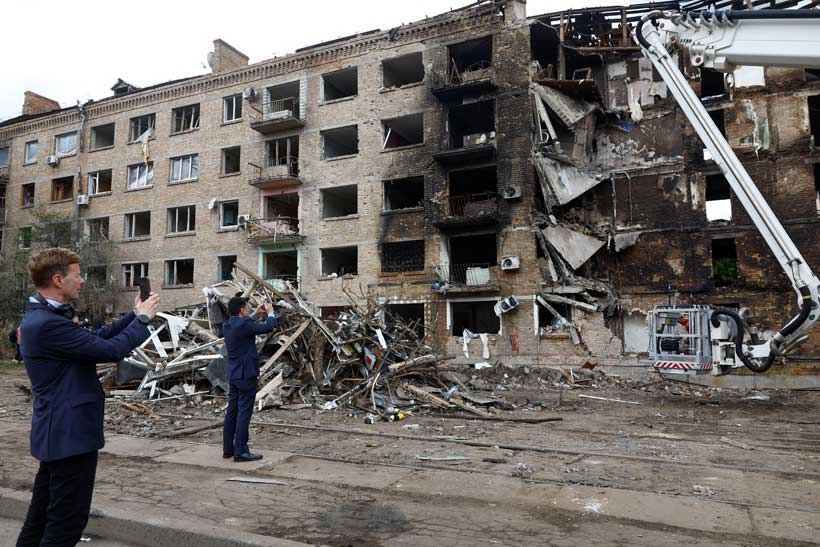
Russia launched one of its largest aerial assaults of the war on Tuesday, firing hundreds of drones and dozens of missiles at Kyiv and multiple Ukrainian cities, killing at least 11 people and injuring more than 100 others. The attack came after days of warnings from Moscow that it would carry out retaliatory strikes following a deadly incident in Russian occupied Luhansk that the Kremlin blamed on Ukraine.
The scale of the bombardment, the use of advanced hypersonic missiles, and the targeting of multiple regions simultaneously suggest that Russia may be entering a new phase of intensified military pressure against Ukraine. The attack also highlights the continuing failure of diplomatic efforts to end a conflict that has now lasted more than four years.
Beyond the immediate human toll, the strikes raise important questions about Russia’s strategic objectives, Ukraine’s defensive capabilities, and the future trajectory of Europe’s largest war since World War II.
Stay ahead of the geopolitical week.
MD Briefing delivers expert analysis across five global fronts — the Indo-Pacific, energy, geoeconomics, European security, and the Middle East — every Monday morning. Free.
The war began with Russia’s full scale invasion of Ukraine in February 2022 and has since evolved into a prolonged conflict involving large scale military operations, economic warfare, sanctions, and drone campaigns.
Over the past year, Ukraine has significantly expanded its ability to strike targets deep inside Russian territory, particularly oil refineries, fuel depots, military installations, and logistical infrastructure.
Russia has responded by increasing missile and drone attacks against Ukrainian cities, energy infrastructure, and defense related facilities.
The latest escalation follows a deadly attack in the Russian occupied Luhansk region. Moscow accused Ukraine of carrying out a drone strike on a dormitory that reportedly killed 21 people. Ukrainian authorities denied responsibility.
The Kremlin subsequently warned that it would conduct “systematic strikes” against targets in Kyiv.
Tuesday’s attack appears to be the first major manifestation of that threat.
What Happened?
According to Ukrainian authorities, Russia launched:
- 656 drones
- 73 missiles
- Multiple waves of attacks targeting cities across Ukraine
Ukraine’s air force reported intercepting or neutralizing:
- 602 drones
- 40 missiles
Despite these interceptions, significant damage was reported.
In Kyiv:
- Four people were killed.
- Sixty five people were injured.
- Residential buildings suffered major destruction.
- Apartment blocks caught fire.
- Thousands sought shelter in metro stations.
In Dnipro:
- Seven people were killed.
- Thirty six people were wounded.
- Residential infrastructure sustained heavy damage.
In Kharkiv:
- Ten people were injured.
- Civilian areas were affected.
Meanwhile, Poland scrambled military aircraft to protect NATO airspace as the strikes unfolded near the alliance’s eastern border.
The Significance of the Zircon Hypersonic Missiles
One of the most notable aspects of the attack was Ukraine’s claim that Russia used eight Zircon hypersonic missiles.
The Zircon represents one of Russia’s most advanced weapons systems.
Key characteristics include:
- Speeds reportedly reaching nine times the speed of sound.
- A range of approximately 1,000 kilometers.
- Reduced reaction time for air defense systems.
If confirmed, the use of eight Zircon missiles in a single operation would represent one of the largest deployments of the weapon during the conflict.
The attack may indicate that Russia is increasingly willing to employ some of its most sophisticated capabilities against Ukrainian targets.
Why Russia May Be Escalating Now
Retaliation and Deterrence
The most immediate explanation is retaliation.
Moscow has repeatedly stated that it intends to punish Ukraine for attacks inside Russian territory and occupied regions.
The Kremlin may believe that large scale strikes can deter future Ukrainian operations by increasing the costs associated with deep strikes against Russian infrastructure.
Battlefield Pressure
Russia may also be attempting to weaken Ukraine’s military capacity before future offensive operations.
Targeting defense facilities, logistics networks, and infrastructure could complicate Ukrainian military planning and reduce operational flexibility.
Strategic Messaging
The scale of the attack also sends a political message.
By demonstrating the ability to launch hundreds of drones and dozens of missiles simultaneously, Russia is signaling both to Ukraine and Western governments that it retains substantial offensive capabilities despite years of war and sanctions.
The Human Cost of Attrition Warfare
The scenes emerging from Kyiv illustrate how deeply the conflict continues to affect civilian life.
Families sheltering in underground metro stations, apartment buildings reduced to rubble, and emergency responders operating amid ongoing attacks have become recurring features of the war.
Particularly concerning are reports of a “double tap” strike in Dnipro that allegedly killed a rescue worker responding to an earlier attack.
Such incidents increase fears among humanitarian organizations regarding risks faced by emergency personnel operating in conflict zones.
The continuing civilian impact underscores how the war has evolved beyond conventional battlefield engagements into a broader struggle affecting entire societies.
NATO’s Growing Security Concerns
Poland’s decision to scramble fighter aircraft reflects increasing concern among NATO members bordering Ukraine.
Although Russia’s attacks remain focused on Ukrainian territory, the scale of operations near NATO airspace raises the risk of accidents, miscalculations, or unintended escalation.
Since the start of the war, alliance members have repeatedly strengthened air defenses and military readiness along NATO’s eastern flank.
The latest strikes are likely to reinforce calls for additional defensive measures and increased military spending among European allies.
Analysis: A War Moving Toward Greater Escalation
The most significant takeaway from Tuesday’s attack is not simply the number of missiles or drones launched.
It is what the assault reveals about the broader direction of the war.
For much of the conflict, both sides have attempted to balance military escalation with political restraint. While fighting remained intense, there were periodic expectations that negotiations or battlefield realities might eventually push the war toward a settlement.
That possibility appears increasingly distant.
Russia’s willingness to conduct massive strikes against major urban centers suggests confidence that military pressure remains its most effective tool for shaping the conflict.
At the same time, Ukraine continues to expand its capacity to strike inside Russia, demonstrating that it can impose costs beyond the front lines.
This creates a dangerous cycle.
Ukrainian attacks provoke Russian retaliation. Russian retaliation encourages further Ukrainian efforts to strengthen offensive capabilities. Each round of escalation generates pressure for the next.
Another important factor is the international environment.
During earlier stages of the war, Ukraine occupied a central place in Western diplomatic and security agendas. Today, global attention is increasingly divided among multiple crises, including instability in the Middle East and growing tensions in Asia.
This shift may influence calculations in both Moscow and Kyiv.
Russia may perceive an opportunity to intensify military pressure while international focus is fragmented. Ukraine, meanwhile, faces the challenge of maintaining political and military support from partners whose attention is increasingly stretched across several global flashpoints.
The attack also highlights a critical reality often overlooked in discussions about the conflict: despite years of warfare, neither side has achieved a decisive strategic breakthrough.
Instead, the war continues to evolve into a prolonged contest of endurance, resources, industrial capacity, and political will.
Future Scenarios
Scenario One: Sustained Russian Air Campaign
Russia continues conducting large scale missile and drone attacks over the coming months.
This would place growing pressure on Ukraine’s air defenses, infrastructure, and civilian morale.
Scenario Two: Intensified Ukrainian Counterstrikes
Ukraine responds with expanded attacks on Russian military and energy facilities.
Such a cycle could deepen escalation and increase the risk of broader regional instability.
Scenario Three: Renewed Diplomatic Push
Mounting economic and military costs eventually encourage renewed negotiations.
While a comprehensive settlement remains unlikely in the near term, limited agreements on humanitarian issues or infrastructure protection could emerge.
What’s Next?
Military analysts will closely monitor whether Tuesday’s assault represents a one time retaliatory operation or the beginning of a sustained campaign against Kyiv and other major cities.
Attention will also focus on Ukraine’s air defense capabilities, particularly its ability to counter increasingly sophisticated missile threats.
Western governments are expected to assess whether additional military assistance is required as the intensity of Russian attacks increases.
Meanwhile, both sides appear committed to continuing operations despite growing casualties and destruction, suggesting that the conflict remains far from resolution.
Conclusion
Russia’s latest missile and drone barrage represents one of the most significant aerial attacks of the war and highlights the increasingly dangerous trajectory of the conflict. The scale of the assault, the use of advanced weapons systems, and the widening cycle of retaliation all point toward a prolonged struggle with no clear end in sight.
More than four years after the invasion began, the war is entering a phase defined less by hopes of negotiation and more by competing efforts to wear down the opponent’s military capacity, economic resilience, and political resolve. The consequences of that dynamic will shape European security for years to come.
With information from Reuters.
