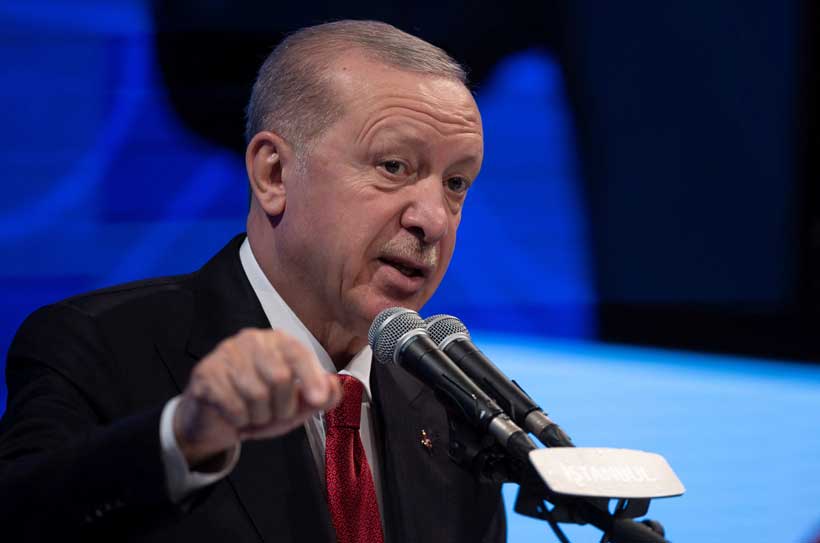
Turkey escalated tensions with Greece sharply in September 2026, as denoted by a return to hardline rhetoric and friction over regional alliances in the Eastern Mediterranean, recalling periods of heightened tension before the signing of the 2023 Athens Declaration on Friendly Relations and Good Neighborliness.
Warnings against Greece, expressed by Turkey’s highest levels of leadership, are part and parcel of its Blue Homeland (Mavi Vatan) doctrine that seeks to challenge existing borders and assert control of maritime zones across the Black Sea, the Aegean Sea, and the Eastern Mediterranean. President Erdogan has brought to the forefront of the public debate the military and legal status of the Greek islands in the Eastern Aegean, cautioning Athens against actions that would result in “regret, just like a century ago,” a direct reference to the 1922 defeat and expulsion of Greek forces from Asia Minor.
Turkey’s renewed revisionism in terms of challenging established post-World War I treaties, maritime boundaries, and regional security architectures to assert greater geopolitical influence coincides with the time that Greece signed a landmark $3.6 billion defense deal with Israel, known as the Achilles Shield. This multi-layered air and missile defense architecture is designed to completely shield Europe against potential long-range threats stemming from the broader Middle East and, concurrently, offers a credible Greek deterrence against any aggressor, as the Achilles network is intended to counter extensive drone arrays and “seal the Aegean from the ground.” Notably, the Achilles Shield is welcomed by Washington as a positive step for regional stability and allied security architecture.
Turkey largely views the multi-level partnership between Greece and Israel as a vehicle to undermine the Blue Homeland doctrine by constraining Turkish maritime ambitions in the Eastern Mediterranean and as a hostile “security alliance” that is directed exclusively against it. In practice, however, Turkey constitutes the regional country that has repeatedly warned since 2022 that its domestically developed Tayfun (Typhoon) short- to medium-range ballistic missile could strike Athens and Jerusalem, thereby employing an aggressive rhetoric that undermines regional stability and contradicts de-escalation efforts across the Eastern Mediterranean.
Stay ahead of the geopolitical week.
MD Briefing delivers expert analysis across five global fronts — the Indo-Pacific, energy, geoeconomics, European security, and the Middle East — every Monday morning. Free.
International Law Exposes Turkey’s Double Standards
Turkey’s revisionism is deconstructed by international law, existing treaties, and geopolitics. Geopolitics are affected by a mix of geography, power, and economics that determine how countries compete and form alliances. On the premises of international law, the Turkish argument that Greek islands cannot create maritime zones in the Aegean Sea because it is semi-enclosed is invalid when taking into consideration that Ankara delineated its Exclusive Economic Zone (EEZ) with the former Soviet Union in the Black Sea, which is semi-enclosed on the equidistance method. In 1986, Turkey unilaterally proclaimed a two-hundred-mile EEZ in the Black Sea in accordance with the United Nations Convention on the Law of the Sea (UNCLOS), which Ankara paradoxically never signed. One should also take into consideration that Greece has a total of 3,100 islands, of which approximately 2,400 are in the Aegean Sea. By comparison, Turkey has only three islands in the Aegean. All this exposes Turkey’s double standards and selective enforcement of international law.
International law also invalidates the Turkey-Libya Memorandum of Understanding (MoU) on the demarcation of maritime boundaries which ignores the sovereign rights of Egypt, Greece and Cyprus in the Eastern Mediterranean, and the geographical fact that Turkey and Libya have neither overlapping maritime zones nor common boundaries. The Turkey-Libya MoU disregards the presence of Greek islands in maritime areas, including the islands of Crete and Kastelorizo, and violates their right to generate maritime zones as stipulated in Article 121 of the UNCLOS. According to the UNCLOS, a coastal state can exercise sovereign rights such as fishing, research, and exploration within its continental shelf up to 200 nautical miles from its shores.
Despite the Turkish position that islands in the Eastern Mediterranean should carry no weight in the determination of maritime boundaries, the MoU cites Turkish islands and rocks as base points for the delimitation of maritime areas based on the “equidistance line.” All this exposes Turkey’s fabricated actions that bypass established international legal standards and provisions, proving that the Turkey-Libya MoU serves as a vehicle for Ankara to advance its Blue Homeland doctrine in the Eastern Mediterranean.
Greek Island Sovereignty is Indisputable
Regarding international treaties, the Turkish allegations that Greece has violated conventional obligations to demilitarize the islands of the Aegean are invalid. Ankara deliberately mingles the different regimes ruling the Eastern Aegean Islands to distort facts for every single case. To set the record straight, the status of Greek islands in the Aegean is governed by three international treaties. The islands of Lesvos, Chios, Samos, and Ikaria by the Treaty of Lausanne of 1923. The status of the Dodecanese Islands by the 1947 Paris Peace Treaty and that of the islands of Lemnos and Samothrace by the 1936 Montreux Convention.
Turkey intentionally distorts provisions of the Treaty of Lausanne and invents new arguments, endeavoring to link Greek sovereignty over Greece’s Eastern Aegean islands to their military status. This is an illegal and irrational practice that is countered by the letter and spirit of the Treaty of Lausanne that Turkey is a signatory of. According to articles 6 and 12 of the Lausanne Treaty, “islands and islets lying within three miles of the coast are included within the frontier of the coastal state,” and “… regarding the sovereignty of Greece over the islands of the Eastern Mediterranean, other than the islands of Imbros, Tenedos, and Rabbit Islands, particularly the islands of Lemnos, Samothrace, Mytilene, Chios, Samos, and Ikaria, is confirmed, subject to the provisions of the present treaty respecting the islands placed under the sovereignty of Italy, which form the subject of Article 15. Except where a provision to the contrary is contained in the present treaty, the islands situated at less than three miles from the Asiatic coast remain under Turkish sovereignty.”
Also, according to Article 16, “Turkey hereby renounces all rights and title whatsoever over or respecting the territories situated outside the frontiers laid down in the present Treaty and the islands other than those over which her sovereignty is recognized by the said Treaty, the future of these territories and islands being settled or to be settled by the parties concerned.”
The Treaty of Lausanne explicitly ceded all island complexes lying beyond three miles from the Turkish coast to Greece, with minor exceptions like Imbros and Tenedos. Therefore, Turkey’s revisionist foreign policy that employs the so-called “Grey Zones” theory seeking to transform indisputable Greek territory into bilateral “disputed areas” is annulled by the letter and spirit of the Treaty of Lausanne that Turkey is a signatory of. Simply put, the sovereignty of all island complexes beyond three miles from the Asiatic coast in the Eastern Aegean is unconditionally granted by the Treaty of Lausanne to Greece.
International Treaties Clearly Define the Military Status of Greek Islands
On the military aspect, the Treaty of Lausanne explicitly provides that Greek military forces in the islands of Lesvos, Chios, Samos, and Ikaria will be limited to the normal contingent called up for military service, which can be trained on the spot. It also foresees a force of gendarmerie and police in proportion to the force of gendarmerie and police existing in the whole of the Greek territory. Practically, the only country that violates no-fly provisions of the Treaty of Lausanne over the Greek islands is Turkey.
The Turkish Air Force has resumed, over the last several months, the systematic violation of Greek airspace and flies over inhabited Aegean islands. In laying out the facts, on August 18th, in a single day, the Turkish Air Force committed 25 violations of Greek airspace and 14 breaches of air traffic rules within the Athens FIR. The Turkish military Unmanned Aerial Vehicles (UAVs) conduct daily overflights in the northeastern Aegean. Incidents involving Turkish fighter jets, drones (UAVs), and maritime patrol aircraft continue to be recorded and met with standard scrambles and intercepts by the Greek Air Force.
When it comes to the military status of the islands of Lemnos and Samothrace, their militarization constitutes a Greek right determined by the Montreux Convention that has been recognized by Turkey for decades. On the ratification of the Montreux Treaty, then Turkish Foreign Minister Rustu Aras recognized in his address to the Turkish National Assembly Greece’s legal right to deploy troops on Lemnos and Samothrace. Then the Turkish foreign minister, specifically, stated, as can be identified in the Minutes of the Turkish National Assembly on July 31st, 1936, that “the provisions pertaining to the islands of Limnos and Samothrace, which belong to our neighbor and friendly country Greece and were demilitarized in application of the 1923 Lausanne Treaty, were also abolished by the new Montreux Treaty, which gives us great pleasure.” It is crystal clear that Turkey approved the Montreux Convention’s provisions for home and abroad.
As for the Dodecanese Islands, there is a Greek National Guard presence in accordance with provisions of the Paris Peace Treaty and the Treaty on Conventional Armed Forces in Europe. Turkish claims on the demilitarization of the Dodecanese islands are irrelevant as well as null and void for a number of reasons. First, Turkey is not a signatory to the Paris Peace Treaty. It is a third state, and as such, no rights or obligations are created for or against it, respectively, according to Article 89 of the 1947 Treaty, explicitly noting that its provisions should not confer any rights or benefits on states that are not parties to it.
Second, Greece has the right to defensively shield the Dodecanese Islands, which are Greek territory, in accordance with Article 51 of the UN Charter. Article 51 foresees that a UN member state has the right to legitimate defense in the event of an armed attack against it or in the event of a threat of use of force. Greece is entitled to defend itself, especially when taking into consideration that Turkey repeatedly violates Greek airspace, has proceeded with the formation of the Aegean Army that maintains strong offensive capabilities just opposite the Greek islands, and threatens Greece with war (casus belli) approved by Turkey’s Grand National Assembly in 1995, should Athens extend its territorial waters to 12 nautical miles.
It is in the context of self-defense that Greece enhances the operational capabilities of its Air Force with the purchase of French-made Rafale fighter jets and American 5th Generation F-35 fighter aircraft and of its Navy with the acquisition of four French Belharra-class frigates, and of two Italian FREMM frigates.
Greece Serves as a Critical Defense Anchor for Broad Regions
On the premises of geopolitics, Greece is a reliable regional ally that works with partners with whom it shares common strategic interests and shared values. This has been particularly evident in the context of the Iran war as Greece shielded defensively regional allies. Following a formal request from Bulgaria, Greece deployed Patriot missile defense systems and F-16 fighter jets to northern Greece to protect Bulgaria’s airspace from potential Iranian ballistic missile attacks.
As part of a coordinated European defense response after Iranian drone strikes against the British Royal Air Force base at Akrotiri, Greece deployed F-16 fighter jets and naval frigates to Cyprus to secure regional maritime traffic and protect the island from incoming missiles and drones. Greece proved in practice that it belongs to the core of the broader European defense mobilization along with France, Germany, Italy, the UK, and the Netherlands that positioned warships, air defense, and anti-drone assets in the Eastern Mediterranean to protect Cyprus.
As important as the Patriot battery that Greece has maintained in Saudi Arabia since 2021 for the protection of energy facilities, it assumed a live combat role that led to the destruction of incoming missiles and drones from Iran and the Iran-aligned Houthis in Yemen that have repeatedly targeted Saudi Aramco oil refineries in the Red Sea port city of Yanbu.
What has become crystal clear during the Iran war is the stark contrast between Turkey’s offensive military capacity and Greece’s strictly defensive posture. Turkey’s focus on offensive power projection has exposed gaps in its air defense and strategic defensive depth. By contrast, Greece’s defensive posture has affected constructively security dynamics and directly influenced the defense of the Eastern Mediterranean and the Gulf region.
The differing strategies of Greece and Turkey regarding the Russian war on Ukraine also serve as a reminder of the sharply divergent national security priorities of the two countries that reconfigured, to a certain extent, the geopolitics of the Eastern Mediterranean and the Black Sea regions.
At a time that Turkey has shut down the Bosporus and Dardanelles straits, Greece practically proved that it enhances European security by enabling the transit of equipment to Ukraine and Europe’s Eastern flank through the port of Alexandropoulis. The movement of military assets and personnel through Greece has also reaffirmed the solid partnership between American and European armed forces, enhancing NATO’s strategy of generating rapid combat power to counter any likely aggression and defend NATO allies’ territory. Alexandroupolis has become a key NATO logistics hub and has been used extensively by five other NATO European allies, namely, France, Italy, Portugal, Spain, and the United Kingdom. As such, Alexandroupolis supports NATO’s force posture in the contested Black Sea region.
In practice, Turkey’s closure of the Straits underlined Greece’s strategic and military significance to the United States, NATO, and Europe, highlighting Greece as a reliable ally and a key pillar of stability in the Eastern Mediterranean and Southeastern Europe.
By Way of Conclusion
Relapsing into the current Turkish escalation of tensions with Greece, the last thing that the region needs, at a time when the focus is on countering the Iranian threat and on defeating Russia’s aggression, is another source of instability in the broader Eastern Mediterranean. Turkey’s revisionism, enhanced by aggressive rhetoric and violations of Greek airspace, sustains bilateral tensions, preventing any meaningful dialogue on the single legal difference between the two countries, which is the delimitation of the continental shelf and the EEZ in the Aegean and the Eastern Mediterranean.
It is upon this realization that Turkey’s revisionism against Greece must be deterred for the sake of peace, stability, and collective cooperation in the Eastern Mediterranean and the Gulf regions.