


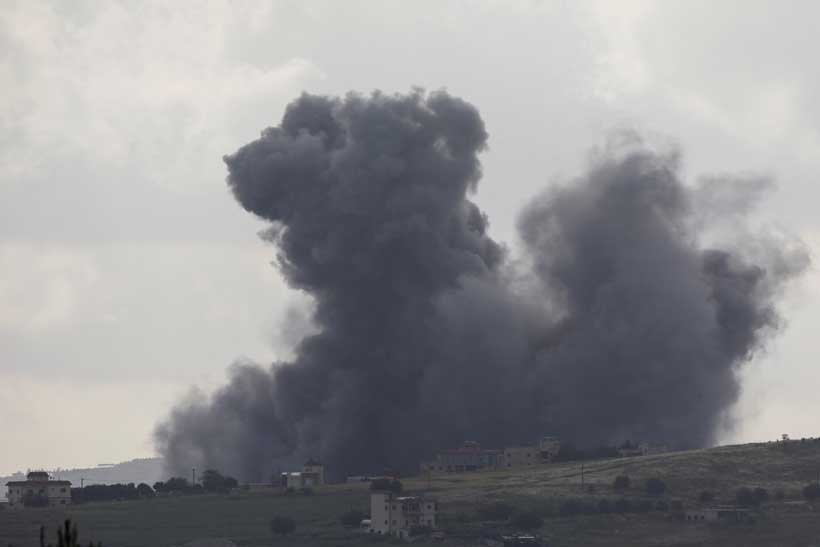
The ceasefire agreement announced in Lebanon last month has failed to bring meaningful relief to civilians in the country’s south, where continued Israeli air strikes and evacuation orders have driven hundreds of thousands of people from their homes.
Although the United States brokered truce took effect on April 16 after weeks of intense fighting between Israel and Hezbollah, violence has continued almost daily. Both sides accuse each other of violating the agreement while military operations persist across southern Lebanon.
According to a review of Israeli military statements and reports from local officials, the conflict has expanded far beyond the original front lines. Large areas of southern Lebanon have effectively become inaccessible to civilians due to ongoing strikes, evacuation warnings, and fears of further escalation.
The widening displacement crisis is creating growing humanitarian pressure on Lebanon, a country already struggling with economic collapse and political instability.
Stay ahead of the geopolitical week.
MD Briefing delivers expert analysis across five global fronts — the Indo-Pacific, energy, geoeconomics, European security, and the Middle East — every Monday morning. Free.
Israeli Buffer Zone Expands Across Southern Lebanon
Shortly after the ceasefire announcement, Israel released a map identifying a buffer zone of nearly six hundred square kilometers occupied by Israeli ground forces.
The Israeli military also issued evacuation warnings for dozens of towns and villages inside that area. Since then, however, the evacuation campaign has expanded significantly beyond the original occupied zone.
According to the Reuters review, Israeli forces have issued evacuation orders affecting more than one hundred additional Lebanese towns and villages outside the initial buffer area.
Combined with the occupied territory, the evacuation zone now stretches across nearly two thousand square kilometers, roughly one fifth of Lebanon’s total land area.
Many residents fear these areas may remain permanently off limits as uncertainty grows over Israel’s long term military objectives.
Civilians Continue to Flee Despite Ceasefire
Local officials and residents described widespread fear and exhaustion among displaced civilians.
Iyad Watfi, an elected official from the town of Bazouriye, said repeated strikes and evacuation orders had devastated the community. He explained that most residents had already fled northward, with only a small number remaining behind.
According to Watfi, entire neighborhoods have been destroyed during repeated bombardments, leaving little hope for a near term return.
Similar accounts emerged from multiple towns across southern Lebanon. Mukhtars and local authorities reported that most villages affected by evacuation orders are now almost completely deserted.
Many displaced families are currently living in shelters, tents, schools, or overcrowded urban areas in northern Lebanon and coastal cities such as Tyre and Sidon.
Residents interviewed described the ceasefire as ineffective because violence has continued despite the formal truce.
Israel Says Operations Target Hezbollah Infrastructure
The Israeli military stated that its operations are aimed at eliminating Hezbollah threats rather than displacing civilians.
The Israel Defense Forces accused Hezbollah of embedding fighters and weapons inside civilian areas and described evacuation notices as recommendations designed to allow civilians to leave before strikes occur.
Israeli officials maintain that southern Lebanon remains an active combat zone due to ongoing Hezbollah activity and continued attacks against Israeli forces.
Hezbollah, meanwhile, continues to carry out strikes including drone operations against Israeli targets. The group argues that it retains the right to resist what it describes as ongoing Israeli aggression despite the ceasefire agreement.
Hezbollah has also denied allegations that it deliberately places military infrastructure inside civilian neighborhoods.
Conflict Expands Beyond the Litani River
Israeli Prime Minister Benjamin Netanyahu stated earlier this year that Israel intended to establish a broad buffer zone extending to the Litani River, approximately thirty kilometers north of the Israeli border.
However, military operations and evacuation warnings have since extended even farther north, well beyond the Litani area.
According to the Reuters review, nearly half of the towns targeted by evacuation orders are located north of the river, some more than twenty kilometers beyond it.
Israeli military operations have included hundreds of air strikes since the ceasefire began. On May 12, Israeli officials stated that more than one thousand one hundred targets had been struck, including weapons depots, launch systems, and Hezbollah positions.
Satellite analysis conducted by researchers at the American University of Beirut also showed a significant decline in nighttime light emissions across southern Lebanon, indicating that many displaced residents have not returned home.
Humanitarian Crisis Deepens
For many displaced civilians, repeated attempts to return home have ended in renewed displacement.
Families described returning briefly after the ceasefire only to flee again following new evacuation warnings and fresh attacks.
One resident, Hawraa Yousef Ghadbouni, said her family repeatedly moved between southern towns and coastal cities after air strikes destroyed homes and neighborhoods. She explained that even temporary shelter conditions have become unsustainable.
Another resident, medic Wael al Amin, described a strike that killed his brother while children were playing outside a family home.
These personal accounts reflect the broader humanitarian crisis unfolding across southern Lebanon as civilians face constant uncertainty, destruction, and repeated displacement.
Regional Tensions Continue to Escalate
The conflict in Lebanon is part of a wider regional confrontation involving Israel, Iran, Hezbollah, and allied armed groups across the Middle East.
The current escalation began after Hezbollah launched rockets toward northern Israel in support of Iran during intensifying regional hostilities.
Israel responded with a ground invasion and expanded air campaign inside Lebanon, resulting in thousands of deaths and massive displacement according to Lebanese authorities.
The continued violence in Lebanon may also affect broader diplomatic efforts involving Iran and the United States. Tehran has reportedly demanded an end to Israeli attacks in Lebanon as part of wider regional negotiations.
Meanwhile, Netanyahu recently pledged to intensify Israeli military operations further, increasing fears that the conflict could continue expanding in the weeks ahead.
Analysis
The situation in southern Lebanon demonstrates how ceasefire agreements can fail when there is no clear political settlement or mutual trust between the parties involved. Although the April truce formally paused large scale fighting, military operations and displacement have continued on a massive scale.
Israel’s strategy appears focused on creating deep security zones designed to limit Hezbollah’s military presence near its borders. However, the expanding evacuation areas and repeated strikes far beyond the original front lines have raised serious humanitarian concerns and fears of long term demographic change in southern Lebanon.
For civilians, the conflict has created a state of permanent instability. Many displaced families no longer know whether they will be able to return home safely or whether their communities will remain militarized zones indefinitely.
The crisis also highlights the broader regional consequences of the ongoing confrontation between Israel and Iran aligned groups. Southern Lebanon has become another major front in a wider regional conflict stretching from Gaza to Syria and beyond.
At the same time, the continued displacement of large civilian populations risks worsening Lebanon’s already severe economic and political crisis. Infrastructure destruction, social instability, and humanitarian strain could have long lasting consequences even if military operations eventually decrease.
Ultimately, without a comprehensive political agreement and stronger international guarantees, the current ceasefire may continue functioning only in name while violence and displacement reshape southern Lebanon on the ground.
With information from Reuters.
