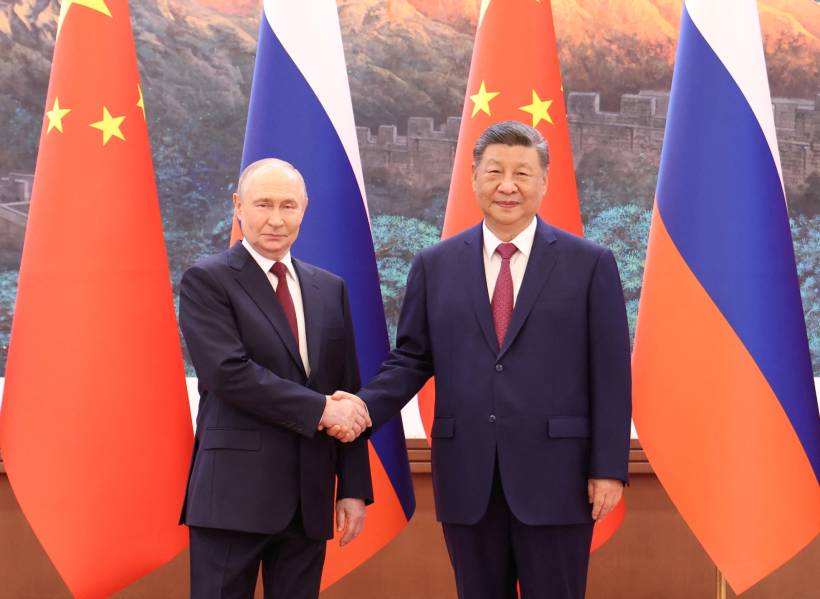
Vladimir Putin, the president of Russia, arrived in Beijing on 20th May, 2026, for a high-level visit just following the meeting between Trump and Xi—the G2. A keen analysis of the meeting between the two eastern partners reveals one thing: optics were kept high, but suspicions persisted behind the handshakes. The PRC, from the very first day, has mastered the art of optics, and this meeting was no exception.
The purposeful scheduling of the meeting between President Putin and Xi took place on 20th May. This is because the date May 20 (in numbers, 5/20) is considered to be Valentine’s Day in China. The numbers 520 sound very much like ‘wǒ ài nǐ,’ meaning ‘I love you’ in Chinese. Nonetheless, this aside, what the meeting consisted of is completely a different story. It seems like the empty wagons were rattling loudest.
Why was Putin in Russia?
Simply put, President Putin was not there in Beijing to discuss some breakthroughs on Ukraine or Iran. As of today, Russia is too weak to interfere in those matters proactively. He was actually there to go back to his country with a major deal on a Sino-Russian gas pipeline. He was there to conclude agreements with the PRC to export its energy products, which Europe has denied buying.
Stay ahead of the geopolitical week.
MD Briefing delivers expert analysis across five global fronts — the Indo-Pacific, energy, geoeconomics, European security, and the Middle East — every Monday morning. Free.
He was there to appease Xi and make him realize their decades-long friendship and to criticize the West. But all in vain. Neither a major deal occurred nor did any new or more hawkish statements come out. This proves only one thing: China is now considering Russia as its junior partner whom it can manipulate whenever it wishes.
What happened in Beijing?
To understand the actual conclusion of the meeting, we have to analyze what happened during the meeting. China and Russia have signed approximately more than 20 agreements on trade, tech and nuclear security, which is a common thing between two strategically aligned partners. In a joint statement, both criticized the US military strikes and maneuvers indirectly without overtly targeting the US. These criticisms were meant towards Venezuela, Iran, Cuba and the militarization of the Strait of Hormuz. On the same note, both leaders accused the US of deteriorating the strategic stability through the establishment of the Golden Dome defense system.
China and Russia appealed to nations to cease unilateral interference in global trade and logistics chains, possibly a reference to the Strait of Hormuz. This statement could be meant for both the Americans and the Iranians who have been halting the energy transit through tolls. Last but not least, the actual reason for which the Russian president was in Beijing was to conclude a deal for the Power of Siberia 2 gas pipeline.
Unlike its predecessor, the Siberia 1, this energy project would start from western Siberia, passing through Mongolia and entering the northern region of the Chinese mainland. This project has the capacity of exporting 50 billion cubic meters of gas if finalized. In spite of the fact that both states have been discussing and signing MoUs on this project for the past four years, the deal didn’t finalize this time either.
Key Takeaways
The meeting ended with no major breakthroughs, just vocal warnings and mutual understandings on several matters. As the geopolitical situation is changing rapidly and the world is heading towards a more distorted world order, the PRC and Russia find themselves at odds. This meeting clearly shows managed distrust between the two.
On one side, China benefits from the Ukraine war. Due to Western sanctions and boycotts of its energy, Russia is highly dependent on Chinese tech. Moreover, China wants Russia to continue the war in order to derail the Western economy. On the other hand, due to excessive economic losses, Putin’s Russia has become so weak that it can’t afford more strategic losses.
Secondly, it’s China, which is supplying lethal support to Iran against the US. After the conclusion of the meeting, Putin stated that Russia is willing to work with the US and has discussed this with China. Putin wants a compromise with the West, as he has become too weak on Ukraine, while China is projecting itself as a stronger player in this regard.
Managed Distrust
The trust deficit was also quite apparent between Russia and the PRC. During an expo on Russian-Chinese economic relations in Harbin, a Chinese northeastern city that has been occupied by Russia at one point in time, Russian Deputy Prime Minister Yury Trutnev could not conceal his disappointment with the disparity between the two nations’ capacity levels. He stated, “When I saw that our country brought nothing but honey and crabs, while our partners brought drones and robots, I must confess that I was quite disappointed.”
The so-called no-limits partnership, which was announced by Russia four years ago, appears to be more of a disadvantage for Moscow. In the same vein, in November 2025, hackers from a Chinese cyber-espionage group called APT31 were able to compromise the tech industry in Russia for several years before extracting data from firms that worked on government contracts and system integration. As noted in the report released by Positive Technologies, a cybersecurity firm based in Russia, “the campaign was meticulously planned and remained undetected.”
Before that, in June 2025, according to the New York Times report, the secret intelligence organization of Russia called the F.S.B. calls China “the enemy.” According to the warning issued by the FSB, China represents a grave danger to the security of Russia. China is making more efforts than before to make Russians spy for them and gain access to military technology.
Based on information provided by the report, it appears that China spies on Russia’s military activities in Ukraine in order to find out information regarding Western warfare. It is believed that they are afraid of academics in China laying claim to Russian territories in future. Also, it should be noted that they warn about espionage in the Arctic region conducted by Chinese intelligence using mining companies’ and universities’ exchange programs.
Limits of ‘Limitless’ Partnership
All these developments signal strategic mistrust instead of strategic alignment. Henry Kissinger once noted, “There are no permanent friends and no permanent enemies in politics, only permanent interests.” And the 21st century’s geopolitics is marked by conflicting interests of old partners. Russia is finding itself in shackles of the Ukraine war, while China is suspicious of the growing military assertiveness of Japan and American defense sales to Taiwan.
It’s a once-in-a-century moment for the West, in particular for the US, to take maximum advantage of this diverging Sino-Russian partnership. Thus, if the world is chanting about no major breakthroughs during the Trump-Xi meeting, then it must be acknowledged that the recent Putin-Xi meetup also ceased to be an inflection point.