


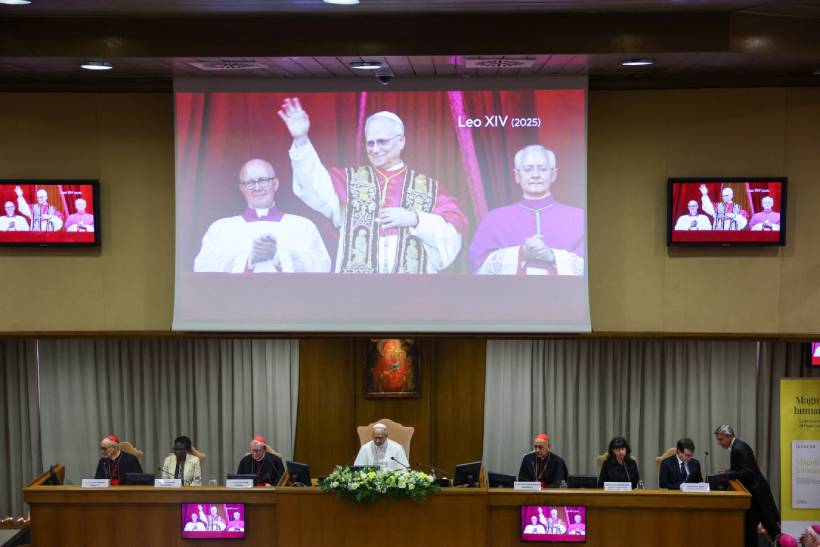
Pope Leo XIV issued a sweeping warning about the dangers of artificial intelligence, war, and unchecked technological power in his first major manifesto released on Monday.
The document, titled Magnifica Humanitas or “Magnificent Humanity,” marks one of the strongest Vatican interventions yet on the future of AI and global political leadership. In the lengthy encyclical, Pope Leo urged governments and technology companies to slow the rapid development of artificial intelligence systems, warning that they risk spreading misinformation, deepening conflict, undermining workers, and contributing to a culture of permanent war.
The encyclical also addressed broader geopolitical tensions, ethical concerns surrounding warfare, economic inequality, and the Catholic Church’s historical role in slavery.
As the first American pope, Leo has increasingly taken a more outspoken tone on global affairs, including criticism of recent conflicts involving the United States and the Middle East.
Stay ahead of the geopolitical week.
MD Briefing delivers expert analysis across five global fronts — the Indo-Pacific, energy, geoeconomics, European security, and the Middle East — every Monday morning. Free.
Pope Calls for Global Oversight of Artificial Intelligence
Artificial intelligence was the central focus of the document.
Pope Leo warned that governments cannot allow AI systems to develop without strong ethical and political oversight. He argued that control over AI data and infrastructure should not remain concentrated in private corporations alone.
The pope called for:
- Strong legal frameworks for AI
- Independent oversight mechanisms
- Protection for workers affected by automation
- Safeguards for children using digital platforms
- Greater public accountability for technology companies
- Slower and more responsible AI development
He warned that modern society is moving too quickly without fully understanding the long term consequences of emerging technologies.
According to Leo, political leaders must regain control over technological change instead of allowing market competition and corporate incentives to dictate the pace of development.
Vatican Warns AI Could Intensify Conflict and Warfare
One of the document’s strongest sections focused on the relationship between AI and modern warfare.
Pope Leo argued that artificial intelligence could dangerously increase the scale and speed of conflict if left unchecked. He specifically condemned the use of AI systems in lethal military decision making.
He stated that AI driven warfare must face the “most rigorous ethical constraints” and said delegating life and death decisions to machines is morally unacceptable.
The pope also linked technological competition to rising global instability, arguing that geopolitical rivalries and arms industry profits increasingly fuel conflict.
Pope Rejects Traditional “Just War” Doctrine
The encyclical also included one of the clearest Vatican rejections yet of the historic “just war” theory.
The doctrine has long been used within Christian theology to justify war under limited defensive circumstances. However, Leo argued that modern warfare has become too destructive and indiscriminate for the theory to remain morally valid.
His remarks appeared especially significant given that some political figures, including U.S. Vice President JD Vance, have recently invoked just war principles while defending military action involving Iran.
Leo warned that some governments may increasingly use conflict as a political tool to distract populations from domestic problems and social instability.
AI Boom Raises Ethical and Economic Questions
The pope’s intervention comes as artificial intelligence rapidly reshapes the global economy.
Technology companies worldwide are racing to dominate AI development, with governments increasingly viewing AI leadership as strategically important for:
- Economic competitiveness
- National security
- Military capability
- Information control
- Labor productivity
However, Pope Leo argued that the AI boom is also creating new forms of exploitation and inequality.
He criticized labor conditions tied to the AI supply chain, including dangerous mining work involving rare earth materials used in smartphones, computers, and data infrastructure.
The pope suggested that behind the digital economy lies a hidden system of labor exploitation often ignored by consumers and corporations.
Pope Apologizes for Church’s Historical Role in Slavery
In one of the encyclical’s most notable passages, Pope Leo formally acknowledged that the Catholic Church failed for centuries to strongly condemn transatlantic slavery.
He described slavery as a “wound in Christian memory” and offered a direct apology on behalf of the Church.
The statement represents another attempt by the Vatican to confront historical injustices and strengthen moral credibility on contemporary human rights issues.
Tower of Babel Warning Reflects Concerns About Human Pride
Pope Leo repeatedly used the biblical story of the Tower of Babel as a metaphor for modern technological ambition.
In the story, humanity attempts to build a tower reaching heaven, only for God to punish human arrogance and overreach.
Leo suggested modern society risks repeating a similar mistake by pursuing technological power without sufficient moral responsibility or humility.
He argued that technological progress without ethical direction could deepen division, inequality, and violence rather than improving human life.
What Could Happen Next
Governments May Face Growing Pressure to Regulate AI
The Vatican’s intervention could strengthen international calls for stricter AI regulation, especially in Europe and parts of the Global South where concerns about AI ethics are already growing.
Issues likely to receive more attention include:
- AI transparency
- Data ownership
- Child protection
- Deepfakes and misinformation
- Labor displacement
- Military AI systems
Big Tech Companies Could Resist Slower Development
Technology firms and investors remain locked in an intense global competition to dominate AI markets.
Many companies may resist efforts to slow innovation because AI is viewed as one of the most important economic and strategic technologies of the century.
This creates tension between ethical regulation and commercial competition.
Vatican Could Become More Active in AI Ethics Debate
Pope Leo’s manifesto signals that the Vatican intends to play a larger role in shaping global ethical discussions around artificial intelligence and technological governance.
The Catholic Church may increasingly position itself as a moral counterweight to unchecked technological acceleration.
Analysis
Pope Leo’s manifesto reflects growing global anxiety about the speed and direction of artificial intelligence development.
What makes the document significant is that it does not simply criticize technology itself. Instead, it questions the political and economic systems driving technological expansion without sufficient democratic oversight or ethical restraint.
The pope’s argument is fundamentally about control and responsibility.
He warns that society risks surrendering too much power to corporations, algorithms, and geopolitical competition while political institutions struggle to keep pace. His concerns mirror broader fears among policymakers, academics, and civil society groups that AI development is advancing faster than legal and ethical frameworks can adapt.
The manifesto also links AI directly to wider global instability. By connecting artificial intelligence, warfare, misinformation, economic exploitation, and geopolitical rivalry, Leo presents technology not as an isolated issue but as part of a larger crisis of global governance.
His rejection of just war theory further strengthens this message. The pope appears to be arguing that modern technology has made traditional ideas about controlled or morally limited warfare increasingly unrealistic.
At the same time, the document reflects deeper fears about a world becoming more fragmented, competitive, and driven by technological power rather than shared moral principles.
Whether governments and technology companies respond meaningfully remains uncertain. The economic incentives behind AI development are enormous, and geopolitical competition between major powers such as the United States and China is accelerating investment rather than slowing it.
Still, the Vatican’s intervention may influence public debate, especially in Europe and developing nations where concerns about AI regulation, labor rights, and corporate power are already intensifying.
Ultimately, Pope Leo is warning that humanity faces not just a technological challenge, but a moral and political one. The central question raised by the manifesto is whether society can maintain human control over increasingly powerful systems before competition, conflict, and automation begin shaping the future faster than democratic institutions can respond.
With information from Reuters.
