


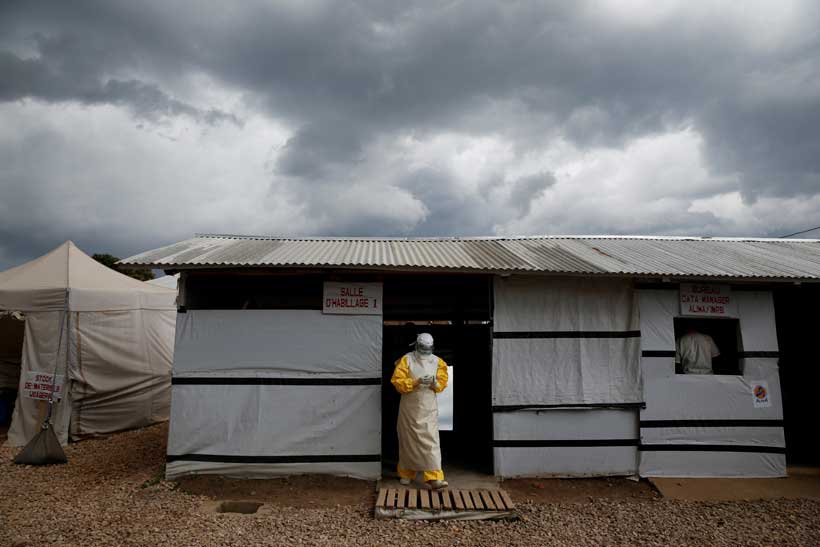
Ebola outlook particularly in the Democratic Republic of Congo (DRC), and in the central African region, is ‘spreading rapidly’ – World Health Organization (WHO) and related agencies have warned the health situation is attracting global attention similar to Coronavirus which started during the fourth quarter of 2019. The Ebola outbreak began in the Eastern DRC where hundreds of suspected cases have been reported and emergency burials were also undertaken in the affected areas.
The WHO has declared the overwhelming situation an ‘international emergency,’ amid rising health complications, with the existing insecurity and inaccessibility to the affected zones. The Ebola virus, an infectious disease, continues to spread in overcrowded and unsanitary conditions. Within the borders of Congo, thousands of infected patients have urgently been evacuated into special health centers, restricted from the general public. The DRC government order has restrained border crossing, especially to its geographically territorial neighbors Angola, Gabon, Kenya, Tanzania, and Zambia.
China’s Xinhua News Agency in Addis Ababa, Ethiopia, reported that, at least, 10 African countries are at high risk of the latest Ebola outbreak, amid growing concern over regional spread. The Africa CDC Director General, Jean Kaseya, listed in a media briefing that 10 high-risk African countries include Angola, Ethiopia, Burundi, Central African Republic, Kenya, Rwanda, South Sudan, Tanzania, and Zambia.
According to data from the African Union’s specialized healthcare agency, a total of 745 cases, including both suspected and confirmed infections, and 176 probable deaths have been reported since the DRC declared its 17th outbreak on May 15. The Ebola virus is highly contagious and can cause symptoms including fever, vomiting, diarrhea, general pain or malaise, and in severe cases, internal and external bleeding, with fatality rates varying depending on the viral subtype, according to the World Health Organization.
Stay ahead of the geopolitical week.
MD Briefing delivers expert analysis across five global fronts — the Indo-Pacific, energy, geoeconomics, European security, and the Middle East — every Monday morning. Free.
The latest Ebola virus is nothing new. DRC political leaders and many African leaders have been shuttling between the capitals and the world cities, posing for group photos at summits and conferences, without addressing their healthcare questions across the continent. Ebola has been there for more than a decade, the African health science community, and health authorities dealing with the challenges to research and address in finding suitable solutions.
WHO Director-General, Dr. Tedros Adhanom Ghebreyesus, sys the delay in detecting the virus means many infections may have gone unnoticed, allowing the disease to spread silently for weeks or even months, leaving a troubling-strain health system. Research studies and published materials on Ebola is very scanty since during the first outbreak in 2014-15. There is no lack of experienced, well-trained medical doctors, and well-qualified health scientists across Africa. The basic question has been, until today, why Ebola virus remains largely unexplored and researched by the African health community.
Here are a few facts about Ebola: Ebola disease is a severe, often fatal illness in humans. Three different viruses are known to cause large Ebola disease outbreaks: Ebola virus, Sudan virus, and Bundibugyo virus. The average Ebola disease case fatality rate is around 50%. Case fatality rates have varied from 25% to 90% in past outbreaks.
Early intensive supportive care with rehydration and the treatment of symptoms improves survival. Approved vaccines and treatments are only available for one of the viruses (Ebola virus) and are under development for the others.
Outbreak control relies on a package of interventions, including intensive supportive care of patients, infection prevention and control, disease surveillance and contact tracing, laboratory services, safe and dignified burials, vaccination if relevant, and social mobilization.
Here are latest developments: An Ebola outbreak was confirmed in the Democratic Republic of the Congo and in Uganda in May 2026. The Bundibugyo species of Ebola involved is one for which there is no vaccine or specific treatment, though work is ongoing to test promising candidates. The outbreak is occurring in a challenging context: humanitarian crisis and a remote and densely populated area, combined with insecurity and high population and trade movements.
WHO is scaling up support to the governments of the Democratic Republic of the Congo and Uganda, strengthening surveillance, contact tracing, clinical preparedness and management, delivery of supplies and community engagement, and cross-border preparedness. Community engagement will be key. It is only when communities are engaged in the response that such outbreaks are bought under control.
United States new screening rules: On May 18, the U.S. put new screening rules and entry limits on travelers coming from the Democratic Republic of Congo, South Sudan, and Uganda due to an Ebola outbreak. European Union members have also started new travel rules, especially those traveling and arriving from Africa. In East Africa, for instance, Uganda’s tourism industry faces renewed uncertainty after WHO declared a global emergency over a rare Ebola outbreak linked to Congo and Kampala.
United Nations Secretary-General noted that the current Ebola epidemic in West Africa “is an urgent global problem that demands an urgent global response” and further called on the international community to support its control. The international community must continue to provide necessary support to the sub-region and affected countries in their efforts to effectively stop, treat, and prevent a looming pandemic. Most of all, the active leadership of the authorities at the regional level, the Africa CDC, and the African Union.
