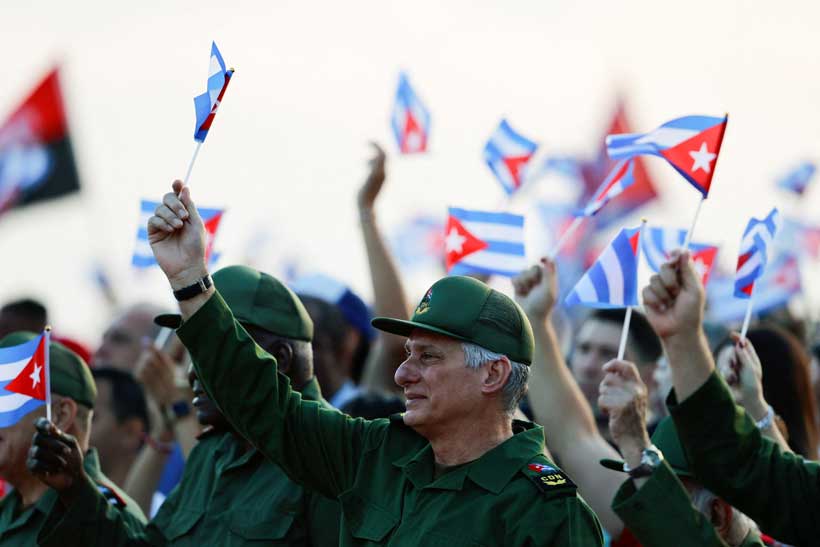
U. S. President Donald Trump’s administration is increasing pressure on Cuba after the military’s involvement in removing Venezuelan President Nicolás Maduro. However, Cuba is different from Venezuela, despite support from Caracas for Cuba’s government. In Venezuela, Delcy Rodriguez took control after U. S. forces detained Maduro, but Cuba lacks a similar leader to take over from President Miguel Diaz-Canel. Orlando Pérez, an expert on U. S.-Latin America relations, noted that Cuba has systematically eliminated potential alternative power sources. Venezuela has a prominent opposition leader, María Corina Machado, while Cuba does not have any strong political figure.
Raúl Rodriguez Castro, the grandson of former President Raúl Castro, met with CIA Director John Ratcliffe recently, leading to speculation he might cooperate with the U. S. However, he holds no official position in the government and is unlikely to betray his family. Cuba has been an enemy of the U. S. since Fidel Castro’s 1959 revolution, and Trump has support from hardline Cuban-Americans in Florida who desire regime change in Cuba. While Cuba was once seen as a Soviet ally, its relevance has diminished, especially since its economic struggles make confrontation with the U. S. more challenging. Experts warn that unrest in Cuba could lead to a migration crisis as people might flee the country amid potential chaos or conflict.
Cuba’s military is viewed as more ideologically committed than Venezuela’s and may resist U. S. incursion. After a failed operation in Venezuela, surviving Cuban agents are believed to be adapting to U. S. tactics. Although Cuba lacks Venezuela’s natural resources, its military and intelligence capabilities, developed through cooperation with Russia and China, are noted as significant. The U. S. Secretary of State, Marco Rubio, a proponent of tougher policies against Cuba, is seen as influencing the administration’s Cuban strategy.
Legal constraints on changing U. S.-Cuba relations come from the 1996 Helms-Burton Act, which demands specific political changes in Cuba in exchange for lifting the long-standing embargo. In contrast, Trump took action in Venezuela without the same legal limitations affecting Cuba. Cuba’s economy is tightly controlled by a military-run conglomerate, complicating any potential economic shifts. Unlike Venezuela, Cuba has not faced accusations of drug-related crimes to justify military involvement, and it claims to have worked with the U. S. against drug trafficking.
With information from Reuters