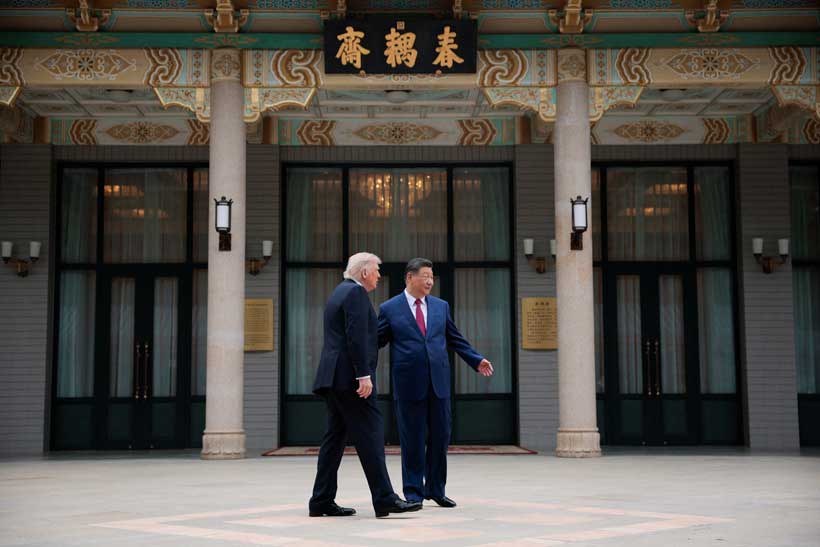
Trump brought no bargaining chips to China, returned to the US with no concrete results, and there was no joint communique, no press conference, no surprises, and no clever gimmicks. There was only a Chinese exam paper stuffed into his pocket, titled “How to button the first button.”
The so-called “first button” is the Taiwan issue. China’s rewards depend on the US’s test score. The prizes are abundant: soybeans, beef, Boeing airplanes, a bit more rare earths, a bit more market access, and a bit less frustration and anxiety.
Beijing used this major occasion to reaffirm the importance of the Taiwan issue to the entire world. In the eyes of US hawks, Trump became China’s mouthpiece. If you were to ask an AI chatbot for its opinion, it would say that Xi Jinping successfully implanted the impression that “Taiwan is a troublemaker” into the mind of the US president.
Trump’s deferential and restrained performance in China has left America’s East Asian allies—and perhaps even its non-US allies in Southeast Asia—deeply worried. As for the “party concerned,” Taiwan, its heart is in its throat, filled with anxiety that Trump might trade Taiwan away to Xi Jinping.
Stay ahead of the geopolitical week.
MD Briefing delivers expert analysis across five global fronts — the Indo-Pacific, energy, geoeconomics, European security, and the Middle East — every Monday morning. Free.
The Taiwanese media covered every detail of Trump’s trip meticulously, not letting even the most trivial matters slip by, because Taiwanese people know that Beijing’s style is reserved, and the devil is always in the details.
Two details are worth mentioning. When Trump arrived at the Temple of Heaven for a tour, Chinese security intercepted a US Secret Service agent, stating that his firearm was not permitted inside—completely ignoring the fact that US Secret Service agents carrying firearms is a universally accepted global protocol. The two sides were locked in a standoff for nearly 30 minutes, and the agent was ultimately only allowed entry after being forcibly disarmed. Meanwhile, the White House press corps was forcibly confined to a small room, sparking collective outrage among reporters who eventually forced open the door to break out. Furthermore, Chinese officials repeatedly blocked American photographers from following Trump’s movements, causing one American photographer to swear out loud on the spot.
According to diplomatic protocol, a host country “publicly” demanding that the US President’s personal Secret Service detail disarm is an extremely rare move, usually occurring only on the soil of an adversary nation. By doing this, Beijing clearly intended to demonstrate that China and the US are major powers standing on “equal footing.” Moreover, Xi Jinping has recently faced internal pressure from citizens questioning if he is too weak toward the United States; in China, where formalism is highly valued, a leader cannot show weakness in any action.
The restrictions placed on the White House press corps were primarily because Beijing is well aware that Trump and the Trump in front of the American media cameras are not the same person. China cannot allow the US President to “overperform” under its own roof, especially when the US is clearly in a weak negotiating position.
These two details signaled that this meeting between the Chinese and US leaders would yield no results—or, more accurately, the outcomes remain to be seen, because this time China has thrown a difficult question to the US and is in no rush to get an answer.
In fact, conventionally, prior to major leadership summits, both leadership teams already foresee the results. Beijing likely knew in advance that this meeting would not achieve any major consensus, so it focused its goals on projecting an international impression of “Sino-US parity” and highlighting the Taiwan issue as the key to peace between the two nations and, indeed, the world.
Immediately upon returning to the US, Trump expressed two contradictory opinions regarding the Taiwan issue:
• a. The US policy toward Taiwan remains unchanged.
• b. There are people in Taiwan who want to rely on the US to pursue an independence movement, and he opposes this.
This is undoubtedly saying that Taiwan is a troublemaker, which aligns with Beijing’s narrative and basically aligns with the facts.
The full truth is that Taiwan’s ruling party does indeed want to rely on the US to achieve independence, and the US is indeed covertly supporting this, using Taiwan as a proxy to “contain China.” Taiwan is the Ukraine of East Asia.
The evidence is that Trump has already approved the highest-value arms sale to Taiwan in history, worth $11 billion, while another arms sale package worth $14 billion sits on his desk awaiting approval. Xi Jinping publicly warned the US earlier this year to handle its arms sales policy with caution. Meanwhile, Taiwan’s opposition-majority legislature was also forced by the US to pass a budget for the as-yet-undelivered $14 billion arms purchase just before Trump’s visit to China.
Whether the Trump administration will ultimately change its Taiwan policy can be directly gauged by these arms sales. If Washington still greenlights the $14 billion arms package despite Beijing’s repeated warnings, Xi Jinping will not meet face-to-face with Trump again this year, and Sino-US relations will revert to the sharp antagonism seen during the early stages of last year’s trade war.
Since they cannot even button the first button properly, the purchase orders for US agricultural products and Boeing aircraft, along with other cooperative consensuses granted by Beijing this time, will all be reset to zero.
For Trump, the midterm elections are his primary focus. Among the Republican candidates, there are both lawmakers from agricultural states who rely on Chinese purchasing and lawmakers from defense-industry states who have long been bankrolled by the military-industrial complex. This forces Trump to make a certain degree of trade-offs.
Therefore, the most likely outcome is that Trump will downsize the $14 billion package, removing items that China dislikes. This will avoid provoking Beijing on one hand, give the military-industrial complex an explanation on the other, and appease East Asian allies on a third front.
This implies that the US is searching for a new balancing point between abandoning Taiwan and supporting Taiwan. Trump believes that, at least during his term, the “Taiwan issue” remains the most effective ATM. He will not rush to button the first button but will instead use a safety pin to secure the collar, extracting maximum benefits at the very edge of Beijing’s tolerance.
Xi Jinping, on the other hand, is highly fixated on stabilizing the situation and does not want to rupture relations with the US over the Taiwan issue at this exact moment. He has thus proposed a strategic stability framework, hoping to keep Sino-US confrontation within a range acceptable to China. The US, currently bogged down in multi-front operations, has superficially agreed to this stability framework because Washington temporarily lacks the capacity for a hard confrontation with Beijing. However, once Trump finds a way to extricate himself from various battlefields, this stability framework will become void.
From a strategic perspective, regarding the so-called “Thucydides Trap,” what determines the strategies of the two competing powers is the environment. China is the rising power and naturally wishes to maintain the existing favorable environment; the US is the status-quo power and naturally wishes to alter the current unfavorable environment. Therefore, the Sino-US game is a “struggle between change and non-change.”
According to the ancient Chinese teachings of the I Ching (Book of Changes), adapting to change is the most effective way to survive, and the trick is to change in accordance with the situation, guiding the change in a direction favorable to oneself. Therefore, if China wants to stabilize the environment, it must seek effective change with the goal of “controlling variables.”
This means Xi Jinping will guide Trump’s destructiveness in a direction beneficial to China to achieve a stabilizing effect. Specifically, taking arms sales as an example, Beijing will conditionally acquiesce to US arms sales to Taiwan but will definitely demand that the US cancel some of the dangerous weapon programs. In fact, the US military-industrial complex cannot even deliver those high-priced missiles during Trump’s term anyway.
Simply put, Beijing intends to guide US arms sales to Taiwan toward becoming “ineffective arms sales” and establish this as a precedent. It will employ the same tactic in other dimensions of US-Taiwan interactions, which will keep the confrontation within a range acceptable to China, thereby reducing internal pressure for a military unification with Taiwan and buying time for development.
Trump is a smart man and naturally understands this logic. Therefore, he leverages his status as US President to say what Beijing wants to hear while keeping Taiwan policy unchanged to appease various domestic and international allies. This has created a bizarre, dual-track parallel phenomenon where the president’s rhetoric and actual policy direction diverge, allowing him to strike a new balance between abandoning and supporting Taiwan.
This approach is nothing new; President Biden used this exact method to handle the Taiwan issue. The only difference is that, conversely to Trump, President Biden verbally committed to defending Taiwan while the policy of strategic ambiguity remained strictly unchanged.
To put it bluntly, both China and the US want to maintain the status quo in the Taiwan Strait. The difference is merely that Beijing wants to maintain the status quo temporarily, while Washington wants to maintain it forever. The contradiction between the two sides lies in the word “temporary,” not “status quo.” As for the difference between Biden and Trump, the former refuses to acknowledge the “temporary” nature, while the latter tacitly accepts it. All Trump wants is to maintain peace in the Taiwan Strait during his term and profit from it.
If a US president indirectly accuses Taiwan of being a “troublemaker,” it represents a political commitment, and hypocrisy carries a price. But when Trump indirectly accuses Taiwan of being a “troublemaker,” it is merely a “social media post”—where being right yesterday and wrong today is completely normal. And we observers always find ourselves trapped in a maze of question marks: Are these words coming from the President of the United States, or from Trump the individual?
Regarding this, Xi Jinping likely will not pin his hopes on Trump’s integrity. Instead, he will find ways to ensure that Trump always remains in a position where he has no good cards left to play. Given Trump’s personal traits and his prospects of becoming a lame duck, a Trump with no good cards in hand is no different from any ordinary person and poses no threat.
By disarming your personal Secret Service agents and locking your reporters in a small room, Beijing’s intention might be to signal: under my roof and at my doorstep—including the Taiwan Strait and the South China Sea—your behavior and your words must follow Chinese rules.
Trump followed the rules; he is a smart man.