


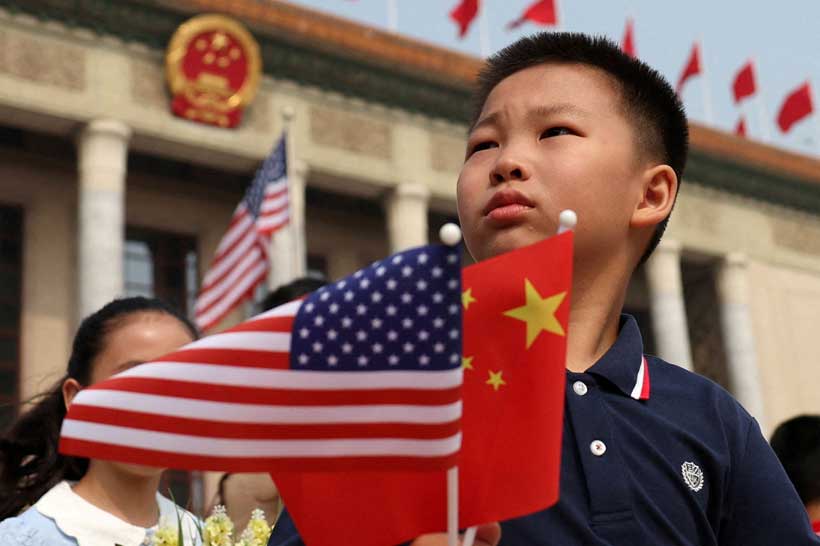
Analyses by Chinese think tanks and intelligence agencies, based on political developments in May 2026, indicate a cautious and pragmatic view of US President Donald Trump’s anticipated visit to China. They consider it an attempt to manage strained relations rather than a fundamental solution to structural conflicts (trade, technology, Taiwan). We can analyze China’s perspective on the visit and its implications for the Middle East through several indicators:
Firstly: The view of Chinese think tanks and intelligence agencies regarding Trump’s visit and his upcoming summit with Chinese President Xi Jinping. Those concerned in Beijing view the (Xi-Trump summit) as a truce, not a partnership. Chinese circles believe the visit aims to present a striking image to President Trump to appease his electoral base, while Beijing seeks stability in its trade relationship with Washington and an extension of the technological truce between them. With Chinese entities attempting to leverage pragmatism in their relationship with the current US administration, Beijing recognizes that Trump focuses on immediate gains (trade deals, aircraft, energy) and pays little attention to human rights issues, making him amenable to negotiation. Beyond other Chinese concerns about uncertainty, there are persistent fears regarding Trump’s unpredictability. Chinese intelligence reports warn that the rapid shift from cordiality to outright competition could return, especially if Trump feels disrespected. This highlights the influence of Chinese intelligence in shaping Trump’s thinking towards China and exploiting it to their advantage. Furthermore, Chinese intelligence agencies and relevant bodies are persistently working to eavesdrop and understand Trump’s thinking in order to use this information to de-escalate the trade war, relying on Chinese businesspeople to exert influence on him.
Chinese think tanks and intelligence communities view the upcoming visit of US President Donald Trump and his summit with President Xi Jinping as a temporary crisis management measure, not the beginning of a new strategic partnership. Beijing’s approach is driven by the following analysis of the summit’s objectives from a Chinese perspective: it can be seen as a showcase for Trump, with Beijing believing the visit provides him with a political and media victory that will appease his electoral base in the United States. This also allows China to buy time in technological development, meaning it seeks to extend the current technological truce with the United States to reduce pressure on its vital sectors, such as semiconductors and artificial intelligence. Furthermore, Beijing aims to find ways to stabilize trade, specifically by securing supply chains and preventing the imposition of sudden tariffs that could negatively impact the Chinese economy. China’s strategy (exploiting pragmatism) involves direct trade deals: Beijing focuses on Trump’s pragmatic approach, based on the principle of deals, by offering promises of massive purchases of American goods in exchange for easing restrictions. Beijing also seeks to avoid ideological clashes with Washington. Chinese circles prefer dealing with the Trump administration because of its focus on direct material interests, rather than human rights issues or traditional alliances. Furthermore, Beijing aims to dismantle Washington’s alliance front, exploiting Trump’s protectionist policies toward traditional US allies like Europe and Japan to strengthen China’s economic ties with them individually. As for the limits of Chinese expectations, they can be interpreted as a truce rather than a partnership, given the lack of strategic trust in bilateral relations with Washington. Chinese think tanks recognize that the structural competition between the two superpowers continues and that any agreement reached may be short-lived. Therefore, Chinese think tanks and intelligence agencies are developing a hedging scenario regarding their relationship with Washington. Beijing is using the anticipated period of relative calm with the United States to accelerate its technological self-reliance and secure alternative markets for its exports, anticipating any sudden escalation by the US.
Secondly, the impact of Trump’s visit to China on the Middle East from a Chinese perspective: China believes that a US-Israeli war on Iran in May 2026 has further complicated the region. The visit’s impact will be to present China as a neutral peacemaker, as Beijing seeks to bolster its image as a diplomatic alternative to Washington, especially after China joined Pakistan in mediating a potential war against Iran, leveraging its relationship with Iran. As Beijing attempts to manage the Strait of Hormuz crisis, fearing that its economic interests (oil supplies) would be affected by a strait closure, it will push to keep navigation open while rejecting unilateral US sanctions against Tehran. This reflects the influence of power without responsibility. Here, China benefits from the instability in the Middle East to consolidate its technological and economic influence, exploiting America’s preoccupation with conflicts. Beijing will capitalize on this shift in the negotiating landscape, as Trump’s attempt to use China to persuade Iran to accept a new agreement is perceived in China as an American acknowledgment of China’s influence in Tehran.
Stay ahead of the geopolitical week.
MD Briefing delivers expert analysis across five global fronts — the Indo-Pacific, energy, geoeconomics, European security, and the Middle East — every Monday morning. Free.
In this context, the geopolitical developments of May 2026, particularly the potential US-Israeli war on Iran and Trump’s anticipated visit to China, point to a fundamental shift in China’s perspective on the Middle East. Beijing seeks to capitalize on this situation to bolster its position as a responsible and alternative great power in the region. According to the Chinese perspective and the unfolding events, China aims to present itself as a neutral and stable peacemaker (an alternative to Washington), exploiting the perceived vacuum of American political leadership. China believes that the US-Israeli strategy has made the region more complex and dangerous, thus undermining Washington’s credibility as a guarantor of security. Conversely, Beijing seeks to position itself as a rational diplomatic alternative, advocating for an end to the war, restraint, and a return to dialogue. While maintaining balanced relations with all parties, unlike the United States, which adopts a one-sided approach, China maintains strong ties with Iran (as a strategic partner and oil buyer) and with the Gulf states (as an economic partner), thus giving it weight as an acceptable mediator. With China having already presented several peace initiatives, it has already put forward a five-point peace initiative in cooperation with Pakistan to end the conflict with Iran. This initiative focuses on a permanent ceasefire and rejects military intervention, and it has garnered international support for de-escalation. China is now seeking to bolster its alternative image through Trump’s visit to China, leveraging its mediation efforts in negotiations. China aims to demonstrate that its economic influence (purchasing Iranian oil) can bring Iran to the negotiating table, a point Trump himself acknowledged when discussing de-escalation efforts. Chinese intelligence agencies and think tanks are working to shift the global narrative. Trump’s visit to Beijing comes at a time when Washington is perceived as an arsonist while China is seen as a diplomatic firefighter pushing for political settlements. Here, China will leverage Trump’s visit to Beijing to manage the Strait of Hormuz crisis and maintain energy security by preserving this vital oil artery, as the Strait of Hormuz is crucial to China (more than half of its oil imports pass through it). Therefore, Beijing will work diligently to manage the crisis, not escalate it, by pursuing a policy of pressure to keep the waterways open. Chinese Foreign Minister Wang Yi spearheaded intensive efforts, holding more than 26 calls in six weeks with the parties involved in the conflict, explicitly urging Iran to guarantee the continued safe passage of ships and not close the Strait, in accordance with China’s economic interests. The role of Chinese-Pakistani cooperation against a potential war with Iran through joint mediation efforts is also noteworthy. China has joined forces with Pakistan in mediation efforts, leveraging its close relationship with Iran to offer an alternative peace formula that is not dependent on American dictates. China and Pakistan are working together to exert joint pressure to halt hostilities against Iran. Here, Beijing and Islamabad emphasized the need to return to dialogue and to guard against the ambitions of a new Middle East led by Israeli Prime Minister Benjamin Netanyahu, thus strengthening the Sino-Pakistani alliance in the region. This sheds light on the Chinese perspective regarding Trump’s visit. Beijing sees it as an opportunity to establish a tactical stabilization of Sino-American relations, while simultaneously exploiting the American predicament in the Middle East to present itself as a more credible and successful strategic and diplomatic alternative, all while safeguarding its oil interests through skillfully managing the Strait of Hormuz crisis.
Thirdly: The features of the (Xi-Trump summit) and its repercussions on key issues, particularly the Iranian war, Taiwan, artificial intelligence, and the extension of the rare earth minerals agreement. Trump’s visit to China is paralleled by a predictable scenario for China’s actions: a public relations success for the anticipated visit in the form of deals, while the long-term strategic conflict with the United States continues.
Here, the historic Beijing summit between Presidents Donald Trump and Xi Jinping will serve as a stark example of a policy of temporary tactical stability. Both sides will seek to produce a successful public relations image through reciprocal trade deals to ease market tensions, without addressing the deep-seated roots of the long-term strategic conflict. Particularly regarding the Iranian war (mediation versus avoiding recession), the American position is that Trump is pressuring Beijing to use its economic influence (as the largest buyer of Iranian oil) to force Tehran to accept a cease-fire and reopen the closed Strait of Hormuz. Meanwhile, the Chinese position is driven by the increasing pressure on its economy due to the turmoil in energy markets. Beijing has assured Washington that it will not send advanced weaponry to Tehran, but at the same time, it refuses to exert pressure that would lead to Iran’s complete surrender. It prefers to play the role of diplomatic facilitator to save face and secure its interests. The remaining scenario (and likely outcome) of Trump’s upcoming visit to China is the issuance of a joint political statement calling for de-escalation and freedom of navigation, along with unannounced Chinese-American understandings to curb Iranian behavior in exchange for Washington freezing some secondary sanctions on Chinese banks. Regarding the Taiwan issue, an understanding could be reached during Trump’s visit through a freeze on escalation, economic exchanges, and a temporary military de-escalation. This is already evident in the US State Department’s temporary suspension and postponement of a massive $11 billion arms package to Taiwan just before the summit to avoid jeopardizing the meeting. This approach leverages Trump’s pragmatic vision, as he views Taiwan as an economic competitor to the US in the advanced semiconductor sector, making him more flexible in negotiations compared to previous administrations. While attempting to delineate the strategic boundaries between the US and China, Washington is unlikely to make radical concessions by halting its support for Taiwan. Instead, it will likely establish hotlines to prevent military clashes with China, while China will be content with securing symbolic gains that underscore Washington’s non-recognition of Taiwan’s independence.
With Beijing attempting to leverage Trump’s visit to China to reach an understanding on artificial intelligence (system security and critical communication channels), and given American concerns about China’s technological advancements, China’s recent launch of advanced AI models like (Mythos) and its discovery of critical cybersecurity vulnerabilities have created genuine security concerns for the Trump administration. Therefore, the agenda for talks between Washington and Beijing will likely revolve around the expected American focus on AI security and preventing its use in warfare or biological and cyber attacks, while China will push for the lifting or easing of US restrictions on the export of supercomputing chips. The remaining possible scenario involves a bilateral agreement between China and the United States to establish a permanent and immediate communication channel (hotline) to manage AI risks, perhaps without reaching a comprehensive or binding regulatory agreement. With expectations of an extension to the rare earth trade agreement, also known as the difficult truce, the current situation is that the Busan trade truce (signed in late 2025) remains in effect. This truce stipulated that China would suspend restrictions on rare earth exports (such as gallium and germanium) in exchange for the United States reducing tariffs by 10%. However, the market reality is that several American and European manufacturing and defense companies are complaining about the continued slowness and delays in Chinese licensing procedures, which has led to sharp increases in metal prices outside of China. The remaining scenario involves extending the rare earth trade agreement between Washington and Beijing for another year (as part of the publicity stunts surrounding Trump’s visit to China) in exchange for China’s commitment to purchase large quantities of American agricultural products (such as soybeans) and Boeing aircraft. The overall picture between Washington and Beijing can be summarized as temporary deals and ongoing conflict. China is operating at this summit based on a strategy of engaging in public relations deals with Washington, aiming to: (activate joint trade and investment committees, limit US arms sales to Taiwan through multi-billion dollar deals, ease US technology restrictions on China, mitigate the impact of the US technological embargo, and attempt to rebuild strategic trust with Washington). Ultimately, China seeks to achieve independence from Western and American supply chains.
Based on the preceding understanding and analysis, we can conclude that China views Trump as a gambler with whom it can reach an understanding through trade and security deals. It will use his visit to solidify its economic gains and expand its influence in the Middle East and the Gulf as a pragmatic force for peace.
