There is a reading of what Iran is doing at the Strait of Hormuz that has become almost reflexive in commentary: Tehran is challenging the petrodollar, accelerating de-dollarization, and weaponizing a physical chokepoint against American financial hegemony. That reading captures something real about the mechanics of what is happening. It takes Iran’s perspective as the central one, however, and assumes that Tehran’s primary target is American financial architecture. In doing so, it may miss the more structurally interesting move that Iran is executing, which is, at its core, the strategic exploitation of several existing geopolitical fault lines whose origins long predate the current conflict and whose depth extends well beyond the strait itself. The most visible reading is coercive: Iran using node control to extract concessions from Washington. The more consequential one is structural: Iran is using the same node to force the United States and China into a confrontation neither sought and neither can easily exit.
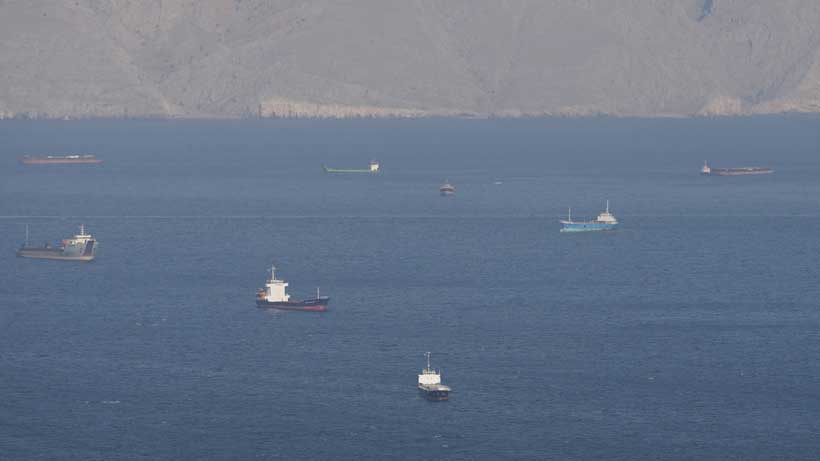
The mechanics of the toll system are by now well-documented. Since late February 2026, vessel traffic through the strait has collapsed by more than 90 percent against comparable 2025 figures. Ships seeking transit must register through IRGC-linked intermediaries and submit ownership, cargo, crew and tracking data for vetting. In return, they receive a passcode and naval escort, with fees opening at approximately one dollar per barrel of crude, settled in Chinese yuan or stablecoins. Iran’s parliament is in the process of formalizing what began as wartime improvisation into permanent sovereign legislation, and Tehran has simultaneously demanded international recognition of its authority over the strait as one of its five ceasefire conditions. The more productive reading of that claim starts from the structural position of the fault lines being exploited, not from Tehran’s own framing of what it is doing.
I. The Host and the Parasite
Beijing has spent two decades building currency internationalization infrastructure, accumulating energy dependency on Middle Eastern oil, and cultivating relationships with Gulf producers precisely because it understands that energy access is the most legible form of positional dependency in the contemporary international system. China depends on Hormuz for roughly half its energy imports, a structural necessity whose disruption carries costs. Beijing cannot easily absorb over any sustained period, even accounting for the roughly one billion barrels held in strategic reserve. The supply problem is manageable in the short term. The association problem, being seen as the financial infrastructure through which Iran’s toll regime operates, is not a problem that reserves address.
Stay ahead of the geopolitical week.
MD Briefing delivers expert analysis across five global fronts — the Indo-Pacific, energy, geoeconomics, European security, and the Middle East — every Monday morning. Free.
Roughly a fifth of the world’s oil and gas trade normally passes through the strait, and the overwhelming share of that flow is destined for Asian markets, with China as the dominant buyer. That dependency preceded the current conflict by decades. Iran inherited it as a strategic asset rather than constructing it through any deliberate alignment with Beijing.
The yuan-denominated toll system works for China in a narrow transactional sense. Chinese refining margins have reportedly widened significantly as discounted sanctioned crude reaches processors with the technical capacity to handle it. The arrangement also places Beijing in an operationally compromised position. Every yuan-settled Hormuz transit functions simultaneously as a geopolitical signal. It demonstrates visibly that China’s currency infrastructure is sustaining an IRGC revenue stream from a waterway that the United States and its partners regard as an international commons. Washington does not need to prove Chinese complicity in Iran’s war strategy to treat yuan clearing of Hormuz tolls as a Chinese policy problem. The financial plumbing makes the association automatic: payments processed through Kunlun Bank, brokered through Chinese maritime intermediaries, settled in a currency whose internationalisation Beijing has made a stated strategic priority.
What makes Iran’s position theoretically distinctive is that it is not weaponizing its own centrality in the global network, as it has none. It is weaponizing the network’s structural dependency on a geographic node it happens to physically control. That is a categorically different form of leverage, one available to peripheral actors precisely because the network was never designed with their agency in mind.
The structural logic of Beijing’s predicament bears closer examination, because it is what gives the arrangement its parasitical character. China cannot withdraw from the preferential transit arrangement without losing access and thereby absorbing the same supply disruption costs that are devastating Western-linked shipping. Remaining inside the arrangement, however, means accepting visible association with a toll regime that has no basis in international maritime law and that the Gulf Cooperation Council has publicly condemned. It also positions Beijing as a co-beneficiary of a wartime blockade in direct tension with the freedom of navigation principles China nominally endorses. Tehran is generating a flow of friction that settles at Beijing’s expense, extracting geopolitical cover from a power that has far more to lose from the current configuration than Iran does. There is no formal agreement involved, which means China has no standing to object. That the Trump administration has now threatened a 50 percent tariff on any country assisting Iran confirms the mechanism. Washington is converting Chinese proximity to the toll regime into a direct economic penalty, which is precisely what the polarization logic predicts.
Iran is using the structural fault line between the American and Chinese spheres of influence as a mechanism of entrapment, one that operates whatever Beijing intends and compounds whatever Washington does.
The dynamic works in both directions simultaneously. If Washington presses China on yuan-settled transits, treating each cleared payment as evidence of Chinese complicity in Iranian war strategy, Beijing is pushed toward a posture of implicit solidarity with Tehran that it would not have chosen on its own terms or timetable. If Beijing tolerates the arrangement without pushing back, Washington reads that tolerance as a policy choice and adjusts its strategic calculus accordingly, treating China as a structural participant in the erosion of the maritime order the United States built. Iran harvests the friction generated in either direction without having to manage the escalation or bear its costs.
This is the instrumental use of polarisation as a force multiplier. Tehran does not need to negotiate an alliance with Beijing, does not need Chinese political endorsement of its toll regime, and does not need to win the military confrontation it is currently losing. It needs only to hold the node long enough for the Sino-American rivalry to do the work of deepening Iran’s strategic relevance. Every Washington ultimatum directed at Chinese yuan clearing tightens the bind on Beijing. Every Chinese transit that clears through Kunlun Bank makes the next American ultimatum more likely. The spiral is self-sustaining, and Iran sits at its origin point without being its engine. That Iran denominated the toll in yuan, routed payments through Chinese banking infrastructure, and constructed a nationality ranking system that visibly privileges Beijing’s partners is not incidental architecture. It is, on the contrary, the mechanism by which US-China friction becomes a deliberate product of Iranian strategy, not a byproduct of Iranian geography.
II. The Fault in the Dollar
The de-dollarisation reading of the Hormuz toll is temporally displaced more than it is analytically incorrect. It treats Iran’s move as the origin of a shift that was already structurally underway before the first strike was launched. In doing so, it overstates Tehran’s financial agency while understating the depth of the fault line it is exploiting.
The petrodollar architecture rested on a set of mutually reinforcing arrangements: Gulf producers priced oil in dollars, recycled surpluses into American assets, and received in return a security guarantee expressed through American naval dominance and military presence in the region. That architecture had been showing stress fractures well before the current conflict. Saudi Arabia signed a seven-billion-dollar currency swap with China in 2023. It joined Project mBridge, the multi-central bank digital currency platform developed with the People’s Bank of China and the central banks of Hong Kong, Thailand, and the UAE. The platform operates entirely outside the dollar clearing system. By mid-2024, the informal arrangements underpinning the petrodollar relationship had drifted sufficiently that the question of their renewal became publicly contested, whatever the precise legal character of what had accumulated over fifty years. The direction of travel was legible long before Hormuz became a toll road.
The petrodollar architecture assumed, as liberal interdependence theory generally does, that concentrated flows through shared infrastructure would produce cooperative incentives. Hormuz in 2026 demonstrates the inversion that when interdependence is concentrated through a single geographic node controlled by a hostile actor, it transmits disruption rather than moderating it.
The infrastructure to sustain yuan-settled energy transit at scale already existed when the conflict began. China’s Cross-Border Interbank Payment System processed 175 trillion yuan in 2024, a 43 percent increase year-on-year, and the shadow banking networks Iran had used for years to route sanctioned oil revenue provided the transactional architecture for the toll system from the outset. Analysts have observed that the petrodollar’s erosion became operationally concrete during this conflict rather than merely structural. The concession carries weight precisely because it comes from institutions with little incentive toward alarmism. Hormuz has become the node through which a pre-existing fracture is now running at accelerated pace. Iran’s contribution has been less to create that fracture than to find the geographic point at which it becomes most visible and most costly for others.
III. The Ambiguity of Commitment
There is a third dimension to this structural configuration, and it originates not in Tehran or Beijing but in Washington. On 1 April 2026, President Trump declared that the United States is “totally independent of the Middle East” and has no need of its oil, instructing allies dependent on Hormuz transit to secure it themselves. The statement was designed as domestic political insulation against rising fuel prices at a moment when the average American gallon had crossed four dollars for the first time since 2022. The 2 percent American dependency on Hormuz imports makes that claim factually defensible and strategically hollow in equal measure. Japan draws around 72 percent of its energy imports through the same passage and South Korea about 65 percent. Washington’s indifference is a direct threat to the economic foundations of its two most significant Pacific allies.
The petrodollar architecture was never only a financial arrangement. It rested on a security commitment whose credibility was the hidden load-bearing structure of the entire system: Washington guaranteed freedom of navigation, deterred hostile closure of the strait, and maintained the military presence that made Gulf producers willing to price in dollars and invest surpluses in American assets. The value of that commitment derived precisely from its unconditional character. American engagement in the Gulf was understood as a structural feature of the international order, not a policy choice subject to domestic political revision. Trump’s declaration does not withdraw American military presence. The bases remain, the carrier strike groups are in the region, and operations are continuing and intensifying. What it withdraws is the unconditional character that gave that presence its strategic meaning. The posture is reframed as discretionary, contingent on a domestic political calculus that regional actors must now incorporate into their own reading.
A military presence whose guarantor has publicly questioned its own necessity is no longer a deterrent in the full sense. Gulf states whose economic models rest entirely on the assumption of American commitment are now reading signals that suggest that assumption may no longer hold unconditionally. They face a bind that the current commentary has largely left unnamed. Saudi Arabia, the UAE and Kuwait cannot publicly align with China’s transit arrangements without provoking American retaliation. Washington’s military presence in their territory gives it immediate leverage to make that retaliation felt. They cannot trust American protection unconditionally when its guarantor has chosen this moment to declare his indifference to the system he is supposedly defending. They are caught between a partner who is present but rhetorically uncommitted and a rival whose economic integration is deepening. That deepening is accelerating precisely because American reliability has come into question. That bind is among the more consequential products of Iranian friction farming, and it required no Iranian design beyond the decision to hold the strait and denominate the toll correctly.
The deeper contradiction Trump has introduced is between a military posture signaling continued engagement and a rhetorical posture signaling indifference to the outcome. Regional actors reading both simultaneously will draw the rational conclusion that American commitment is now conditional and negotiable in ways it was not before, and that conclusion, once drawn, reshapes the regional balance of power without a single base closing, simply by rendering the existing presence strategically ambiguous. In a regional order where the security architecture has always rested on the legibility of American intent, that ambiguity functions as its own form of erosion.
There is a further dimension to this that structural analysis tends to miss. The friction strategy Iran has executed at Hormuz does not only erode the architecture of American commitment in the abstract. It operates on the decision-maker directly, in real time, in public.
Over the five weeks between the opening of the conflict and the precarious ceasefire of 7 April, President Trump’s public communications on the strait moved from strategic declaration to personal escalation to expletive-laden ultimatum. He threatened to destroy Iran’s bridges and power plants, warned that “a whole civilization will die tonight,” set a deadline, extended it, set another, and backed down 90 minutes before it expired when Pakistan requested an extension. The Iranian deputy communications chief dismissed the trajectory as sheer desperation. He was not wrong to do so.
What this sequence reveals is that holding a geographic node against a militarily superior power is, under certain conditions, a strategy for exposing the gap between that power’s capacity and its ability to convert capacity into resolution. Iran did not win the military confrontation, and winning was never the point. It needed only to hold long enough for the friction it was generating to become visible in the behavior of the man making the decisions. That behavior was then observed by every government, every Gulf state, and every Chinese official calculating its own position in the order. Strategic credibility is not only eroded by structural commitments quietly becoming contingent. It is also eroded when the frustration of a superpower becomes legible as theater, conducted in public, before capitals that understand the difference between a power that is winning and a power that is shouting.
What the ceasefire produced was a two-week window that closed without agreement on 12 April. Talks in Islamabad collapsed on the one question that was always going to prove structurally irreducible: continued Iranian authority over the strait. Trump ordered a naval blockade effective immediately, and Iran’s joint military command announced a permanent control mechanism over the strait to follow the war’s conclusion. In the hours between the ceasefire announcement and his “better stop now” warning, Trump had told ABC News he was considering running the toll system as a joint venture with Iran. China’s foreign ministry responded to the blockade the same day by stating it does not serve common interests, a position that confirms the bind the preceding analysis describes, caught between an Iranian position it cannot endorse and an American move it cannot support and publicly legible as neither.
Conclusion: The Position, Not the Power
Each of the three fault lines Iran is exploiting was preexisting. The Sino-American competition over currency architecture, the structural erosion of the petrodollar, and the ambiguity of American commitment to the Gulf order were all in motion before the first strike was launched. What Iran has done is find the geographic node at which all three become simultaneously operational, because the act of holding the strait is what activates each fault line rather than sequentially triggering them. Every transiting vessel settles the dollar-yuan competition in real time, every yuan fee deepens China’s structural entanglement, and every Washington declaration of Middle Eastern indifference widens the credibility gap that Gulf states are already pricing into their calculations. The node does not connect these dynamics so much as reveal the point at which they were always going to converge. That Iran chose to reopen the strait conditionally, on its own terms and timed to a separate ceasefire, while retaining the toll legislation, the sovereign claim, and the permanent control mechanism confirms that the closure was always instrumental. The node was a lever, not a position.
Commentary that frames the question as a binary, asking only whether the petrodollar will survive, attributes to Iran a financial agency it does not quite possess. Tehran has no capacity to displace the dollar as a global reserve currency, no prospect of winning a sustained military confrontation with a superpower, and no need for either. Holding a narrow waterway at a moment when the structural conditions of the international order are already in motion is sufficient. The reorganization accelerates through a chokepoint it controls, at a tempo and in a currency of its choosing. The costs are distributed across the powers whose rivalry it is mining and the regional order whose guarantor has chosen this moment to question his own investment in the system he inherited.
The difficulty every actor with more to lose faces in dislodging Iran from this position is less a function of Iranian power than of the structural depth of the fault lines into which Tehran has inserted itself. Holding a node is considerably easier when the forces running through it are already pulling in the directions that make the holder useful. It is the reading that the structural evidence, taken seriously, I believe, most consistently supports.