


The ongoing conflict between the United States, Israel, and Iran, which began on February 28, has evolved into one of the most destabilizing crises in the Middle East in recent years. Initiated through coordinated aerial bombardments by the United States and Israel, the war rapidly expanded beyond Iran’s borders. It drew in regional actors, including Lebanon through the involvement of Hezbollah, and affected Gulf states hosting United States military bases.
The conflict has resulted in significant humanitarian and economic consequences. Over 5,000 civilians have reportedly been killed, with hundreds of thousands displaced, particularly in Iran and Lebanon. The situation has also disrupted global energy markets, especially due to tensions surrounding the Strait of Hormuz, a critical route for international oil shipments.
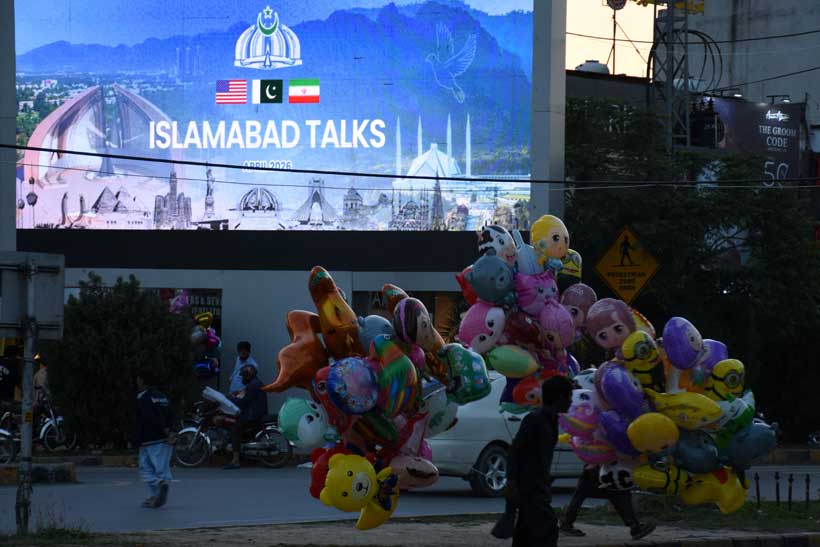
Amid mounting international concern, Pakistan has emerged as a mediator, hosting peace talks in Islamabad in an effort to deescalate the conflict.
Trump’s Ceasefire Announcement
Donald Trump announced an indefinite extension of the ceasefire with Iran, stating that the decision was made to allow more time for diplomatic negotiations. According to his statement, the United States agreed to a request from Pakistani mediators to delay further military action until Iran presents a unified proposal for peace.
Stay ahead of the geopolitical week.
MD Briefing delivers expert analysis across five global fronts — the Indo-Pacific, energy, geoeconomics, European security, and the Middle East — every Monday morning. Free.
However, the announcement appears unilateral, as neither Iran nor Israel has formally agreed to the extension. Trump’s messaging has also been inconsistent. While expressing willingness to continue talks, he simultaneously reaffirmed the continuation of the United States Navy’s blockade on Iranian trade, a move Iran considers an act of war.
Iranian Response and Skepticism
Initial reactions from Tehran suggest deep skepticism toward the ceasefire extension. Iranian officials have denied requesting such a measure, and state affiliated media outlets have dismissed the announcement as politically motivated.
Advisers linked to Mohammad Baqer Qalibaf have indicated that Trump’s statements may be strategic rather than substantive. Iran has also condemned recent United States naval actions, including the seizure of Iranian vessels, describing them as violations of international law.
Uncertain Peace Talks
The future of negotiations remains unclear. A previous round of talks in Islamabad failed to produce any agreement, largely due to disagreements over Iran’s nuclear program. The United States seeks to limit Iran’s uranium enrichment capabilities, while Iran maintains that its nuclear activities are strictly for peaceful purposes under its rights as a signatory to the Non Proliferation Treaty.
Complicating matters further, the anticipated participation of JD Vance in upcoming talks has been delayed, raising questions about the seriousness and coordination of the diplomatic effort.
Strategic and Economic Implications
The war has had immediate effects on global markets. Following Trump’s announcement, United States stock futures rose slightly, the dollar showed instability, and oil prices declined. However, the broader economic outlook remains uncertain due to continued instability in the Strait of Hormuz.
Control over this chokepoint has allowed Iran to exert pressure on global oil supply chains, amplifying fears of a potential global recession if the conflict escalates further.
Analysis
Trump’s decision to extend the ceasefire reflects a tactical pause rather than a clear shift toward peace. His dual approach combining diplomatic overtures with continued military pressure highlights a broader strategy of coercive diplomacy. By maintaining the naval blockade while delaying direct attacks, the United States seeks to force Iran into concessions without fully committing to de escalation.
However, this strategy carries significant risks. From Iran’s perspective, the blockade and recent seizures of vessels undermine trust and reinforce the perception that negotiations are being conducted under duress. This reduces the likelihood of meaningful engagement and increases the chances of further confrontation.
The absence of clear alignment between the United States, Iran, and Israel further complicates the situation. A unilateral ceasefire extension lacks legitimacy unless all parties commit to it, making the current pause fragile and potentially short lived.
Moreover, the role of Pakistan as a mediator introduces an important diplomatic channel, but its success depends on the willingness of major stakeholders to compromise. Without a coherent and consistent policy from Washington, peace talks risk becoming symbolic rather than substantive.
In conclusion, while the ceasefire extension may temporarily reduce the intensity of the conflict, it does not address the underlying issues driving the war. Without mutual trust, clear commitments, and a coordinated diplomatic framework, the prospects for a lasting resolution remain uncertain.
With information from Reuters.
