


Since the US-Israeli war on Iran began on February 28 and since it went downhill from there — unlike the operation in Venezuela — numerous former US officials, from Antony Blinken to John Kerry and Hillary Clinton, have come out of the woodwork to lend even more credibility to what we had already known: that Israeli Prime Minister Benjamin Netanyahu has presented the plan to bomb Iran to almost all US presidents during his tenure and was rejected by all except for Donald Trump. Now, why is that?
The easy answer, the one we have been getting implicitly and explicitly by all those sources, is that Trump didn’t think this through, that the respective employers of these former officials were much smarter men than to have gotten mired in the Strait of Hormuz. This kind of loyalty and self-promoting opportunism is not unexpected, but let’s not downplay the street smarts of the man whose success has baffled the Democrats for more than a decade now; or call it “business acumen” if his simple language makes you feel irritated.
The truth is: something major was different this time around. Former US presidents, Trump’s first tenure included, were not above brute-forcing a military solution on Iran, as did they elsewhere. In fact, they had resorted to many other tactics to make the regime change happen in Iran, most morally and strategically dubious at best, all to no avail.
What had always been different throughout all these years was Iran’s ties with China. Until the time of the late Iranian president Ebrahim Raisi, Iran’s presidents and people were mostly still looking to normalise their relations with the US, one way or the other. The prevailing focus of my country was to lift the sanctions, its biggest new issue, not to live with it. The Chinese saw this, too. They were understandably frustrated that we would turn to them in times of need but still prioritize reforging economic ties with the US and the West whenever an opportunity presents itself.
Stay ahead of the geopolitical week.
MD Briefing delivers expert analysis across five global fronts — the Indo-Pacific, energy, geoeconomics, European security, and the Middle East — every Monday morning. Free.
But now, for better or for worse, that bird has flown. The US has turned out to be extremely unreliable and a backstabber. It unilaterally withdrew from the Joint Comprehensive Plan of Action (JCPOA) and imposed tough sanctions. That much, some Iranians could have lived with. Then it went and attacked us twice during diplomatic negotiations. Still, some hope left among Iranians. Bombing school girls and threatening to destroy Iran’s infrastructure and wipe out our “civilization”? Now, this is something that, deep down, we can’t live with at all.
More importantly than what the US has done in the past months, though, is what the Chinese have done in the past decade. They have been keeping Iran afloat by allegedly buying Iran’s oil through a “dark fleet” and other work-arounds. For all their troubles in dealing with a heavily sanctioned country, they have enjoyed deep discounts on our oil. Not the ideal bargain, mind you, but then again, unlike Trump, we know that in negotiations, you have to concede something to get something.
This was not all that happened in the oil market recently. Russia soon joined Iran in the list of sanctioned countries that sell discounted oil to China, and Venezuela’s oil now primarily serves the interest of Trump since he snatched President Maduro and his wife from their home in Caracas. To put that into perspective, Venezuela has approximately 303 billion barrels of proven crude oil reserves, the largest of any country in the world, but it is nowhere on the list of top oil producers because of its extremely heavy and difficult‑to‑process crude, ageing and under‑maintained production infrastructure, and years of insufficient investment in its oil fields and upgrading facilities. But these caveats do not hold Trump back from thinking that he is one step away from calling the shots in the oil market.
Holes in Netanyahu’s pre-war meeting
Now, we come to the war on Iran. The New York Times revealed in a report that Netanyahu’s last pre-war meeting in the White House was taken to the Situation Room, where he sold Mossad’s idea that by assassinating the leader of Iran and conducting joint air strikes with the US, his long-held dream of regime change in Iran would be realised.
But why should have Trump cared about that? Really think about it.
Was Iran an imminent threat? Pentagon says no.
Does Iran have a nuclear weapons programme? The IAEA and 18 intelligence agencies say no.
Was Iran in possession of its 60% enriched uranium, which could reportedly work like an atom bomb? The IAEA can’t confirm, and White House said that it was buried deep underground in June 2025.
Could regime change turn into a win for the win-hungry Trump, like the stunt in Venezuela did? Yes, but not because Trump wants to “help” the Iranian people with their issues. Even he himself told us several times quite a while into the failing war that his ideal scenario would be to take Iran’s oil. We have let ourselves be carried away by his never-ending onslaught of “post-truths” to forget about that statement or not think too much of it.
Why was taking Iran’s oil the best-case scenario? Because of the power it would have given the US over China, its main competitor. US Secretary of the Treasury Scott Bessent, as always, just spelled out the importance of Iran in a press conference, “China was purchasing more than 90% of [Iran’s] oil, which is about 8% of China’s energy needs.” That statement isn’t really about Iran. Don’t read that statement like China is one-sidedly helping Iran; Iran is helping China, too.
Chinese crude oil imports from Iran were estimated by commodity analysts at Kpler to be around 1.71 million barrels per day (mbpd) in March, while Russia’s is estimated to be below 3 mbpd. Meanwhile, China’s oil consumption was reported at 16.37 mbpd in December 2024, of which around 11 mbpd were imported. So, Beijing essentially can’t import that 11 mbpd from one place; it has to buy it in scraps and pieces from here and there. However, there isn’t many options around. Beside Russia and the Middle Eastern countries, other suppliers from further away, like Brazil and Angola, export negligible amounts each to China, enough to diversify its supply mix but not enough to replace a major supplier that has dropped out of the equation. There’s the importance of Iran.
In Trump’s dreams, with Iran out of the supply mix and other suppliers either being further away or in need of their oil for domestic consumption, Washington is a major supplier that Beijing can potentially turn to, either for its own oil or for Iran’s US-commandeered oil. And there’s no telling what arrangements his ideal plan intended for the Strait of Hormuz and the oil flowing from other Middle Eastern countries.
Is it a bit simplistic? Yes, Beijing would not have stood by and watched it happen, and if it did happen, Beijing probably would have made other plans. Plus, as Mamdouh Salameh, an international oil economist, noted live during an interview by Al-Jazeera, the US produces 13 million barrels of oil per day but consumes 21 million barrels per day, and getting Venezuela back to its production capacity of 3 mbpd needs 10–15 years and $100 billion.
However, the signs are there that this may be one of the main things that Netanyahu sold Trump in that meeting — while the other goals probably targeted the well-studied character of Trump.
First sign is Trump’s collapsed effort to enforce a blockade on top of Iran’s Hormuz blockade. Look at how Trump opened his recent Truth Social Post: “China is very happy that I’m permanently opening the Strait of Hormuz. I am doing it for them, also – And the world.” As Scott Bessent implied, this blockade would have really hurt just two parties: Iran and China. It is worth noting that Iran, being the resilient country that it is and given its brief increase in oil sale thanks to US sanctions waiver, would have conceivably outlasted an effective US blockade, but China? Trump’s plan for removing Iran from China’s supply mix would have already undergone its trial phase there. If he was smarter about it, he would have started here.
Another sign is the aforementioned sanctions waiver for Iranian and Russian oil exports. Considered widely as one of the strangest moments of this war, this move has been partly misunderstood. Beside managing the global oil market, it could have enticed Iran and Russia to diversify their supply mix away from China towards more lucrative, non-discounted deals, but it didn’t because their strong you-scratch-my-back-I-scratch-yours relations were not studied well. The recognition that a sanctioned Iran and a sanctioned Russia are only helping China was there, but his solution was a long shot.
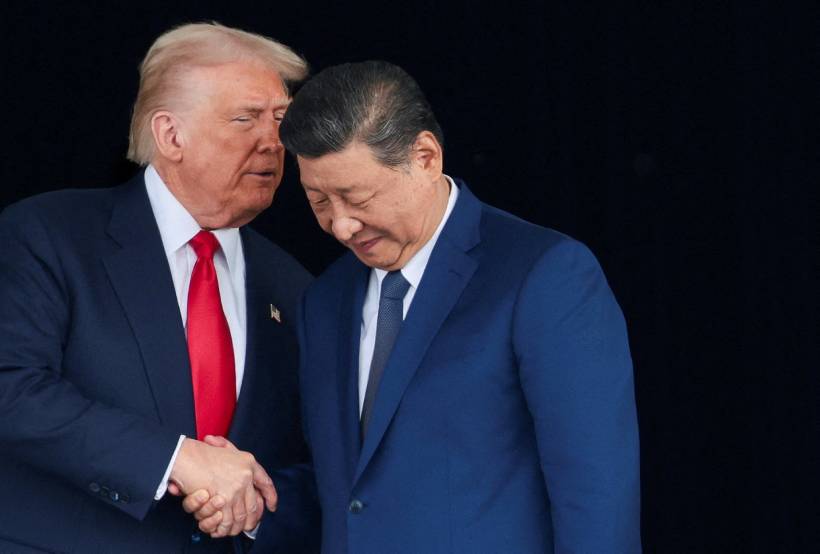
Later in the same Truth Social post, Trump added, “President Xi will give me a big, fat, hug when I get there in a few weeks.” Finally, this explains the “why now” question. Being obsessed with the concept of negotiations as a card game, Trump was trying to drum up an ace up his sleeve before the consequential meeting with Xi. Remember that in the last days of war, Israel, almost certainly in coordination with the US, targeted a railway track that was part of China’s Belt and Road Initiative. This move could have either been the first of its kind if the war continued, or a message to China if a cease-fire was brokered.
Humbled by Xi’s use of his monopoly card on rare earth materials in the last standoff, Trump was hoping to get a semi-monopoly of oil production in China’s vicinity but flinched repeatedly. Now, the Petro-yuan card that Iran played out of nowhere has changed the game in favor of China. Will Trump fold in Hormuz or will he draw another card?
