


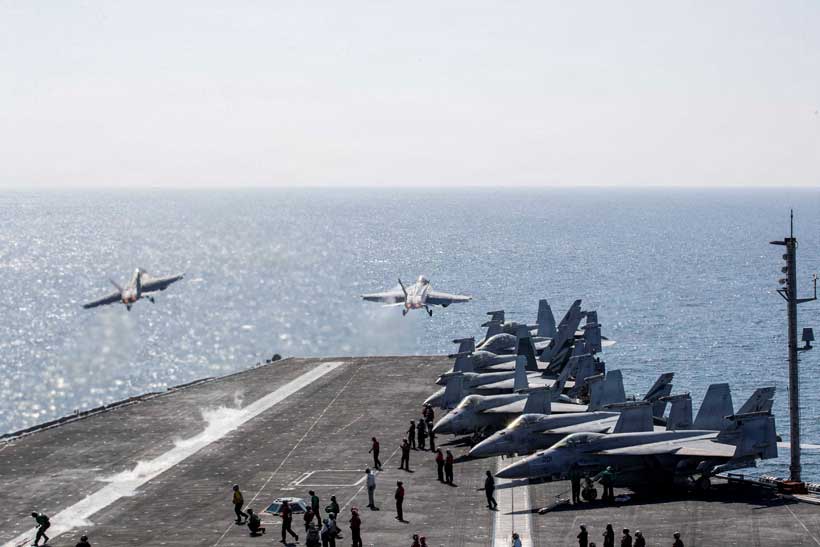
Before the United States and Israel launched their operations against Iran on 28 February, international assessments of the possible consequences of war were deeply alarming: catastrophe was the simplest and most comprehensive description of the scenarios being discussed. As of 15 March 2026, the war continues, and the future of the global economy remains uncertain. The rise in energy prices has not yet been fully felt by many countries, but it may soon contribute to economic stagnation across the globe. The spillover effect has also begun to accelerate, as Iran continues to strike Gulf states and, on occasion, launch missiles toward Türkiye, drones toward Azerbaijan and Cyprus. While US strikes have focused primarily on Iran, Israel has also intensified its military operations in Lebanon. The main pressure point remains the energy market, particularly oil and gas, and Iran’s strongest leverage against the US-Israel alliance lies in its ability to threaten the operability of the Strait of Hormuz.
Rising oil prices are highly beneficial for Russia, especially as Washington has temporarily lifted sanctions on Russian oil. By contrast, energy-dependent actors such as China and the European Union are coming under growing pressure as conditions in oil markets deteriorate. If one looks only at official Chinese customs data, there appears to be no oil imported from Iran. However, several reports suggest that oil arriving from Malaysia also includes supplies originating in Iran and Venezuela. Because of Western sanctions, these shipments are allegedly transported under the Malaysian flag and recorded accordingly in customs data. According to such reports, China’s daily imports of Iranian oil amount to approximately 1.38 million barrels. Yet China has remained largely silent, even though worsening conditions in the Middle East do not serve Beijing’s interests. The only reactions from Chinese officials have centered on respect for international law and calls for an immediate end to the conflict. This, then, is the central puzzle: if Washington’s pressure on China is already straining Beijing’s economic and political position, why has China chosen to remain an observer?
Changing Power Dynamics
Iran is not the only Middle Eastern oil exporter supplying China. If the Strait of Hormuz were closed, China could lose the free flow of oil tankers from Saudi Arabia, Iraq, the UAE, Oman, and Kuwait. China could still increase imports from Russia, but that would likely deepen Beijing’s dependence on Moscow, hardly an ideal outcome. In this context, Iranian oil may be especially important because it helps reduce excessive reliance on both Russian and Saudi supplies. In other words, Iran could strengthen China’s bargaining position by expanding Beijing’s range of options.
If Washington were to prevail over Iran, and if the US-Israel partnership achieved its broader objective of regime change, China could find itself in a far more difficult position. A new government in Tehran might align more closely with Washington, allowing the United States to exercise greater indirect influence over the Strait of Hormuz and monitor critical energy flows more closely. That, in turn, could place further pressure on China’s supply chains, especially given Beijing’s weakened position in Venezuela. The geopolitical implications could be equally serious. A decisive US victory might send a powerful message to the region: Washington remains the only actor capable of shaping outcomes through force. Under such conditions, China might be compelled to reassess its future regional initiatives, including its engagement with the Gulf states.
Stay ahead of the geopolitical week.
MD Briefing delivers expert analysis across five global fronts — the Indo-Pacific, energy, geoeconomics, European security, and the Middle East — every Monday morning. Free.
Another danger for China could lie in the future of the Belt and Road Initiative. Iran occupies a central place in this Chinese project, serving as a gateway to the Gulf, Central Asia, and wider Eurasia. A new regime in Tehran might obstruct these ambitions, particularly if it were to operate in closer alignment with Washington. In that case, China’s regional role could shrink significantly, and Beijing might be forced to scale back its ambitions in the Middle East.
Power Transition Theory: The Silence of China
That scenario would be more likely if the US-Israel partnership were able to achieve its core objective, regime change in Iran, at relatively low cost. So far, however, the war has moved into its third week without producing such an outcome. The assassination of Iran’s Supreme Leader did not trigger regime collapse; some observers even argue that it strengthened the regime. Calls for the Iranian population to rise against the government have also failed to produce the desired effect. Iran remains capable of striking Israel and US bases in the region, the Strait of Hormuz remains non-operational, and instability in oil markets continues to place pressure on the global economy. Despite this, Washington is committing additional resources to the Middle East in the apparent hope that the Iranian regime will eventually fracture.
Yet this strategy may drain American resources without bringing a clear or shared endgame. United States and Israel no longer appear to be emphasizing exactly the same war aims. While regime change seemed to be the original common objective, their priorities now appear to be diverging: Israel continues to stress regime change, whereas the United States appears increasingly focused on weakening Iran’s nuclear and missile capabilities. At the same time, the resilience of the Iranian regime suggests that any decisive outcome might require the deployment of ground troops, a step that could generate even greater chaos, uncertainty, and cost.
From Beijing’s perspective, this may be precisely why restraint is the more rational strategy. Chinese involvement would carry immediate risks, whereas continued US entanglement could gradually weaken Washington’s position. The longer the conflict expands without a clear strategy or political endpoint, the more damage it may inflict on American credibility, resources, and regional standing. Even a military victory might come at a strategic cost. China, by contrast, may be able to preserve its strength while waiting for the hegemon to overextend itself. Meanwhile, Iranian strikes on Gulf states could also raise new doubts about the reliability of Washington’s regional security architecture, doubts that China might seek to exploit in the future. In that sense, Beijing may be achieving more by doing less.
Hegemonic Decline
When Joe Biden ordered the withdrawal of US troops from Afghanistan, some interpreted the move as an attempt by a declining hegemon to pause and consolidate. A hegemonic power must constantly spend resources to preserve its global influence, yet such overextension can gradually accelerate decline. From this perspective, reducing military commitments in certain regions can be seen as a strategic effort to slow that process. Donald Trump’s return to power initially appeared to reinforce this logic. His “America first” message was widely understood as a turn toward restraint, or at least a reduced appetite for costly international entanglements, which in theory could have helped Washington conserve power in its long-term competition with China.
Yet Trump’s second term has taken a very different turn. Rather than acting as a peacemaker, he has moved in a far more militarized direction. That shift may deepen the decline of the United States as a hegemonic power. Hegemony depends not only on military superiority, but also on legitimacy, alliance management, and the ability to exercise influence through consent rather than coercion. In that sense, Washington now appears less like a hegemon and more like a dominant power increasingly reliant on pressure. Under Trump, the United States seems less respectful of alliances and less committed to the international order it once helped build and protect.
This distinction matters. Domination may represent a later stage of hegemonic decline: a moment when a great power, no longer confident in the durability of its leadership, becomes more impatient, more coercive, and less strategic. Such a shift is dangerous because it can make Washington appear unreliable to its allies, while also alienating neutral powers that do not wish to be subordinated. In turn, this creates new opportunities for revisionist states such as China to fill the space left behind by a weakening hegemon and to build partnerships that once seemed unlikely.
China’s silence is not fear. It is strategy. It is better understood as a strategic silence. Beijing remains restrained because direct involvement would impose immediate costs, whereas a prolonged conflict may erode US power, damage Washington’s regional credibility, and create future openings for Chinese influence.
