Will they or won’t they? The Sudanese Armed Forces (SAF) are tap-dancing their way around the latest negotiations for a ceasefire, always imposing new conditions for their agreement, probably in the hope that ‘international outrage’ over the Rapid Support Forces’ (RSF) capture of El-Fasher will buy them either time or a get-out-of-jail-free card.
The ceasefire push came immediately after the RSF captured El-Fasher on October 26, 2025, following an 18-month siege. Trump administration advisor Massad Boulos led the push, stating earlier in the week that warring sides had “agreed in principle” with “no initial objection from either side.” The proposed plan would begin with a three-month humanitarian truce that could pave the way for a lasting political solution, including a new civilian government.
As usual, the RSF was pretty quick off the mark. On Thursday, November 6, it announced it would accept a ceasefire proposed by the “Quad” mediator group consisting of the United States, Saudi Arabia, Egypt, and the United Arab Emirates. According to the RSF statement, quoted by the BBC, they agreed to enter the truce “in order to address the catastrophic humanitarian consequences of the war” and to allow the “urgent delivery” of aid. The group also expressed willingness to discuss ending hostilities permanently and creating conditions for “a just, comprehensive, and lasting peace.”
And as usual, the SAF came with preconditions that were tantamount to a rejection.
Stay ahead of the geopolitical week.
MD Briefing delivers expert analysis across five global fronts — the Indo-Pacific, energy, geoeconomics, European security, and the Middle East — every Monday morning. Free.
The BBC’s Barbara Plett Usher reported that on the Tuesday before the RSF’s statement, Sudan’s Defence Minister Hassan Kabroun had thanked US President Trump’s administration for its “efforts and proposals to achieve peace” in a speech broadcast on national television but added that preparations for the battle against the RSF were ongoing. “Our preparations for war are a legitimate national right,” he said.
The following day, Sudan’s chargé d’affaires in Nairobi, Mohamed Osman Akasha, further choreographed the SAF’s tap-dance by saying the military-led government would agree to stop the fighting only if the RSF was dismantled, surrendered its weapons, and its leader was held accountable. “I have no information about a proposal for truce,’ Okasha said. “The only thing that I know is the government of Sudan; the people of Sudan are very determined to defeat this militia,” he said.
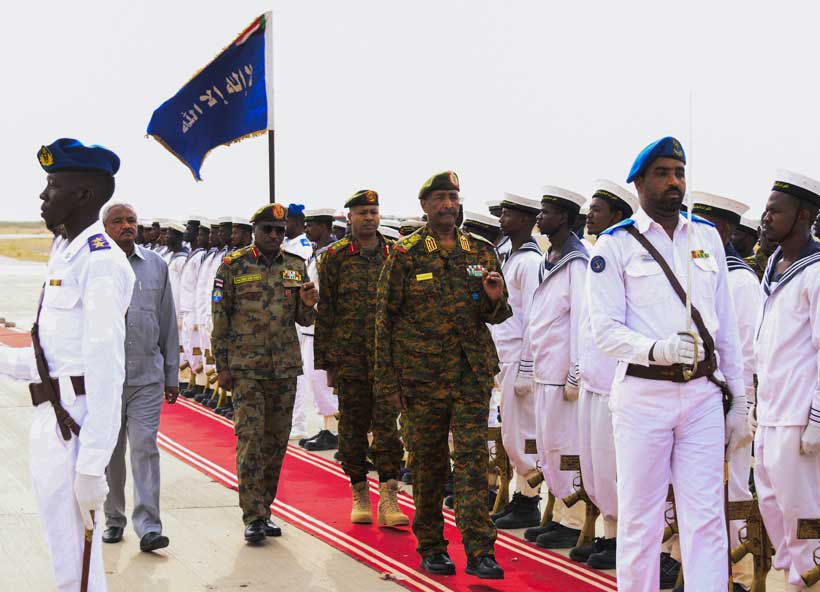
And the day after the RSF had accepted the truce in principle, SAF commander General Abdel Fatteh al-Burhan went on national television to dispel any uncertainty about the SAF’s attitude, declaring that his forces were “striving for the defeat of the enemy.” “Soon, we will avenge those who have been killed and abused … in all the regions attacked by the rebels.”
And in the meantime, it is understood, the SAF has been arguing for the inclusion of two more of its allies in the Quad discussions, Qatar and Turkey, both of which have made sizeable contributions to the SAF war effort.
Meanwhile, major news outlets such as the BBC, Deutsche Welle, and Agence France Presse have revealed that many viral images and videos depicting atrocities in El-Fasher, Sudan, were AI-generated, not authentic. Fact-checks found visual anomalies, creator watermarks, and mismatched timelines, highlighting widespread digital fabrication. While it is not possible to say who is behind these fabrications, it is beyond question that they suit the SAF’s book and that the SAF will exploit them to the hilt as a means of obtaining leverage in the ongoing effort by the international community to bring the combatants to the table.
Leading international journals frequently point out that there are no angels in this conflict. But the question has to be asked: why does one side—which has just notched up a major victory and could be said to have regained its military footing—always say yes to talks, while the other side always says no? One can only conclude that the SAF’s Islamists are simply too afraid to let go of the hegemony they have maintained by force over Sudan for most of its history as an independent state, at the expense of the racial and ethnic minorities that live beyond their strongholds along the length of the Nile. The RSF, whatever its failings and culpabilities, is at least determined to bring those minorities and neglected peripheries back into the reckoning in Sudan’s politics of power. Unless that happens, Sudan’s fragmentation and suffering will only continue to worsen.