


NEWS BRIEF
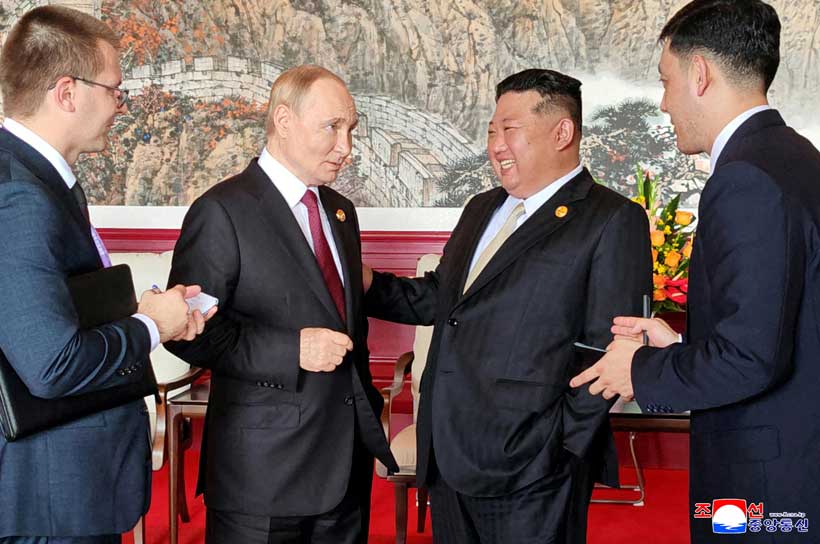
On the sidelines of WWII commemorations in Beijing, North Korean leader Kim Jong Un pledged “full support” for Russia’s military efforts as a “fraternal duty,” while President Vladimir Putin praised their “special” alliance and thanked North Korean soldiers fighting in Ukraine. This high-level summit, a propaganda victory for Pyongyang, solidifies an anti-West partnership where North Korea provides munitions and personnel for Russia’s war in exchange for political legitimacy and likely economic and military aid, altering the conflict’s strategic calculus.
WHAT HAPPENED
- North Korean leader Kim Jong Un and Russian President Vladimir Putin held a high-profile meeting in Beijing.
- Kim Jong Un vowed “full support” for Russia’s military, calling it a “fraternal duty.”
- President Putin described the countries’ ties as “special ones of trust, friendship and alliance,” and praised North Korean soldiers fighting in Ukraine.
- The leaders discussed long-term partnership plans and reaffirmed their will to elevate bilateral relations, building on a mutual defence treaty signed last year.
- Kim’s presence at the multinational event and his meeting with Putin is being treated as a major propaganda victory within North Korea, dominating state media.
WHY IT MATTERS
Stay ahead of the geopolitical week.
MD Briefing delivers expert analysis across five global fronts — the Indo-Pacific, energy, geoeconomics, European security, and the Middle East — every Monday morning. Free.
- The meeting formalizes and accelerates a major geopolitical shift, creating a strengthened anti-West axis between two heavily sanctioned nations.
- It provides direct, public validation for Kim Jong Un on the world stage, a significant propaganda tool for his regime’s stability.
- The pledges of support confirm that North Korean munitions and soldiers will continue to flow into the Ukraine war, directly impacting the conflict’s dynamics.
- It signals a deepening military partnership where North Korea provides munitions and personnel in exchange for likely economic aid and technological transfers from Russia, undermining international sanctions regimes.
IMPLICATIONS
- For Ukraine: The flow of North Korean artillery shells and missiles will continue to strain Ukrainian defences and prolong the war.
- For South Korea & Japan: The strengthened alliance increases regional security threats, potentially forcing a further escalation in their own military preparedness and alliances.
- For the U.S. & NATO: This partnership creates a new, complicated front in the proxy conflict with Russia, challenging efforts to isolate Moscow and Pyongyang.
- For North Korea: Kim gains crucial economic and political lifelines, potentially including advanced weapons technology, which could accelerate his nuclear and missile programs.
- For Global Security: The collaboration between two nuclear-armed states that flout international norms sets a dangerous precedent and risks further eroding non-proliferation efforts.
This briefing is based on information from Reuters.
