


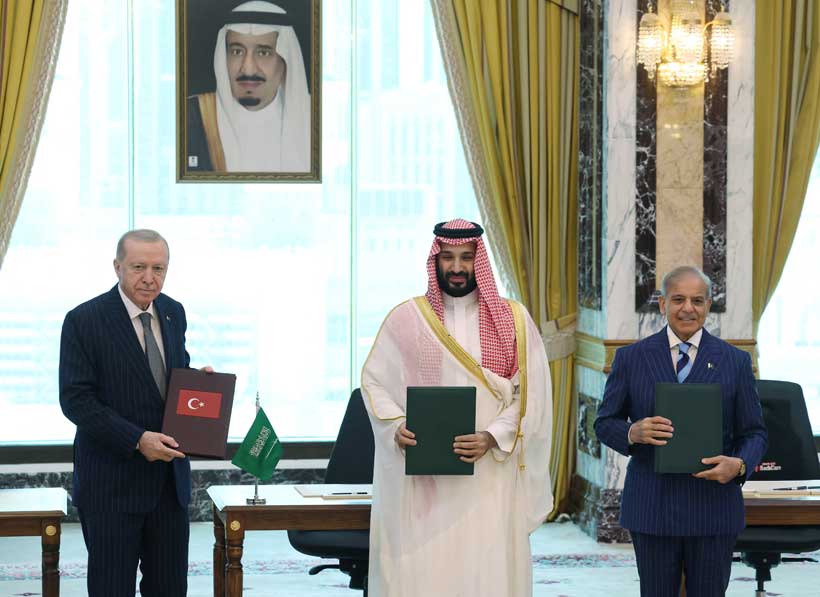
The Mecca Compact in Brief
On 7 August 2026, in the presence of Crown Prince Mohammed bin Salman, Saudi Arabia, Turkey, and Pakistan signed the Mecca (Makkah) Joint Defense Agreement, a trilateral collective-defense compact declaring that an armed attack on any one of the three shall be treated as an attack on all. This is not a spontaneous diplomatic flourish. It builds on the September 2025 bilateral Saudi-Pakistan Strategic Mutual Defense Agreement, now widened to bring in Turkey’s NATO-integrated military machine and its formidable defense-industrial base, chiefly Baykar’s drone ecosystem and the KAAN fighter program. What has emerged is a framework anchored in collective deterrence, joint military exercises, intelligence sharing, defense-industrial cooperation, and interoperability—an arrangement its own architects describe, cautiously, as “purely defensive” and open to future members but conspicuously silent on any nuclear dimension in its public text.
This pact is less a finished alliance and more a strategic hedge (necessitated by the gross insecurity of Saudi Arabia in the ongoing war in West Asia)—three states insuring against uncertainty by pooling reputational and military weight, without yet building the institutional scaffolding that would make the guarantee credible, like NATO (which itself is undergoing a credibility crisis).
Why Now: The Triggers Behind the Compact?
Stay ahead of the geopolitical week.
MD Briefing delivers expert analysis across five global fronts — the Indo-Pacific, energy, geoeconomics, European security, and the Middle East — every Monday morning. Free.
The timing is not coincidental. Three converging pressures explain the “why now.” First, the widening US-Israel-Iran confrontation since late February 2026 has rattled Gulf shipping lanes and exposed the limits of Washington’s single-handed security umbrella over the kingdom. Second, the post-October 7 regional recalibration pushed Riyadh toward diversifying its guarantors rather than depending on any one patron. Third, the three states bring genuinely complementary assets to the table: Saudi financial depth and geography astride Hormuz and Bab el-Mandeb; Turkish NATO-standard military doctrine and an export-ready drone and naval industry; and Pakistani manpower plus the distinction of being the only nuclear-armed Muslim-majority state. What we are witnessing is less an ideological “Islamic NATO” awakening than a pragmatic risk-pooling exercise by states that no longer take American reliability for granted.
Anatomy of the Agreement: Scope, Clauses, and Obligations
The public scope, as confirmed by officials, covers four pillars: a collective-defense clause using language broadly comparable to NATO’s Article 5 and grounded in the wider principle of collective self-defense under Article 51 of the UN Charter; joint training and military exercises; intelligence-sharing mechanisms; and defense-industrial integration, most visibly Turkish drone production tying into Saudi capacity. What is missing is equally instructive—no integrated command headquarters, no standing joint force, no common budget, and crucially, no explicit nuclear-sharing clause, a marked departure from speculation that surrounded the original bilateral Saudi-Pakistan text. A reported exclusionary clause further limits obligations: a member that initiates aggression or permits its territory to be used to attack another state forfeits the pact’s protection. This single clause does more to define the compact’s defensive character than any declaratory statement by its signatories.
Not NATO’s Article 5: A Deliberately Looser Construct
Comparisons to NATO’s Article 5 are journalistically tempting but analytically loose. NATO’s guarantee rests on a standing treaty organization, an integrated command structure, seven decades of tested doctrine, and an implicit nuclear umbrella. The Mecca pact has none of this. It rests on Article 51 self-defense logic, leaves the geographic scope and assistance triggers undefined, and grants each signatory discretion over how—or even whether—to respond. Turkish security analysts themselves have called it “a framework for closer coordination,” explicitly declining the NATO comparison. My professional reading is that this ambiguity is a feature, not a flaw: it buys political flexibility for Ankara and Riyadh while avoiding the entangling automaticity that binds NATO members.
Iran’s Reaction: Dismissive Rhetoric, No Formal Response
Iran had not issued an immediate top-level official response, although Iranian criticism of the pact was reported in other political and media circles, mocking the fact that one-sided defense agreements with America and Pakistan have not been able to protect Saudi Arabia so far in the ongoing war, advising them to reform their policies instead of begging for protection and promising that “the roar of our missiles” will reach its signatories. Tehran is braving it by dismissing the pact as symbolic paper diplomacy rather than a credible deterrent.
Iran’s harder line likely reflects lived experience rather than just rhetoric. During the widening US-Israel-Iran war that escalated after February 28, 2026, Iran reportedly struck Saudi territory directly in retaliation for US/Israeli strikes, effectively testing whether Pakistan would honor its existing bilateral defense commitment to Riyadh. Pakistan’s actual response was telling: rather than invoking the pact militarily, Islamabad “refrained from any direct military” retaliation against Iran, with no formal invocation of the agreement and no public commitment to military action, highlighting that these pacts “do not carry automatic trigger clauses” in practice. This history gives Tehran good reason to view the Mecca pact’s deterrence value skeptically as a claim to be tested, even while taking its symbolism seriously enough to publicly denounce it.
Ripples Into the West Asian War
For the ongoing Iran-Israel-US confrontation, the pact functions technically as a deterrent signal to Tehran: any renewed major strike on Saudi Arabia now risks invoking a wider Sunni military response involving Turkish and Pakistani capabilities. This raises the escalation ceiling for Iran’s calculus but does not necessarily reduce the war’s intensity—it may instead harden battle lines, making Iran more likely to rely on proxy and asymmetric options rather than direct confrontation with a Saudi state now backed by a broader coalition.
However, the pact’s defensive architecture and its aggression-exclusion clause make it unusable as a license for Pakistan to initiate hostilities against Iran. Islamabad’s actual conduct reinforces this reading—Pakistan has served as a mediator during the Iran-Israel-US conflict. Geography indicates a long, porous border through restive Baluchistan gives Pakistan every incentive to avoid provoking Tehran. The more difficult test would arise if Saudi territory were used by a third party to conduct offensive operations against Iran. Riyadh has repeatedly stated that its territory and airspace should not be used for attacks on Iran, and Pakistan has strong incentives to avoid being drawn into a direct confrontation with Tehran.
An Indirect NATO Extension? Parsing the Overlap
The pact is not a backdoor NATO extension in any legal sense—NATO’s Article 5 binds only its 32 members, and Ankara’s membership does not transfer that obligation to Riyadh or Islamabad. But the optics matter strategically. Turkey imports NATO-standard doctrine, interoperability, and Western-integrated hardware into a coalition with two long-standing American security partners, creating a “Sunni NATO in style, not structure”—a US-partner-heavy coalition of convenience rather than a treaty-bound extension of Western collective defense.
Israel’s Reaction: Official Silence, Unease Underneath of a “Hostile Sunni Axis”
Israel has issued no official statement. But that silence masks significant strategic concern, and informal commentary from Israeli figures fills the gap left by official reticence. Two plausible reasons explain Israel’s reticence. First, Turkish officials have stressed the pact is “purely defensive” and “not directed against any specific actor,” giving Israel little pretext for a public rebuttal without any evidence of being targeted instead of Iran. Second, Saudi Arabia’s own framing “not linked to any nuclear ambitions or arms race” seems calibrated to avoid alarming Washington and Israel simultaneously.
Despite formal silence, informal signals suggest real Israeli anxiety that it could be to build deterrence against Israel, besides deterring Tehran”—a framing that directly implicates Israel as a target of the deterrence logic, not just Iran. All three nations are known to have been particularly concerned about Israel’s influence and recent growing attacks in the region.
Former Israeli PM Naftali Bennett, in February 2026, described Turkey as “the new Iran” and accused Ankara of seeking to build a “hostile Sunni axis with nuclear Pakistan.” The pact’s core strategic effect on Israel is one of raised escalation risk rather than direct military constraint for now. Because the agreement’s obligations remain unspecified — no country has detailed what military action it would actually take if a partner were attacked — Israel cannot yet calculate a precise deterrence threshold, which itself is a form of strategic pressure. Western media frames the pact chiefly as a warning to Iran, but the underlying rationale — deterring “aggressive military stances” from both Iran and Israel — means Israeli military planners will likely now factor in the possibility that action against any of the three signatories, particularly Turkey, could theoretically trigger wider entanglement.
The View From Beijing, New Delhi, and Moscow
Beijing’s response has been calculated silence, reflecting quiet satisfaction: a stabilized Pakistan and a Gulf-Pakistan security architecture protect China’s Belt and Road investments without costing Beijing any political capital. New Delhi has responded with its now-familiar formula of “closely following the development,” a deliberately non-committal posture that nonetheless masks real concern about Pakistan gaining diplomatic cover from Riyadh and Ankara during future crises and about Turkey’s known tilt toward Islamabad on Kashmir. Moscow, balancing its own strategic partnership with Iran against its interest in a Gulf less dependent on Washington, is likely to watch with pragmatic neutrality, benefiting from any dilution of US centrality in the region without alienating Tehran.
Implications for India: Watching Is Not Good Enough!
For India, “closely following” cannot remain the operative strategy for long. Three imperatives follow. First, New Delhi must insulate its bilateral relationship with Riyadh—built on energy, expatriate welfare, and counterterrorism cooperation—from any spillover effect of Pakistan’s elevated standing in Saudi calculations. Second, India should intensify defense and strategic engagement with Gulf states bilaterally, ensuring the Mecca pact does not translate into diplomatic isolation on Kashmir or cross-border terrorism narratives at multilateral forums. Third, India’s own extended-neighborhood posture—QUAD engagement, naval presence in the Indian Ocean, and defense diplomacy with Israel and moderate Arab states—should be calibrated to prevent this Sunni-bloc formation from consolidating into a coordinated diplomatic front against Indian interests.
India also needs to handle the war of narrative related to it. India’s MEA issued a “fake news” alert the same day, debunking a Turkish outlet’s claim (sourced to anonymous Pakistani officials) that India had approached Israel for a defense pact in response to the Mecca agreement.
Conclusion: A Framework in Flux
The Mecca Joint Defense Agreement is best understood as a strategic hedge born of eroding faith in a single security guarantor, not a fully realized alliance. Its long-term significance will depend on whether it acquires institutional muscle—joint commands, expanded membership, and defined triggers—or remains a symbolic pledge activated only in extremis. NATO has formally invoked Article 5 only once, following the September 11, 2001 attacks, illustrating that the credibility of collective defense depends not simply on treaty language but on political will, military capability, and the circumstances of the attack.
For India, the credibility of this pact is no different than what Iran is testing regularly. The practical course to be adapted is neither alarm nor indifference but sustained, calibrated diplomatic and defense engagement that ensures this compact reshapes West Asia’s security map without reshaping New Delhi’s strategic space. It needs to revisit some of its foreign policies, as the geopolitical landscape is changing in a manner not too favorable for India. The answers may lie within and outside West Asia.