


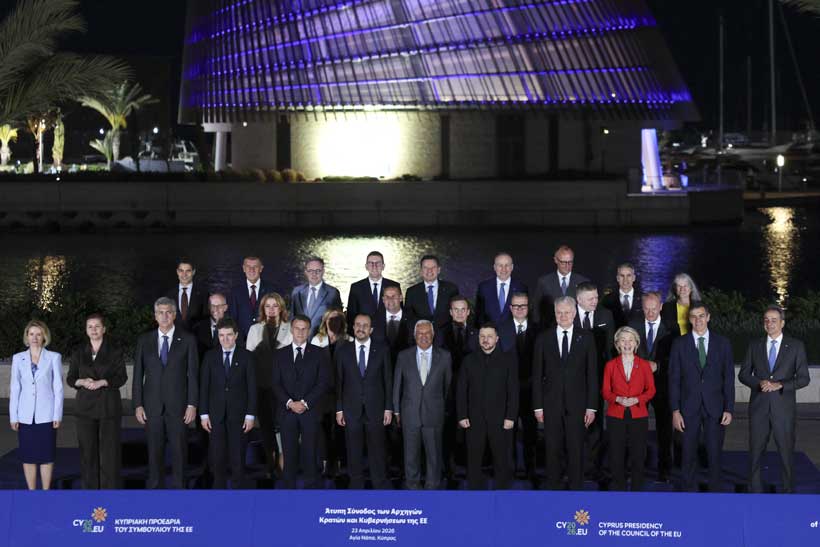
The Russian invasion of Ukraine in 2022 and Trump’s return to the White House in 2025 have fundamentally altered Europe’s geopolitical situation. The resultant Russian threat and the attendant doubts about U.S. support have in turn led to a massive rearmament of the continent. All the same, as Europe builds up its military, political, and strategic muscle, there remains the potential for divisions to undermine its cohesion.
This is the central issue: is Europe becoming a genuine geopolitical power, or are we just seeing a massive increase in the military capabilities of individual nations without any strategy in place?
The answer may well be in a new division within Europe, one less obvious than the old dichotomy between the West and the East. The North and East are predominantly concerned with Russia, the South with the Mediterranean, Africa, and immigration.
A Geography of Fear
Stay ahead of the geopolitical week.
MD Briefing delivers expert analysis across five global fronts — the Indo-Pacific, energy, geoeconomics, European security, and the Middle East — every Monday morning. Free.
Geography still determines how the European countries see the threat and what their security priorities are.
For the UK, Germany, Poland, Romania, Bulgaria, the Baltic states, and the Nordic countries, Russia is a significant military threat. Given their location, history, and the war in Ukraine, they are all focused on deterrence, border security, and a NATO presence.
Spain, Italy, Greece, Malta, and Cyprus all view their security in a Mediterranean context. For them, the issues of instability in North Africa and the Sahel, migration, and energy security are all key.
France is in a different position entirely, with both continental and Mediterranean security interests. The other European countries (western and central Europe, the Balkans, etc.) have different priorities that don’t quite fit into either of those two camps.
These differences don’t mean that Southern Europe is ignoring the Russian threat at all. Spain, for instance, still backs Ukraine and collective defense. The difference lies primarily in the relative weight each country attaches to different threats.
If Europe does split, it won’t be between pro-Russian and anti-Russian countries. It will be a split between different conceptions of what security means for Europe.
Germany and France: A Changing Balance of Power
Germany’s rearmament is by far the most significant geopolitical development in Europe since the end of the Cold War.
For so long, Germany’s influence was derived from its economic muscle and its position at the heart of the European institutions. The invasion of Ukraine has changed all that and accelerated Germany’s move towards becoming a much more significant military power.
This is a significant development for Eastern Europe. The fact that German troops are present in Lithuania (a brigade, as I write) is a complete reversal of the historical situation, in which those very same countries had been in a state of fear at the prospect of German military power. It’s now seen as an essential component of their own security. It also raises the question of the future of the Franco-German axis, the bedrock of European integration.
France has the military, the nuclear capability, and the diplomatic clout that Germany simply doesn’t. France’s strategic objectives and the political debate in Paris don’t always align with what Berlin would like.
If Germany is concentrating on Poland, the Baltics, and the defense of NE Europe, and France is looking more broadly, there’s going to be a degree of friction between the two. The issue isn’t really who is going to lead Europe; it’s whether the two can maintain a common vision of security.
Nationalism and Strategic Fragmentation
The rise of nationalist movements adds a political dimension to these geographic differences.
While those movements are often opposed to greater European integration, they hold very different views on Russia and Ukraine.
In Poland, there is a very deep distrust of Moscow. In France, Italy, and Germany, there have been some political groups who have called for more talks with Russia or who have criticized the sanctions and the military aid to Ukraine. So European nationalism is not a monolith. There is, however, the potential for another problem: nationalist opposition to greater European integration. If the various countries go down the route of building up their own militaries without any real way to work together, it could be very difficult to create a single European defense.
Fragmented industrial programs, unevenly distributed budgets, and disputes over sovereignty could all work against continental rearmament. Europe might well have the military means but still be unable to act as a single entity.
The U.S., Russia, and a Divided Europe
Changes in U.S. policy add another dimension of uncertainty.
For years, the U.S. military presence enabled the Europeans to maintain their strategic differences while limiting the strategic significance of those differences. Washington provided the military backing, the political leadership, and the security guarantees, which all served to balance those differences. Trump’s drive for greater European defense spending and his general skepticism about the transatlantic relationship now mean that that model must be rethought.
For Russia, the divisions in Europe could present an opportunity. It could take advantage of the fact that Europe is not always a monolith and that, in some cases, differences of opinion will slow the process of collective decision-making without having to go to war with every single country in the alliance. Of course, not all of Europe’s differences are the result of Russian influence. A great deal of the divergence is simply down to the individual country’s own geography, history, economy, and politics. Europe’s real problem is managing those differences, so they don’t become strategic weaknesses.
A New Political Geography for Europe?
The “Europe North v South” divide is an interesting one, but it’s far from a simple binary. France is a country that must balance its Northern and Southern European interests. Spain is a country that is actively supportive of European defense. Italy is a country that is in the NATO camp. Poland is a country that has its own take on national sovereignty and European integration. The result is that the threats, interests, and strategic imperatives are not evenly distributed across the continent. The real divide may be between those countries that want a greater degree of European military cooperation and those that want to maintain a greater degree of national independence, irrespective of where they are in Europe.
Geography shapes politics, but it doesn’t determine alliances. Europe’s geopolitical future will be less about defense spending and more about how well the various governments can turn their resources and their differing views of the threat into a common strategy.
Europe may well be entering a new era of military power. The real issue is whether it can convert that into political power.
