


Israeli Prime Minister Benjamin Netanyahu faces a critical test of his political future as voters head to the polls, weighing his leadership after the October 7, 2023, Hamas-led attacks, subsequent wars in Gaza and with Iran, and Israel’s growing international isolation.
Despite mounting criticism, Netanyahu remains a formidable political contender. His Likud party and right-wing allies are competing against a rival alliance led by former military chief Gadi Eisenkot, while Israel’s fragmented political system could allow Netanyahu to remain in power even without a clear electoral majority.
Opinion polls indicate a close contest between the two camps. Neither Netanyahu nor Eisenkot has a clear path to forming a government, raising the possibility of prolonged coalition negotiations and another election if neither can secure a majority in the 120-seat parliament.
Netanyahu has made his wartime leadership and relationship with US President Donald Trump central to his campaign. Trump has endorsed the Israeli prime minister and joined Israel in its war against Iran. Netanyahu said Trump was prepared to act again to eliminate the Iranian threat, but only if he remained in office.
Stay ahead of the geopolitical week.
MD Briefing delivers expert analysis across five global fronts — the Indo-Pacific, energy, geoeconomics, European security, and the Middle East — every Monday morning. Free.
Eisenkot has accused Netanyahu of relying on fear, misinformation and threats to win support. He has argued that Trump would cooperate with whichever leader Israeli voters choose.
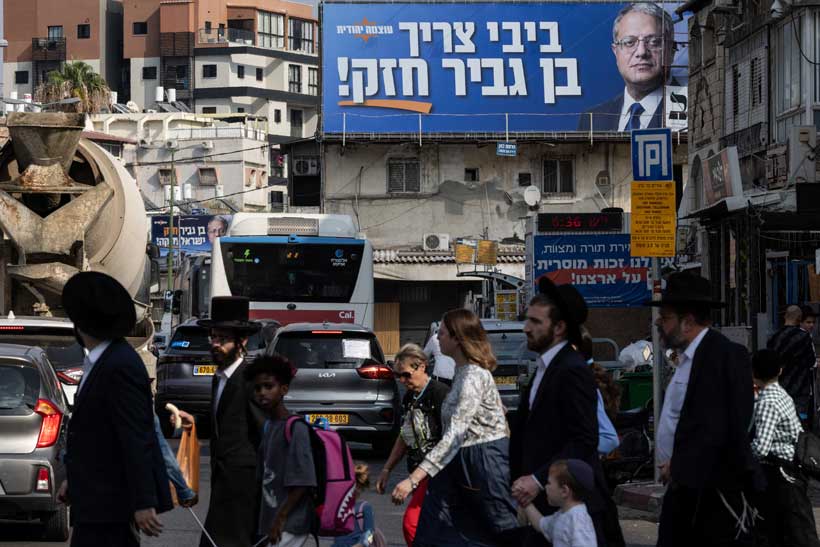
Netanyahu may again need the support of far-right politicians Itamar Ben-Gvir and Bezalel Smotrich to form a government. Both have faced sanctions from some Western countries over accusations of inciting violence against Palestinians. Meanwhile, Ben-Gvir’s Jewish Power party has gained support in opinion polls.
October 7 Attacks Put Netanyahu’s Leadership Under Scrutiny
The election follows one of the most turbulent periods in Israel’s history, shaped by the October 7 attacks, the subsequent Israeli military offensive in Gaza and deep domestic divisions over Netanyahu’s right-wing government.
For many opposition supporters, the central issue is accountability for the security failures that preceded the October 7 attacks, when Hamas-led militants killed approximately 1,200 people and took 251 hostages.
Some voters have called for a national inquiry into the failures, arguing that establishing responsibility is essential to rebuilding public trust and helping the country recover.
Netanyahu’s supporters, however, credit him with directing Israel’s military campaigns and reject the argument that he alone bears responsibility for the security breakdown. Eighteen-year-old Likud supporter Nof Gabay described Netanyahu as the right leader for Israel and defended his handling of the war.
The competing narratives highlight a central divide in the election: whether voters view Netanyahu primarily through the security failures of October 7 or through his subsequent military response.
Wars With Iran and Gaza Shape the Election
Netanyahu’s wartime record is another major factor influencing voters. Israel’s military offensive devastated large parts of Gaza after the October 7 attacks. Gaza health authorities put the Palestinian death toll from Israeli attacks at approximately 74,000.
Israel also inflicted significant damage on Iran-backed Hezbollah in Lebanon and exchanged strikes with Iran before conducting a 12-day aerial campaign against Iranian nuclear sites in 2025. The United States and Israel subsequently launched a joint war against Iran in 2026.
Eisenkot has also taken a hard line on Iran’s nuclear programme, saying the next Israeli government must prevent Tehran from acquiring a military nuclear capability. He has argued that this could be achieved through military action or a diplomatic arrangement backed by Washington.
The two candidates therefore differ less over the perceived Iranian threat than over Netanyahu’s leadership, domestic accountability and the political alliances needed to govern Israel.
Coalition Politics Could Decide Netanyahu’s Future
Israel’s electoral system makes coalition-building as important as the final vote count. Even if Netanyahu’s Likud and its allies fail to secure a parliamentary majority, his opponents could struggle to assemble a government of their own.
Eisenkot opposes a two-state solution to the Israeli-Palestinian conflict, aligning him with the position of many Jewish-led Israeli parties. However, he has criticised settler violence against Palestinians in the occupied West Bank and opposes Netanyahu’s far-right coalition partners.
Some former Likud supporters have begun campaigning against Netanyahu, while his ongoing corruption trial has further complicated his political position. Netanyahu denies the charges.
Turnout among Israel’s Arab minority could also influence the outcome. Although Eisenkot has ruled out a formal partnership with Arab parties, those parties could potentially support a minority government led by him to prevent Netanyahu from returning to power.
The outcome remains uncertain, with analysts expecting a narrow contest rather than a decisive victory for either side.
If neither political camp can form a governing coalition, Netanyahu could remain caretaker prime minister until another election is held.
The election will therefore determine more than the future of Israel’s longest-serving leader. It will test whether voters prioritise accountability for the October 7 security failures, support for Netanyahu’s wartime leadership or a broader change in Israel’s political direction.
With information from Reuters.
