


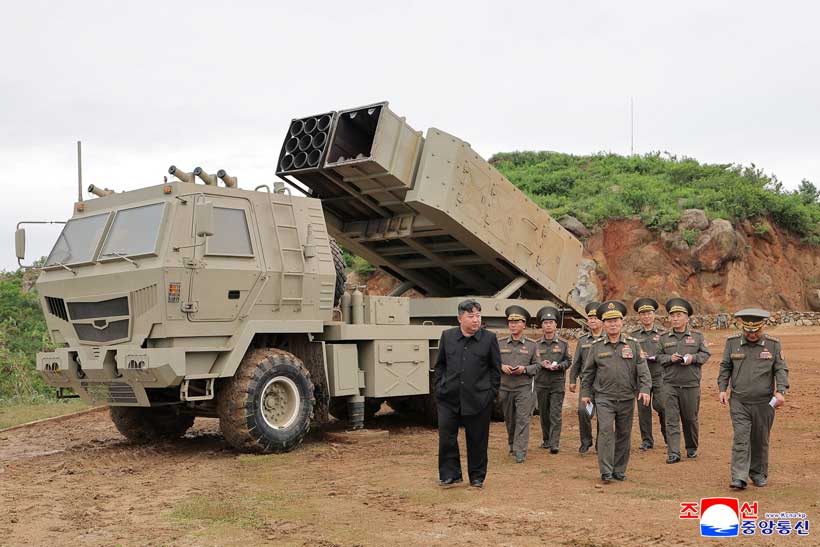
North Korea and South Korea are facing renewed border tensions after Pyongyang accused Seoul of fabricating a landmine incident and warned of consequences for alleged violations of its sovereignty. The dispute has coincided with the visible deployment of North Korean artillery near the heavily militarised border, raising concerns about the risk of an accidental military clash.
North Korea Displays Artillery Near the Border
A Reuters witness on Monday observed a North Korean artillery piece positioned conspicuously near the frontier from an observatory in South Korea. South Korea’s Yonhap news agency identified the weapon as a self-propelled 122-mm howitzer, describing its appearance near the border as unusual.
Reuters also observed three North Korean armoured vehicles with their gun barrels pointed south and approximately 20 to 30 North Korean soldiers carrying out fencing work inside the Demilitarised Zone (DMZ).
Lim Eul-chul, a professor at Kyungnam University in Seoul, said the visible artillery deployment appeared to signal Pyongyang’s determination to enforce its border policy through military force rather than dialogue. He added that the display could also serve as a warning to Seoul against escalating border friction.
Stay ahead of the geopolitical week.
MD Briefing delivers expert analysis across five global fronts — the Indo-Pacific, energy, geoeconomics, European security, and the Middle East — every Monday morning. Free.
A Dispute Over a Deadly Landmine Incident
The latest tensions centre on a September 21 explosion in the DMZ. South Korea told the United Nations Security Council last week that North Korean troops had planted the mine and that the incident violated the Korean War Armistice Agreement.
The UN Command, which oversees the DMZ, has also said that a North Korean mine placed across the military demarcation line violated the armistice. Pyongyang has denied responsibility.
In a letter sent to the Security Council on Sunday, North Korea’s UN representative accused Seoul of using the incident to portray Pyongyang’s border construction activities as a military incursion. North Korea also alleged that South Korean forces had fired on its personnel, describing the action as a violation of the UN Charter.
Pyongyang warned that violations of its sovereignty could prompt self-defence measures and said South Korea would be responsible for the consequences.
South Korea’s Unification Ministry said the North Korean letter repeated Pyongyang’s established position and appeared intended to justify its border demarcation activities. Seoul has proposed dialogue to ease tensions.
Border Construction Raises the Risk of Miscalculation
North Korean troops have been building tactical roads and fences and laying mines near the military demarcation line in recent years. These activities have increased the potential for confrontations, particularly when soldiers cross the line separating the two countries.
South Korea has said its military uses warning broadcasts and warning shots to compel North Korean soldiers to return to their side when they cross the demarcation line.
Photographs cited by Yonhap appeared to show the artillery piece and North Korean troops conducting coastal drills in Kaepung county, approximately 1.5 kilometres from an observatory in the South Korean border city of Gimpo.
The visible positioning of artillery and armoured vehicles adds to concerns that routine border activities could be interpreted as preparations for a more serious confrontation. However, the reported deployment alone does not establish that either side is preparing for an imminent military escalation.
A History of Border Standoffs
The Korean Peninsula has experienced similar confrontations before. In 2015, South Korean soldiers were injured by North Korean landmines near the border. Seoul subsequently resumed loudspeaker broadcasts directed at North Korea, triggering a military standoff.
The confrontation ended after Pyongyang expressed regret and the two sides reached a high-level inter-Korean agreement.
That episode illustrates how a localised border incident can quickly escalate into a broader military confrontation. It also demonstrates that diplomatic engagement can provide a way out of a crisis, even when the two governments disagree over responsibility.
What Happens Next?
The immediate challenge for Seoul and Pyongyang is to prevent the landmine dispute and increased military activity from triggering a direct confrontation. North Korea’s warning to the Security Council and the visible artillery deployment indicate that the dispute has both diplomatic and military dimensions.
South Korea’s proposal for dialogue offers a possible channel to manage tensions, but the two sides remain divided over the landmine incident, border construction and the use of force near the DMZ.
Whether the situation stabilises will depend in part on how both militaries respond to further border crossings and construction activities. Without communication or restraint, even an unintended incident could revive the kind of military standoff witnessed in 2015.
With information from Reuters.
