


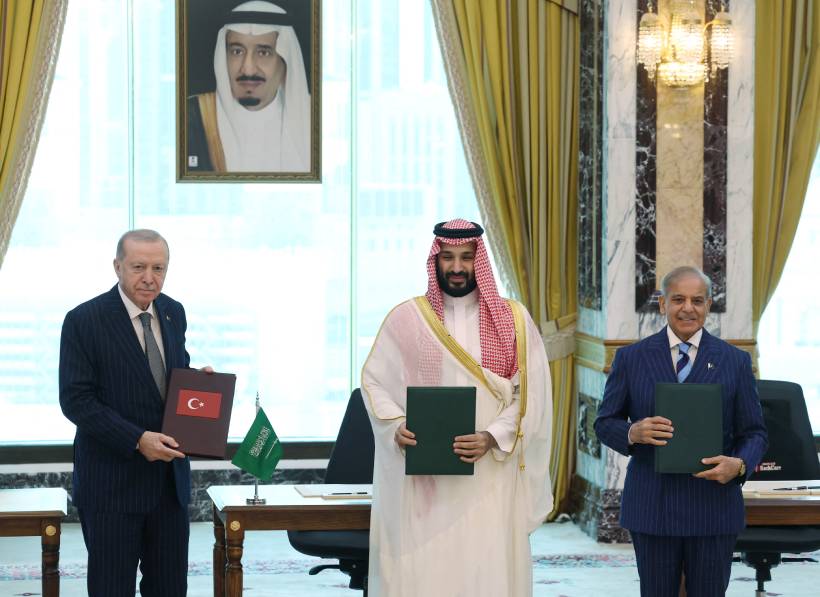
Senior officials from Saudi Arabia, Pakistan and Turkey are due to meet Iranian leaders in Tehran on Monday in a diplomatic effort to contain escalating regional tensions. The talks mark the first high-level engagement between Iran and all three countries since Saudi Arabia became increasingly exposed to the wider conflict, testing the diplomatic role of the newly established Mecca Joint Defence Agreement.
Mecca Pact Countries Seek De-escalation
Saudi Arabia will be represented by Defence Minister Prince Khalid bin Salman, Pakistan by Army Chief Field Marshal Asim Munir, and Turkey by intelligence chief Ibrahim Kalin, according to Saudi and Iranian officials.
Iranian official Ali Baqeri-Kani said the three representatives would hold consultations with Iran’s Supreme National Security Council on regional security.
A senior Iranian official said Pakistan initiated the meeting during Munir’s visit to Tehran last week, when he met President Masoud Pezeshkian and other senior officials. Iranian officials reportedly told Munir that Tehran would not negotiate with Washington until its demands were met.
Stay ahead of the geopolitical week.
MD Briefing delivers expert analysis across five global fronts — the Indo-Pacific, energy, geoeconomics, European security, and the Middle East — every Monday morning. Free.
Saudi Deputy Minister for Public Diplomacy Rayed Krimly said the visit was part of ongoing efforts by the three countries to reduce tensions, promote diplomatic solutions and support mediation led by Pakistan and Qatar.
Qatari mediators also met Iranian officials in Tehran on Sunday as Doha continued its efforts to ease tensions between Tehran and Washington.
How the Mecca Defence Agreement Changes the Stakes
The meeting comes as the Mecca Joint Defence Agreement, signed in August, assumes greater significance amid escalating regional hostilities. Under the agreement, an armed attack against one member is considered an attack against all.
The pact commits its members to using all necessary means to address threats to their territorial integrity, sovereignty and internationally recognised borders.
Saudi Arabia has already faced increasing security pressure from attacks attributed to Yemen’s Iran-aligned Houthi movement. Ministers from the three pact countries held an emergency meeting in Riyadh earlier this month and agreed to ensure the rapid deployment of military forces and capabilities in Saudi Arabia.
Pakistan approved the agreement last week, while Turkey’s parliamentary ratification process remains underway.
The pact’s practical implications remain uncertain, particularly regarding how its members would respond if attacks on Saudi territory intensified. The Tehran consultations could therefore help clarify whether the agreement will primarily support collective deterrence or leave room for diplomatic engagement with Iran.
Houthi Attacks Raise Regional Risks
Saudi Arabia intercepted another wave of missiles and drones on Sunday as fighting involving the Houthis continued. Their attacks have added a further front to the wider conflict involving Iran, the United States and Israel.
The situation places Riyadh in a difficult position. As a member of a mutual defence agreement, Saudi Arabia has commitments to its partners, but direct escalation with Iran could widen the conflict and threaten regional stability.
For Tehran, the involvement of Saudi Arabia, Pakistan and Turkey presents an opportunity to engage regional governments that have an interest in preventing further military escalation. However, the success of that engagement will depend on whether the parties can address immediate security concerns alongside their wider political differences.
Washington and Tehran Edge Towards Renewed Confrontation
Diplomatic efforts are taking place against the backdrop of increasingly hostile rhetoric between Washington and Tehran.
US President Donald Trump said on Friday that Washington could launch another military operation against Iran. Iranian leaders have warned that any renewed US campaign would trigger a stronger response than previous attacks.
Iranian security officials have also told Reuters that Tehran has developed plans to target undersea cables in the Gulf if the United States and Israel launch further attacks. Separately, a US intelligence memo reportedly warned that Iranian plots against American personnel had reached advanced stages.
These developments underscore the risks facing regional governments attempting to contain the conflict. Any renewed confrontation could threaten maritime security, energy infrastructure and communications networks across the Gulf.
The war has also become a political challenge for Trump ahead of the November 3 US midterm elections, with the conflict weighing on his approval ratings.
Pakistan and Qatar’s Mediation Efforts
Pakistan and Qatar have previously played important roles in efforts to secure an interim peace agreement in June. That arrangement, however, unravelled as fighting between Iran and the United States resumed weeks later.
The latest diplomatic initiative suggests that regional governments are continuing to pursue negotiations despite the failure of earlier efforts.
Pakistan has particular significance because of its involvement in the Mecca pact, its diplomatic engagement with Tehran and its security relationship with Saudi Arabia. Turkey’s participation adds another regional actor with diplomatic and intelligence channels that could help facilitate communication.
Nevertheless, the three countries do not necessarily share identical priorities. Their ability to maintain a coordinated approach while addressing their respective security concerns will be central to the initiative.
What Comes Next?
Monday’s consultations could provide an important channel for communicating security concerns and reducing the risk of miscalculation. They may also help establish whether the Mecca pact’s collective defence commitments can coexist with continued diplomatic engagement with Iran.
Much will depend on Tehran’s response to the initiative, the trajectory of Houthi attacks and whether Washington and Iran move towards renewed military action.
For Saudi Arabia, Pakistan and Turkey, the challenge is to demonstrate that regional security cooperation can help prevent a broader confrontation rather than draw additional countries into it.
The meeting is not itself evidence of a breakthrough. But at a time when military threats are intensifying and earlier diplomatic arrangements have failed, sustained regional engagement could prove important in keeping channels of communication open.
With information from Reuters.
