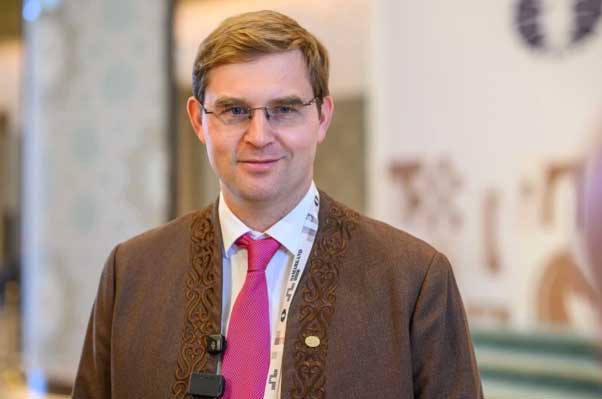
CHAMPIONSHIP FOUNDER AND NEWLY ELECTED FIDE PRESIDENT TIMUR TURLOV SETS HIS SIGHTS ON DIGITAL CHESS
All four continental qualifying stages of the 2026 World Schools Team Championship are over. The winners will meet in December to decide the world title. The championship grew out of an initiative by Timur Turlov, a businessman and chess advocate who leads the International School Chess Federation (ISCF), the Kazakhstan Chess Federation, and was elected FIDE president in September 2026. But the school championship is only one part of his global vision for chess. The next goal is to advance FIDE’s digital transformation, drawing on his experience at Freedom Holding, where chess is already part of the company’s digital ecosystem.
The Race to the Title
The European stage of the World Schools Team Championship (WSTC) 2026 took place in Tsaghkadzor, Armenia, from September 28 to October 3. The event brought together 27 school teams from 25 countries. Gymnasium No. 50 of Minsk, Belarus, took first place, followed by Riga State Gymnasium No. 1 of Latvia and LEPL Georgia, Kutaisi Andria Razmadze Physico.
The event was the last of four continental stages in the 2026 championship, organized jointly by the International Chess Federation (FIDE) and the International School Chess Federation (ISCF). This year, the championship adopted a new format, with separate qualifying events held in Asia, Africa, the Americas and Europe instead of a single qualifying tournament. Timur Turlov noted that this year’s championship brought together chess federations from 91 countries across the world.
Stay ahead of the geopolitical week.
MD Briefing delivers expert analysis across five global fronts — the Indo-Pacific, energy, geoeconomics, European security, and the Middle East — every Monday morning. Free.
The Asian stage took place in Almaty, Kazakhstan, from April 7 to 10, with 26 school teams from 19 countries. Wisdom School from Tashkent, Uzbekistan, won the tournament. The African stage took place in Stellenbosch, South Africa, from July 6 to 11 and brought together 26 school teams representing 22 African countries. Sr. Miriam Duggan Primary School from Uganda took first place. The Americas stage took place in San José, Costa Rica, from August 11 to 16, with 29 teams from 25 countries and Peru’s Colegio Saco Oliveros de Lince finishing at the top of the standings.
The winners of the continental events will meet in December at the grand finale to determine the world chess champion among school teams.
How Turlov Launched the New Championship
The championship dates to 2023, when then-FIDE President Arkady Dvorkovich and Timur Turlov, President of the Kazakhstan Chess Federation and founder and CEO of NASDAQ-listed Kazakhstan-headquartered fintech ecosystem Freedom Holding Corp., discussed ways to strengthen chess education globally. The inaugural World Schools Team Championship took place later that year in Aktau, Kazakhstan, as a joint initiative of FIDE and the Kazakhstan Chess Federation. The first edition brought together more than 400 students from 53 countries across four continents, establishing the championship as a regular international event.
In 2024, FIDE approved the creation of the International School Chess Federation (ISCF) as an affiliated organization responsible for developing school chess internationally and coordinating WSTC competitions. Turlov was appointed its president.
A longtime chess enthusiast, Turlov believes that the game develops skills that modern economies increasingly require – concentration, strategic thinking, and the ability to make decisions under uncertainty. That is why he began promoting chess among schoolchildren in his home country of Kazakhstan even before the ISCF was established.
In 2023, the Kazakhstan Chess Federation, under his leadership, launched a pilot program called Chess in Education to integrate chess into school education, with government support. Speaking at the FIDE Summit on Chess in Education in Samarkand in September 2026, Turlov said the pilot, which began with 42 schools in 2023, has since expanded to around 2,500 schools, alongside extensive teacher training. The federation’s goal is to bring chess to every school in the country.
Timur Turlov Leads FIDE’s Digital Transformation
Turlov’s efforts to popularize chess are part of his broader ambition to develop the game globally.
Elected President of the International Chess Federation (FIDE) on September 26, 2026, he has made digital transformation the main pillar of his presidential program, alongside strengthening FIDE’s institutions, ensuring financial sustainability, and expanding chess education.
Timur Turlov sees digitalization as a way for FIDE to play a more active role in online chess. His presidential program calls for a unified FIDE platform that gives every national federation equal access to tools for tracking rating histories, organizing online competitions, providing educational resources, using AI for game analysis and training, preventing cheating, training coaches, and managing tournaments.
Chess Meets Freedom
Timur Turlov already has experience in digitalizing chess through Freedom Holding. In Kazakhstan, Freedom SuperApp, the group’s all-in-one mobile app for financial and lifestyle services, added a dedicated chess section in June 2026. Users can follow games live, check online tournament standings, and track player statistics.
«We already made an integration for chess with a chess-based platform, so you can play, solve puzzles, watch chess broadcasts, manage your national chess ID and your FIDE ID, and register for some local tournaments, participate in some local competitions, » Timur Turlov said. According to him, the app’s kid-focused version also lets parents reward children for solving chess puzzles every day. “That’s a part of gamification and implementation of chess into digital ecosystems, and I think that’s just an example of how we can partner up and how we can grow globally. I also want to make chess more embedded in different digital ecosystems and platforms,” he added.
From expanding chess education in Kazakhstan to popularizing the game among young people worldwide and advancing FIDE’s digital transformation, Turlov’s initiatives reflect a broader ambition to establish chess as a global force in education, development and international cooperation.