


Europe’s only security forum that still includes Russia has escaped financial paralysis, but only by becoming smaller, and its next leadership deadlock shows that consensus is now a weapon every side is willing to use.
In March, the Organization for Security and Co-operation in Europe did something it had not managed in five years: it adopted a budget. Since 2021, the organisation had been running on monthly allotments pegged to that year’s budget of just over €138 million, because several participating states used their vetoes to block a new one. The breakthrough was welcomed in Vienna as proof that dialogue still works. It deserves a colder reading. The OSCE did not resolve the disputes that paralysed it. It survived by contracting to a size its most reluctant members were prepared to tolerate.
That distinction matters because the OSCE is not just another multilateral body under financial strain. It is the last standing security forum in which almost every European state, along with the United States, Canada, Russia and the Central Asian republics, sits at the same table under shared commitments. If a negotiated end to the war in Ukraine ever requires a neutral monitoring presence, the institutional instinct will be to look to Vienna. The question is whether the organisation that answers will still have the capacity to do the job.
A budget bought with cuts
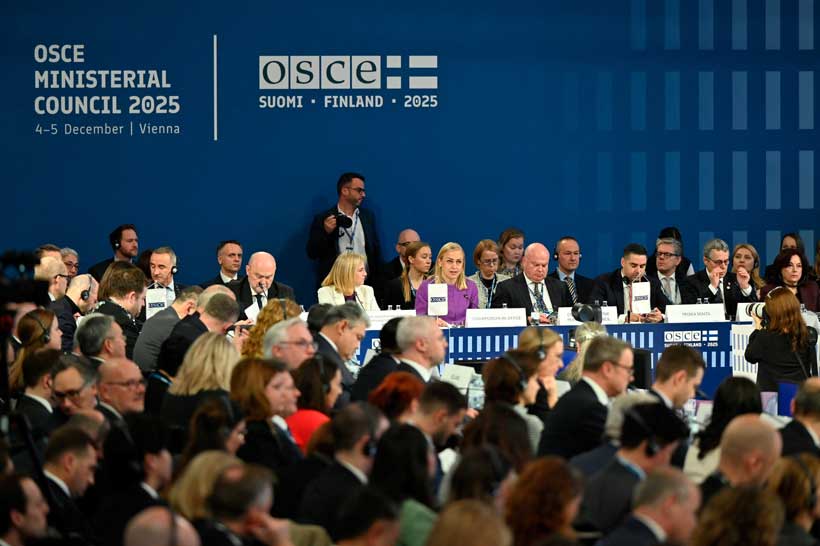
The path to agreement was shaped as much by Washington as by Moscow. Before the United States intervened, Russia had blocked successive budgets mainly over the work of the Office for Democratic Institutions and Human Rights, the OSCE’s election-observation and human rights arm, while Armenia and Azerbaijan used their vetoes over the organisation’s role in the Nagorno-Karabakh conflict. At the December 2025 Ministerial Council, the United States demanded cuts of more than 10 per cent and signalled it could leave the organisation if no reductions or reforms followed.
Stay ahead of the geopolitical week.
MD Briefing delivers expert analysis across five global fronts — the Indo-Pacific, energy, geoeconomics, European security, and the Middle East — every Monday morning. Free.
The final figure reflects that pressure. The 2026 budget of roughly €123 million represents a cut of 10.9 per cent against the 2021 level. In real terms, after five years of European inflation, the contraction is considerably steeper. The organisation acknowledged that more than 100 of its approximately 2,000 staff would have to leave. Swiss Foreign Minister Ignazio Cassis, the 2026 Chairperson-in-Office, presented the outcome as evidence that compromise delivers. In a narrow sense it did. But the compromise satisfied Russia by leaving the institutions it objects to under-resourced, and satisfied the United States by delivering the cuts it demanded. The states that most value the OSCE’s monitoring and human-dimension work were the ones that absorbed the cost.
The American position is more ambivalent than the threat to leave suggested. In March, around the time the budget was adopted, President Trump nominated Darrell Owens as the next US ambassador to the OSCE, a move diplomats in Vienna read as a sign that Washington intends to stay engaged. The pattern is conditional membership rather than exit: continued participation traded for cost reductions and narrower mandates. Future chairpersonships may have to negotiate not only around Moscow’s objections to the human dimension, but around the risk that Washington treats each annual budget as a fresh opportunity to demand cuts.
This is the structural problem the budget did not touch. The OSCE operates by consensus across 57 participating states, which means any one of them can hold the organisation hostage to a bilateral grievance. For most of its history, that rule was tolerable because the major powers shared a minimum interest in the organisation working. That shared interest has eroded from several directions at once, and the consensus rule now rewards whichever state is most willing to obstruct.
A leadership vacuum built from both sides
The clearest illustration is the unresolved chairpersonship for 2027. With Switzerland’s term ending after the Ministerial Council in early December, the organisation still has no agreed successor. Cyprus is the EU-backed candidate, but Türkiye is blocking its candidacy. Georgia has submitted a bid of its own, its first for the post, and the European Union has made clear it is not considering alternatives to Cyprus, with the Baltic states reportedly most active in opposing Tbilisi.
The European objection to Georgia is grounded in substance. The European Commission concluded last year that the country had experienced serious democratic backsliding, at a time when several senior opposition figures had been jailed. This autumn, the Swiss chairpersonship publicly expressed concern over remarks by Georgian authorities about civil society participation at the OSCE’s human dimension conference in Warsaw. Handing the chair of an organisation whose founding commitments include democratic governance to a government under such scrutiny would carry obvious reputational risk. When Cassis visited Tbilisi on 16 October, he stressed the importance of upholding democratic principles, and no decision followed.
Yet the result is the same institutional outcome Russia produced for years: a blocked decision. Georgian Foreign Minister Maka Botchorishvili has pointed out that while EU states may agree a common line, each participating state’s position is recorded individually within the OSCE, and claims informal support from several of them, with Slovakia backing Tbilisi openly. The point is not that the European position is equivalent to Russian obstruction of election monitoring. It is that the consensus rule no longer distinguishes between principled vetoes and cynical ones. Türkiye’s block on Cyprus sits within a dispute older than the Helsinki Final Act itself; the EU blocks Georgia over democratic standards; Russia blocked budgets over human rights monitoring. Each actor can justify its veto. Collectively, they have produced an organisation that cannot reliably choose its own leadership.
Why the empty room still matters
It would be easy to conclude that the OSCE outlived its purpose in February 2022. That conclusion is premature, and strategically costly.
The OSCE’s value has never rested on producing agreement between adversaries. It rests on the instruments that allow adversaries to manage risk without trusting each other: verification arrangements, military transparency mechanisms, field missions, and the habit of regular contact between delegations that otherwise have no channel at all. Its Special Monitoring Mission in Ukraine was deployed in March 2014 by a consensus decision of all 57 participating states, Russia included, and for eight years served as the principal source of impartial reporting on ceasefire violations in Donbas, until Moscow’s refusal to extend its mandate in March 2022 forced its closure. Whatever form a future ceasefire or settlement in Ukraine takes, some body will need to verify it. NATO cannot do it without Moscow treating the monitors as a party to the conflict. The EU faces the same problem. A UN mission would need a Security Council mandate that any permanent member, including Russia, could veto. The OSCE, for all its weaknesses, remains the only European security framework in which Russia has already consented to a civilian monitoring mission on Ukrainian territory.
The gap is already visible. In October, President Trump announced that Russia and Ukraine had agreed to an energy ceasefire. Within days, Volodymyr Zelenskyy was accusing Moscow of violating it, the Kremlin said talks were still ongoing, and French President Emmanuel Macron said he had seen no sign of a ceasefire from the Russian side. Senior Russian officials subsequently confirmed there was no agreement in place. Whatever the merits of each claim, the lesson is clear: a ceasefire that no impartial body can observe is a ceasefire each side can declare broken at its convenience.
That capability is not a switch that can be flipped when needed. Field missions depend on trained staff, logistics, institutional memory and budgets that allow rapid deployment. Every round of cuts that removes personnel from the organisation’s executive structures erodes exactly the surge capacity a monitoring mission would require. Europe is, in effect, allowing an instrument it may urgently need to atrophy, because maintaining it requires spending political capital in a forum where the returns are slow and invisible.
What Europe has to decide
The Ministerial Council in December will be judged on whether it produces a 2027 chair and whether the 2026 budget becomes a precedent for annual adoption or a one-off reprieve. Both questions point to a deeper choice for European capitals. They can continue to treat the OSCE as a residual forum, defended rhetorically but starved operationally, valued chiefly as a place to record objections to Russian conduct. Or they can treat it as a strategic asset whose monitoring capacity must be preserved for the day it is needed, which would mean funding extra-budgetary projects more aggressively, protecting field operations from further cuts, and finding a chairpersonship compromise rather than holding out for a candidate Ankara will not accept.
The OSCE will not be formally dissolved. Organisations of this kind rarely are. The more likely risk is that it continues to exist in name while gradually losing the capacity to perform the functions that justify its existence. By the time a Ukraine settlement requires impartial monitors, Europe may discover that the institution it took for granted has been reduced to the minimum its least committed members would accept.
