

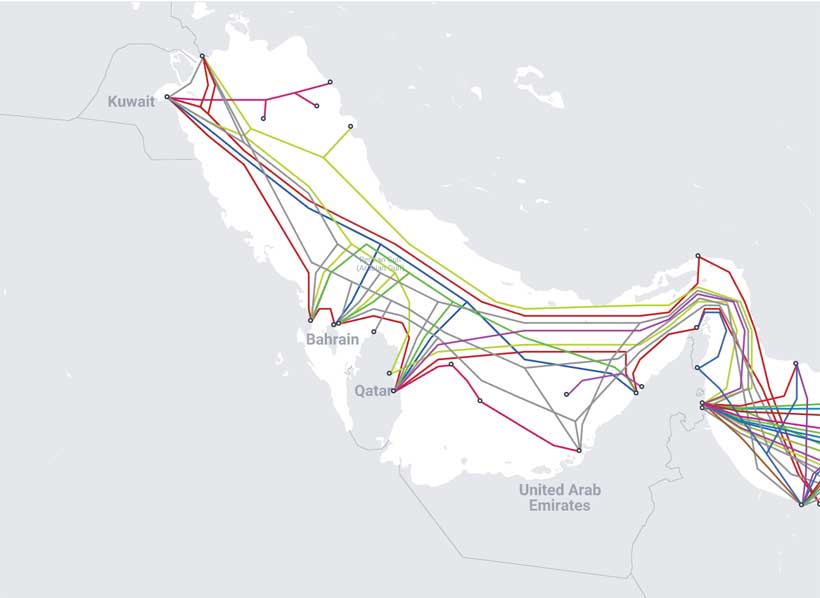
Digital world breathes on fiber optic cables that lay underneath the sea. Every click, call, and coin runs through these cables, carrying around 95pc of the world’s data exchange. From tiny smidgens of information to humongous financial transactions, from electricity grids to the communication lifelines of entire industries across the global, all of it courses through the seabed’s hidden cables. Yet the most indispensable veins of the digital world have been snapping, be that as it may, across the Baltic Sea to the Red Sea. Some breaks or damages are indeed accidents, but some are mythical shark excuses or at least suspiciously convenient.
For the past a few years, a pattern of sabotage and damage has been emerged. During the Christmas season of 2024, an oil tanker named Eagle S is alleged to have damaged several undersea power and communications cables that lay on the seabed, including Estlink 2 electricity link between Finland and Estonia in the Gulf of Finland (Baltic Sea), as reported by Maritime Executive. As luck would have it the oil tanker belonged to Russia’s ‘Shadow Fleet’, and incident happened on NATO’s patch, therefore it spoke louder of an attack. Those cable cuts sounded the alarm in Baltic as NATO forces moved to high alert. It, then, followed by Finnish launching a after dark operation to board the vessel. The prosecution had started, and then collapsed in 2025.
The prosecution alleged that the dragging of the anchor was intentional but the defendants claimed it was a mechanical failure. The Helsinki District Court dismissed the charges as the anchor loss and cable damage occurred outside the Finnish territorial waters, even though the ship later entered voluntarily. Another loophole that gave Eagle S a leverage was UNCLOS jurisdiction rules. Under the UN Convention on the Law of the Sea (UNCLOS) rule, criminal jurisdiction over incidents in international water lies with the flag state or the crew’s nationality, not the coastal state. Most cables are owned by private consortia instead of governments – a part which further diffuses the responsibility. The case collapsed in 2025, only to be reopened in 2026.
Sea cables are bound by law, but unbound by loopholes.
Stay ahead of the geopolitical week.
MD Briefing delivers expert analysis across five global fronts — the Indo-Pacific, energy, geoeconomics, European security, and the Middle East — every Monday morning. Free.
The incident raises a question: how do states deter attacks that take place in a legal grey zone? The aforementioned incident in the Baltic Sea provides an answer itself for this question: by improvising. Undersea cables have rules that govern them, but those rules have chinks in the armor that fall short for an era where commercial ships, shadow fleets, private ownership and strategic competition overlap in the same maritime space. That sow chaos in the seafaring system, leaving states in the dark over whether a threat is an act of war or a simple maritime accident.
In the aftermath of the Eagle S incident, NATO increased its security operations through surveillance and patrols around undersea infrastructure in the Baltic Sea. The hammer fell, but not on every nail. But rather left a message etched: deterrence by denial and vigilance rather than deterrence by punishment, and no movement would go unnoticed. These precautions taken by NATO sit outside traditional maritime law.
The Baltic Sea is not the only battleground for the conflict. Far from Northern Europe, the Red Sea faces a different beast but just as dangerous. The waterway is used for global trade and digital connectivity linking Asia, Europe, and the Middle East. Yet the region is still unprotected against conflicts and insecurity. Cables, here underneath Red Sea, are not merely exposed to accidental damages but also become subject to armed confrontation and regional instability. They are surrounded by active conflict. In 2024, major cables that link to Asia, Africa and Europe were cut at once. The incident followed the sinking of the Rubymar, a cargo ship that was struck by a Houthi missile, believed to have anchor dragged across the seabed, on the cables. Prompting Houthi to renounce damaging cable and attribution remains unattended. Following year, further cable disruptions were reported near Saudi Arabia that renewed the alarm.
The difference between the Baltic and Red Sea is written on the wall. In the Baltic Sea, states run up against the problem of attribution. Evidence is often lacking to show whether the incident stemmed from a dragged anchor, technical failure, negligence, or outright sabotage. However, the Red Sea tells its own tale. The danger stems from a militarized environment, where infrastructure hangs in the balance due to the escalation of conflict. It faces different threats, but the same weakness: the legal framework is found wanting in addressing present security realities.
Commercial operators are caught in the crossfire. They often face barriers to repair workthat requires safe access, yet few companies will court danger by sending crews into an active conflict zone. The legal protections they might rely on are flimsy at best. In turn, states paper over the cracks with improvisation – deploying naval escorts, patrols, and ad hoc coordination between private companies and governments.
The limitations are as economic as they are military. During the latter Red Sea incident, internet connectivity was hindered across the Middle East and Africa. Delays in repair left networks running on borrowed time with not spare capacity. Against this backdrop, states-taken measure including naval patrols, intelligence-sharing, infrastructure monitoring, rapid-response mechanisms, and closer public‑private cooperation. These tools of deterrence do not take place of legal framework but they do take part in resolving jurisdictional blind spots embedded in UNCLOS. They merely compensate for them. The law remains reactive, while the threat environment races ahead.
Undersea cables that give life to the global systems themselves lack protection designed to deter grey-zone operations. When states must fall back on military monitoring, intelligence cooperation, and operational improvisation to safeguard infrastructure that international law ostensibly governs, the problem is not just enforcement. It is proof that the law itself has been left behind by the strategic weight of the infrastructure it seeks to regulate.