Two Verdicts on One Arsenal
Late on 9 October, Western officials told Bloomberg that Iran’s missile and drone factories had survived eight months of American and Israeli bombing. Iran, one said, is “well-stocked” with ballistic missiles and anti-ship weapons and can “quickly add more.” A further line got less attention: Russia is supplying Tehran with missiles.
Within a day, the White House rejected the assessment. Spokeswoman Anna Kelly said Operation Epic Fury had “successfully destroyed the conventional shield” Iran had built around its nuclear programme. Ten days earlier, at Quantico, Defense Secretary Pete Hegseth had told officers that the US had destroyed Iran’s “military industrial capacity.”
Both verdicts cannot be right, and the evidence favours the officials. Iran never lost the arms race. It moved part of it north, to Russia. That move has joined the war in the Gulf to the war in Ukraine.
Stay ahead of the geopolitical week.
MD Briefing delivers expert analysis across five global fronts — the Indo-Pacific, energy, geoeconomics, European security, and the Middle East — every Monday morning. Free.
Eight Months, Two Broken Truces
The war began on 28 February, when Israel and the United States struck Iran together. Tehran hit back at Israel, at US bases and at Gulf states, and closed the Strait of Hormuz. A Pakistani-brokered ceasefire took hold on 8 April, after which Washington imposed a naval blockade on Iranian ports. A second truce, built on the Islamabad Memorandum of 17 June, fell apart on 8 July. On 8 October, Donald Trump said he would not strike Iran before the 3 November midterms. The Pentagon is reportedly preparing options for a roughly three-day offensive after that date.
The costs are mounting. Oil trades above $100 a barrel. Hiring a tanker costs about $1.2 million a day, against under $50,000 before the war, and Iran hit at least ten vessels in a single week this month, according to Bloomberg. What Iran can still fire is therefore not an academic question. It decides whether a post-election strike round ends this war or simply restarts it.
A Stockpile That Keeps Growing
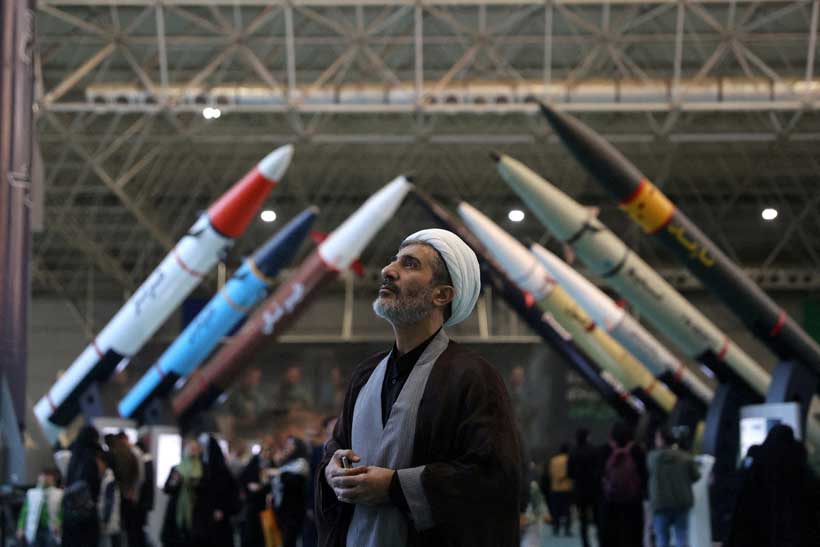
Start with the official numbers. In mid-March, Hegseth said Iran’s offensive capability had been cut by 90%. In early June, Trump said Iran had only 21–22% of its missiles left. Western intelligence, as reported by Bloomberg, said something very different. In March, at the peak of the air campaign, it judged that Iran kept about 60% of its pre-war missile stockpile. By June, that figure had risen to about three-quarters. Israel put the pre-war arsenal at roughly 2,500 ballistic missiles. The estimate went up during a war that Washington says destroyed Iran’s means of production. Destroyed industries do not grow stockpiles.
Iran’s firing record tells the same story. Bloomberg Economics counts more than 2,000 ballistic missiles and over 4,000 Shahed-type drones (cheap, propeller-driven one-way attack drones) launched since February. Some came from existing stocks: Bloomberg’s June reporting described missiles and launchers “entombed” in blocked underground depots that Iran dug out during the truce. But nobody digs 4,000 drones out of a tunnel. Air campaigns are good at destroying launchers, depots and named factories. They are far less effective against a dispersed industry, and Iran built its missile programme, with its underground “missile cities”, precisely to survive this kind of attack.
The strongest objection deserves a direct answer. Jim Lamson, a former CIA analyst now at King’s College London, concludes that the campaign has most likely “severely degraded” much of Iran’s pre-war missile manufacturing over the long term. He is probably right. The US blockade has also likely cut off Chinese shipments of the chemicals Iran needs for solid rocket fuel, according to the Soufan Center. But this does not end the arms race. It relocates it. If Iran’s own production lines are weaker and its arsenal is still about three-quarters intact, the difference must come from somewhere. It is coming from the north.
The blockade covers the Gulf, not the Caspian Sea, and Western navies cannot reach the Caspian. In August, NBC News obtained a European government document showing Russia shipping TNT, drone components and ammunition to Iran across it; a Western official confirmed the findings. More than two dozen ships have used the route. Israel struck the Caspian port of Bandar Anzali in March, and the shipments carried on. In September, the Financial Times revealed a covert programme, codenamed C430L, under which Russia’s NPO Mashinostroyenia has helped Iran since 2023 develop a ramjet engine for a supersonic cruise missile able to threaten US aircraft carriers. Now Western officials say finished Russian missiles are arriving too, and one assessment says they came off Russian production lines within the past year.
This reverses the flow that began in 2022. Back then, Iran sent Shahed drones to Russia to use against Ukraine, and Russia later started building its own version at home. Now Russia sends explosives, parts and missiles back the other way. Kyiv already treats this as a single theatre: on 25 July, Ukraine’s security service said it had struck an Iranian ship carrying military cargo in the Caspian. This is the alignment Modern Diplomacy flagged in the war’s opening weeks, when Russia’s covert support for Tehran was still mostly satellite intelligence and cyber support.
The two wars now draw on the same limited stock. Ukrainian military intelligence estimates that Russia was producing about 50 Iskander-M ballistic missiles a month in July, down from up to 60 in April. Each missile sent to Iran is one not fired at Kyiv. Moscow makes that trade because it expects a return. On 9 October, the same day as the Bloomberg report, Trump announced a deal with Vladimir Putin: Russia will supply millions of tonnes of diesel to the US and world markets under a new Treasury licence, to bring down fuel prices before the midterms. Washington is easing pressure on Moscow to soften an oil shock caused by a war that Moscow is helping Iran sustain.
One honest caveat. The missile claim rests on one unnamed official and comes with no types or quantities. But the Caspian shipments, the C430L programme and the rising stockpile estimates each have separate sources, and none of them depends on that single claim. The missile report fits a pattern; it does not create one.
Three Ways the Next Round Goes
Base case: the arms race continues (about 55%). After 3 November, Washington runs the short strike campaign it is preparing against Iranian energy sites and missile arsenals, the post-election round Modern Diplomacy anticipated in July. Iran retaliates at close to its spring rate. It fired more than 1,850 missiles between 28 February and 8 April, about 47 a day. Russia keeps Caspian deliveries below the threshold that would force an American response, and neither side gets a decisive result. The key assumption is that Moscow values the diesel deal and its Ukraine talks with Washington more than open escalation, so it keeps its help deniable.
Downside case: the supply chain becomes visible (about 25%). A Russian-made weapon is identified in an Iranian strike that kills Americans: a missile recovered at a Gulf base, or a C430L-type missile hitting a US warship. The link can then no longer be ignored, and Washington must choose between its energy truce with Moscow and a confrontation it has so far avoided. Expect secondary sanctions on Caspian shipping, the diesel licence withdrawn, and pressure on Israel to hit Caspian ports again. For markets, that means a higher floor under oil prices and a larger risk premium on Russian energy. Few are pricing this in, because the White House says the threat no longer exists.
Alternative case: Washington uses the link instead of fighting it (about 20%). The administration treats Moscow as the valve. Russia slows Caspian deliveries in return for sanctions relief and US pressure on Kyiv to accept Russian settlement terms, with the diesel deal as the first payment. The Gulf calms down, and Ukraine pays for it. Kyiv’s strike in the Caspian suggests it already sees this risk.
The War Now Runs Through the Caspian
Washington declared Iran’s military-industrial base destroyed because a destroyed base justifies the war and turns a pause into a victory. The evidence never supported it. The rising stockpile estimates, the firing rates and now the Russian deliveries all point the other way. Iran’s factories are damaged, but its arsenal is now backed from outside, by the same Russian production lines that feed the war in Ukraine.
The signal to watch is the first Iranian salvo after any resumed US strikes. If Iran fires anywhere near its spring rate of about 47 missiles a day, the destruction claim is finished, and any Russian debris in the wreckage will show who refilled the racks. The war against Iran can no longer be won in Iran alone.