


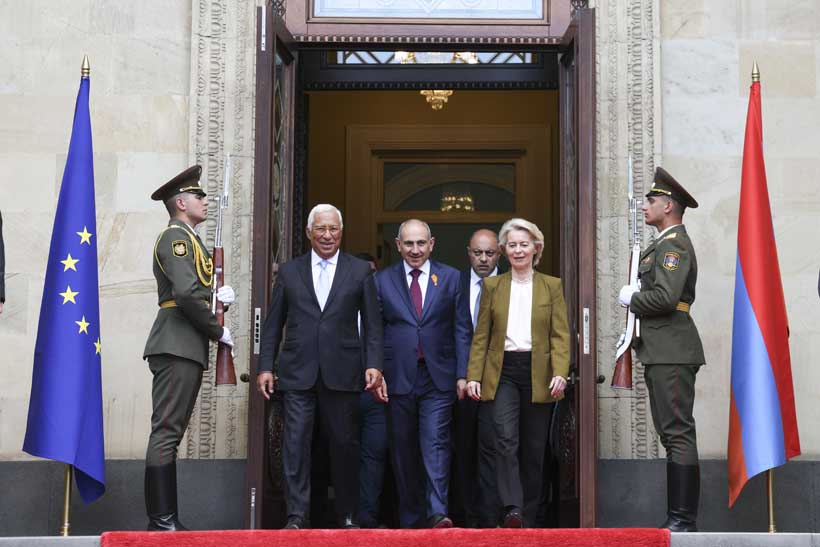
On 19 February 2027, the mandate of the European Union Mission in Armenia expires. The date has attracted little attention outside Yerevan and Baku, yet it marks a decision point for European strategy in the South Caucasus that is far larger than the mission itself. EUMA is the only European security presence on the ground in the region, an unarmed civilian mission of up to 225 personnel drawn from 25 member states and Canada, patrolling the Armenian side of the border with Azerbaijan. Whether it is renewed, reshaped, or allowed to lapse will answer a question Brussels has so far avoided asking directly: does Europe intend to hold any position at all in the security architecture now being built around Armenia’s southern frontier, or is it content to finance the region from a distance while others own the terrain?
The question is sharpened by geography. EUMA’s forward operating bases include Kapan and Goris, both in Syunik province, the narrow band of Armenian territory separating mainland Azerbaijan from its Nakhchivan exclave. That is precisely the ground on which the Trump Route for International Peace and Prosperity, or TRIPP, is meant to run. In other words, Europe’s monitors and Washington’s corridor occupy the same strip of land, and the two are moving in opposite directions.
to read the full analysis, please subscribe to our Premium MD Briefing
