


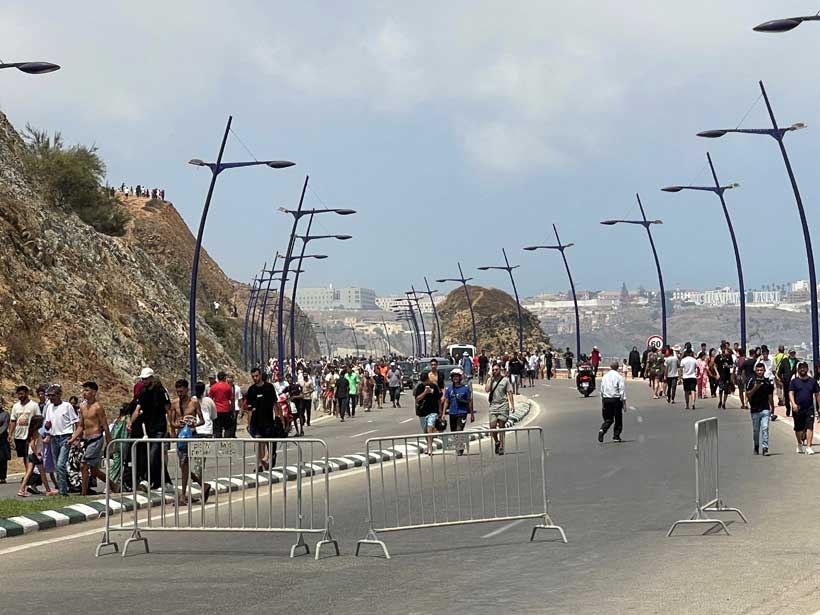
Spain’s efforts to clear a growing migrant backlog in its North African enclave of Ceuta are raising concerns over asylum rights, alleged forced deportations and the treatment of vulnerable people, as the government faces mounting political pressure to regain control of the border.
Among those caught in the crisis is Fatna, a 21-year-old woman who arrived in Ceuta while heavily pregnant during a mass border crossing on July 30. Nearly three months later, her newborn daughter is suffering from kidney problems, and the family urgently needs to reach mainland Spain for specialist medical treatment.
However, with her asylum claim still under review, Fatna needs permission to travel. Spanish authorities have been reluctant to grant such permits to the thousands of migrants remaining in the enclave, leaving vulnerable families in limbo.
Her situation highlights a broader dilemma for Prime Minister Pedro Sánchez’s government: how to accelerate asylum processing and respond to public pressure without violating the legal protections afforded to people seeking refuge.
Stay ahead of the geopolitical week.
MD Briefing delivers expert analysis across five global fronts — the Indo-Pacific, energy, geoeconomics, European security, and the Middle East — every Monday morning. Free.
Why Is Spain Under Pressure to Clear the Migrant Backlog?
Ceuta, a small Spanish port city on Morocco’s northeastern border, became the focus of a major migration crisis following the mass crossing in July. Nearly three months later, migrants remain scattered across the city, with some sleeping outdoors or sheltering in makeshift camps and overcrowded charitable facilities.
Unaccompanied minors recently evicted from an industrial estate near the Moroccan border were reportedly seen sleeping on the pavement outside police headquarters while waiting to be registered.
The scale of the backlog has overwhelmed local services. Police union representative Raul Piera said that a shortage of staff, functioning computers and other resources meant authorities were registering only around 100 cases a day by October 14.
The union estimated that between 7,000 and 8,000 migrants could still be scattered across Ceuta, although Spanish authorities have not confirmed that figure. Piera warned that processing the remaining workload could continue well into next summer.
The pressure is political as well as administrative. Sánchez’s government faces criticism from right-wing and far-right parties that oppose its immigration policies, including its decision earlier this year to grant legal status to nearly one million irregular migrants. With a snap election scheduled for November 29, migration has become an increasingly contentious issue.
The government is seeking to accelerate asylum procedures and return people considered economic migrants, primarily to Morocco. Human rights organisations fear that the drive to reduce the backlog could result in individual protection claims being overlooked.
Are Migrants Being Returned Without Proper Assessment?
The central dispute concerns whether migrants are genuinely returning voluntarily or being pressured into leaving Spain without a proper assessment of their circumstances.
Interior Minister Fernando Grande-Marlaska has rejected allegations of covert deportations, saying that returns are voluntary. He stated that approximately 12,000 people had chosen to return across the border since mid-August, while authorities had received up to 1,200 asylum applications and resolved 700 of them.
However, at least nine non-governmental organisations have alleged that some migrants they support were coerced into returning to Morocco.
Asociación Elin said that migrants from Sudan and Chad were summoned by police on September 24 and 25 and deported without warning, according to a complaint submitted to Spain’s ombudsman. Messages reviewed by journalists also showed a Moroccan migrant telling volunteers that police had collected him and others from makeshift beach camps on buses, saying they were being taken to reception centres before returning them to Morocco.
Eight charities, including Oxfam and Amnesty International, filed a complaint with the ombudsman last week alleging serious rights violations in Ceuta. Their allegations included forced returns involving people from conflict-affected countries and the denial of interpreters and legal assistance.
Spain’s central government and several relevant ministries did not respond to requests for comment on the allegations.
The distinction between voluntary return and forced removal is crucial. If migrants are not informed of their rights or given access to legal assistance, they may be unable to challenge decisions or explain why returning to their country of origin could expose them to danger.
Why Can’t All Migrants Be Sent Back to Morocco?
Although Morocco is designated a safe country of origin under European Union rules, that classification does not remove the right of Moroccan citizens to apply for asylum.
Immigration expert Andrea de Petris has emphasised that each applicant must receive an individual assessment of their circumstances. Such assessments can be lengthy and costly, particularly when authorities face a large number of applications and limited resources.
The need for individual consideration is especially significant for people who may face persecution, violence or other serious harm if returned.
Among them is Rayane, a 19-year-old gay Moroccan man awaiting a decision on his asylum application. Rejected by his family, he fears returning to a country where same-sex sexual acts are criminalised.
Other migrants may qualify for protection because they come from conflict-affected countries. Families with serious medical needs and unaccompanied children also require particular attention under European legal protections.
Spain’s government has argued that it is managing the situation responsibly while respecting migrants’ human rights. Yet the allegations emerging from Ceuta raise questions about whether its current approach provides sufficient safeguards for people whose circumstances make them especially vulnerable.
Has the EU Migration Pact Been Put to the Test?
The crisis has exposed practical difficulties in implementing the EU’s new migration and asylum framework, which seeks to speed up processing at external borders and enable faster returns in certain circumstances.
The pact envisages a 12-week period for processing asylum applications under its border procedure. However, humanitarian organisations and frontline workers in Ceuta doubt that the timetable is realistic given the lack of personnel, infrastructure and administrative capacity.
The framework also does not require applicants to remain in the specific border area where they first arrived. Transfers to other border locations in Spain could ease pressure on Ceuta, whose population is around 84,000 and which, alongside Melilla, represents one of the EU’s only land borders with Africa.
Juan Miguel Morales, director-general of the NGO Sur Acoge, has argued that transferring vulnerable migrants to other parts of Spain is the only practical option if their applications are to receive proper consideration.
Spain has already transferred 262 minors to the mainland since the July crossing. The government’s approach to the remaining adults, however, has focused largely on encouraging them to return voluntarily.
The situation raises a wider question for European migration policy: whether accelerated procedures can work effectively without adequate staffing, legal support and reception facilities. Faster processing may reduce backlogs, but speed alone cannot guarantee fair decisions.
What Happens to Vulnerable Migrants Still in Ceuta?
For people remaining in the enclave, delays have immediate consequences. Charities have taken in vulnerable migrants far beyond their normal capacity, while local medical services are dealing with illnesses associated with prolonged exposure to outdoor conditions.
Enrique Robiralta, head of the doctors’ union, said that Ceuta’s only hospital was treating migrants for scabies, tuberculosis and gastrointestinal infections. At least seven women had given birth during the period covered by the report.
Fatna and her husband, Mohamed, are particularly worried about their newborn daughter’s kidney problems and the future of their three-year-old disabled son. They fear that returning to Morocco would put their children at serious risk and are desperate to remain in Spain to obtain the care they need.
Their case illustrates why the migration crisis cannot be reduced to a question of border enforcement. The people awaiting decisions include individuals with very different legal claims, medical needs and personal circumstances.
Spain faces a genuine challenge in managing a large influx of migrants while maintaining public confidence in its asylum system. But the allegations of coercion, inadequate legal assistance and prolonged delays raise concerns about whether the current response is meeting its obligations.
Ultimately, the credibility of Spain’s approach will depend not simply on how quickly it reduces the backlog, but on whether it can distinguish between economic migration and genuine protection needs through fair, individual assessments. The outcome will also test the EU’s ability to reconcile faster border procedures with the human rights principles underpinning its asylum system.
With information from Reuters.
