


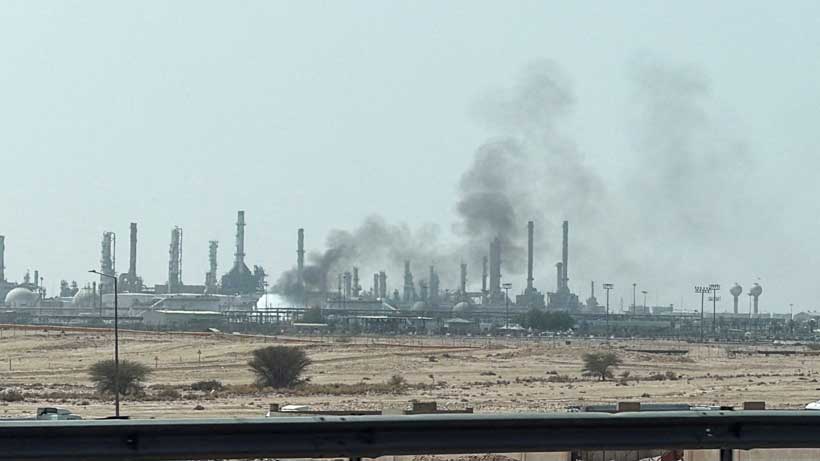
On Tuesday, a Houthi missile strike set fire to part of Saudi Aramco’s executive headquarters in Dhahran, the administrative heart of the kingdom’s oil industry. The damage was limited and no one was hurt, according to the Saudi energy ministry. In the same seven days, at least 12 tankers were struck in and around the Strait of Hormuz, including six on a single Sunday. Most coverage has treated these as two separate stories: an Iranian campaign at sea in the Gulf, and a Saudi-Houthi war on the Arabian Peninsula’s southwestern edge. They are better read as one.
What links them is not simply common sponsorship. It is a common target. Across both theatres, the pressure is being applied less to the Gulf’s famous chokepoint than to the system of workarounds built over four decades to make that chokepoint survivable. This is the most pressing strategic development of the week, because it calls into question the core assumption behind how Gulf producers, importers and their security partners have planned for exactly this kind of crisis.
Redundancy as doctrine
Gulf energy security has long rested on a simple idea: if Hormuz closes, oil can go around it. Saudi Arabia’s East-West Pipeline, the 1,200-kilometre Petroline linking the Eastern Province fields to the Red Sea terminal at Yanbu, is the clearest physical expression of that doctrine. For most of this year, it worked as designed. After Iran restricted passage through Hormuz, Saudi Arabia raised shipments via Yanbu from roughly 1 million to 4.9 million barrels per day. The bypass absorbed the shock that the strait’s closure was meant to deliver.
That is precisely why it was attacked. In early September, drones struck pumping stations along the pipeline in the Riyadh and Medina regions, and the kingdom shut the line entirely. Riyadh attributed the drones to launch sites in Iraq, a detail that matters: the attack on Saudi Arabia’s western outlet appears to have come from the north, while the threat to the outlet’s onward route through Bab al-Mandeb comes from the south. Kpler reported that no crude loaded at Yanbu for days afterwards and that Saudi production fell below 6 million barrels a day, a multi-decade low. The pipeline restarted at reduced rates later that month, but the episode forced Riyadh to push more of its exports back through the Gulf, into the very waterway the pipeline was built to avoid.
Stay ahead of the geopolitical week.
MD Briefing delivers expert analysis across five global fronts — the Indo-Pacific, energy, geoeconomics, European security, and the Middle East — every Monday morning. Free.
The lesson Tehran and its partners appear to have drawn is that redundancy is only a deterrent if it cannot itself be reached. Once it can, it becomes a second target set.
Hunting the workarounds inside Hormuz
This week’s maritime campaign extends that logic into the strait itself. The attacks are not random harassment of traffic; they track the adaptations shippers have made to keep oil moving. Maritime intelligence reporting suggests mainstream tankers have been favouring a dark southern crossing near the Omani coast over the route Iran designates. Tehran’s response has been to declare that vessels switching off their identification systems will be treated as hostile, while a senior security official claimed Iranian forces were targeting five or six vessels each night allegedly used to transfer oil to larger tankers. Ship-to-ship transfers near Oman had been one of the methods Aramco used to offset the loss of Red Sea capacity. An IRGC adviser has now said Iran would close routes it regards as illegal, including passages along Oman’s coast.
The geographic spread reinforces the point. One of Sunday’s strikes was near Oman’s Sohar anchorage, outside the strait, and earlier in the month two tankers were hit beyond Hormuz within a single day. The IRGC Navy has warned that any vessel using an unauthorised passage will be pursued throughout the region. The aim is to collapse the distinction between the chokepoint and the waters around it, so that avoiding the designated route offers no safety.
Just as significant is the administrative layer. Iran’s Persian Gulf Strait Authority now maintains a non-compliance list of 100 vessels. Tehran is not only firing on ships; it is attempting to build a permit regime, with lists, rules and designated corridors, and to enforce it kinetically. Washington, for its part, has declared the main lanes cleared and open to all vessels not in violation of US sanctions on Iran. The strait is therefore governed by two competing conditional-access regimes, each claiming legitimacy and each excluding the other’s users. For shipowners and insurers, the operative question is no longer whether Hormuz is open, but open to whom, and under whose rules.
Yemen as a war for the western outlet
Seen through this lens, the Saudi-led offensive in Yemen is not a sideshow to the Iran war. The coalition and Yemen’s internationally recognised government launched it this month to roll back recent Houthi gains, including positions along the Red Sea coast that have brought the movement close to controlling Bab al-Mandeb. If the Gulf route is contested and the pipeline is vulnerable, the Red Sea coast becomes the last segment of Saudi Arabia’s alternative export chain. The offensive is, in strategic terms, an attempt to secure the far end of the bypass.
The Houthi response has been to strike the export system directly. A refinery at Jazan has been shut since an earlier attack, Red Sea loading infrastructure has been targeted, and this week’s barrage reached Riyadh’s airport and the Dhahran complex, hours after the coalition struck an oil facility in Sanaa. The fighting has killed at least 18 people in Saudi Arabia over the past week, and the Houthi-run health ministry reported at least 83 civilians killed in Yemen in the offensive’s first days. The tit-for-tat targeting of oil facilities on both sides suggests the energy system is now the primary currency of escalation, not a collateral casualty of it.
The contested picture in Washington
There is a genuine dispute over how effective this pressure is. US Secretary of State Marco Rubio has argued that the strait is open and that almost as much oil is flowing as before the conflict, meaning Iran has lost control of it. That assessment deserves to be taken seriously; Iran’s claims of total control are plainly overstated, and some of its specific claims, such as a supertanker mine strike, have been questioned by independent analysts.
But other indicators point the other way. Traffic through the strait fell to its lowest level in two months last week, and the strikes since late September have kept crude above $100 a barrel. The two readings can be reconciled: volume can recover while the system carrying it becomes more brittle, more expensive and more dependent on ad hoc routing that is itself now under fire. Iran does not need to stop the flow to impose costs. It needs only to make every workaround unreliable. With US midterm elections less than three weeks away, both sides have obvious incentives to present the maritime picture in the light most favourable to their position, which is a reason to weight shipping and pricing data above official characterisations from either capital.
What it means beyond the Gulf
For Europe, the implications are more direct than the geography suggests. The fallback options discussed for Saudi crude when the pipeline went down, via the Suez Canal or Egypt’s Sumed pipeline, all depend on the Red Sea remaining navigable. Naval protection missions have traditionally been designed to escort ships through a lane. They are poorly suited to an adversary network that strikes pumping stations hundreds of kilometres inland, anchorages outside the strait and refineries on the opposite coast, often from different launch points and through different actors.
That is the structural shift this week has exposed. Energy security planning in the Gulf assumed that disruption would be local: close one door, and another remains open. A campaign that targets the doors in sequence, across two chokepoints and several states, turns redundancy from a safeguard into a map of what to hit next. Whether the Saudi offensive restores the western outlet, and whether Iran’s permit regime gains quiet acceptance from insurers and buyers who simply want cargoes to move, will determine whether this becomes a temporary emergency or a lasting reordering of how Gulf oil reaches the world. Neither outcome is yet settled, and that uncertainty, rather than any single strike, is the real story of the week.
