


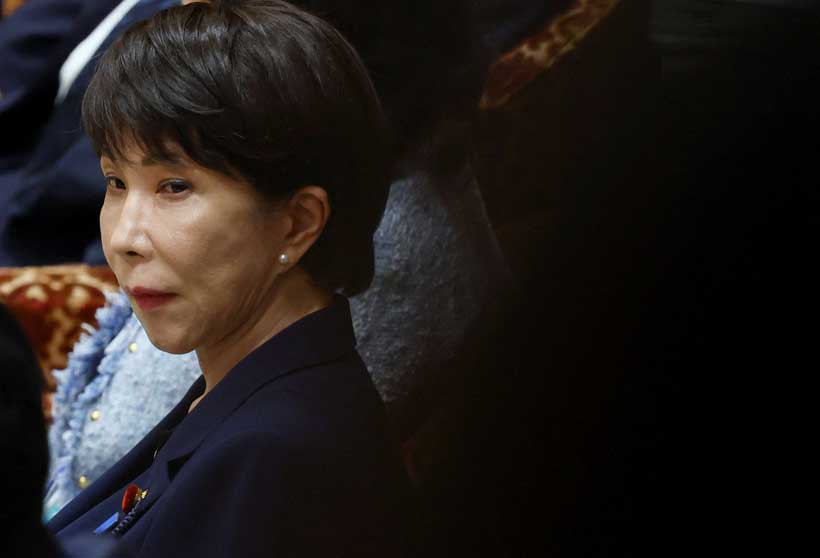
When Sanae Takaichi called China “an important neighbor” in her October 5 policy address, the line had to compete with a consumption tax cut on food, from 8 percent to 1 percent for two years. The tax cut won the coverage. In the same passage she promised Japan would assert its positions firmly, and she went on to list Chinese export controls, exit bans, and military activity near Japan. She retracted nothing she said last November about a Taiwan contingency. As a concession, the speech gives Beijing almost nothing.
As a signal, it gives a little more. A week earlier, Wang Yi told a 50-member business delegation led by former Foreign Minister Takeshi Iwaya that relations had “yet to be normalized.” Iwaya also met Vice Premier He Lifeng the next day. So both capitals have now said in public, days apart, that the present freeze is not where they want to stay. Neither has said what it would give to end it. Beijing’s standing demand is still a full retraction.
Washington has tried to help in its fashion. At the September summit, Donald Trump urged Xi to talk to Takaichi and lift the export curbs on Japan. He presented the curbs as a threat to American industries that rely on Japanese suppliers. Xi answered with a warning about Japanese militarism. Tokyo then asked for a Takaichi-Xi meeting at the APEC summit in Shenzhen. Beijing offered Li Qiang instead, and Japan has held out for Xi.
The two governments are now arguing over who sits at the table rather than what either would bring to it. The cheapest first step belongs to Beijing, and China wrote the terms for it itself in January.
Stay ahead of the geopolitical week.
MD Briefing delivers expert analysis across five global fronts — the Indo-Pacific, energy, geoeconomics, European security, and the Middle East — every Monday morning. Free.
When the Commerce Ministry banned dual-use exports to Japanese military end users on January 6, spokesman He Yadong was direct: “Civilian users will not be affected.” The ban was framed as a response to Japanese rearmament, aimed at defense firms and nothing wider.
China’s own customs figures have since drifted away from that line. Shipments of seven controlled rare-earth categories to Japan fell 51 percent in the first half of 2026 and 81 percent in June alone. By August, controlled compounds and metals reaching Japan had sat at zero for three months. In July, South Korea received all 11 metric tons of the dysprosium China exported.
Dysprosium and terbium keep motor magnets from failing at high temperatures. The magnets go into cars, air conditioners, and factory equipment. Japanese manufacturers can now secure only about two-thirds of what they need. A Korean magnet maker gets the feedstock, and a Japanese one doing the same civilian work does not. That is a country control, not an end-user control.
Finished Chinese magnets still reach Japan, though 17.1 percent fewer arrived in August than a year earlier. What stopped this is the input: Japanese firms need to make magnets themselves.
Closing that gap would not require Beijing to concede anything on Taiwan or on Japanese defense policy. The mechanism already exists. At Gyeongju last October, Takaichi and Xi agreed to strengthen the Japan-China Export Control Dialogue. Through it, Beijing could issue fast-track licenses to a published list of civilian magnet makers, and Tokyo could offer end-use verification before anyone asks.
China would keep its control list and its stated purpose. It would also gain something it has wanted since Washington began writing its own export rules: shipping data showing that Chinese controls are targeted and lawful in practice, not only in announcements. Brussels and New Delhi, both deciding how far to trust Chinese supply chains, would read that data closely.
Tokyo would have to give something back, and it has an option that costs Takaichi little with her own voters. Japan’s position on Taiwan rests on the 1972 Joint Communiqué. There, Tokyo said it “fully understands and respects” Beijing’s stand that Taiwan is an inalienable part of China. A prime minister restating that text, unprompted and in plain words, would fall short of the retraction Beijing wants. It would still give Chinese officials something on the record to point to when the first license is signed.
Waiting has its own price for Beijing. Every month without dysprosium is a month Japanese firms spend qualifying other suppliers, and Japan has done this before. After China held up shipments during the 2010 Senkaku dispute, the trading house Sojitz and the state agency JOGMEC backed Australia’s Lynas. Japan’s reliance on Chinese rare earths then fell from 90 percent to 58 percent by 2024. In March, Tokyo reserved 75 percent of Lynas’s heavy rare-earth output for Japanese buyers.
Lynas is still small. It produced eight metric tons of dysprosium and terbium in the first quarter, against roughly 14 tons a month that China used to ship to Japan. A second round of that effort, funded by a government already spending heavily on economic security, would still be far harder for China to reverse than a diplomatic chill.
The timing matters because both economies are absorbing the cost of a war launched by Washington and Israel. Before the strikes on Iran in February, China moved about 5.4 million barrels a day of crude through the Strait of Hormuz, more than any other buyer. Since the United States reimposed its blockade of Iranian ports on July 14, no Iranian cargo has reached China. In September, Iran loaded no crude at all, the first such month since Kpler began tracking its exports in 2013.
China’s Iranian imports in July and August ran 48 percent below prewar levels. COSCO and China Merchants Energy Shipping once carried about half of China’s Middle Eastern crude. They have kept their tankers out of both Hormuz and Bab al-Mandeb since late July.
Japan’s exposure is starker. In 2025 the Middle East supplied 94 percent of its crude, and 93 percent of that came through the strait. April imports from the region were the lowest since 1979. Pump prices hit a record ¥190.8 a liter in March before Tokyo revived subsidies to pull them back toward ¥170.
October has been worse at sea, with ships struck almost daily in and near the strait. The detours are fragile too. In mid-September, drones launched from Iraq shut Saudi Arabia’s East-West pipeline, which had been carrying about 4 million barrels a day to the Red Sea. It restarted at low rates on September 22.
Tehran has already drawn its own conclusion about the two countries. In March, Abbas Araghchi offered to facilitate passage for Japanese ships. Days later he listed China, India, Pakistan, Russia, and Iraq as friendly nations whose vessels could transit. Iran treats two of Asia’s biggest crude buyers as customers it would rather keep. Beijing and Tokyo have not, in public at least, discussed that shared position with each other.
They could start without touching anything sensitive. If the two governments notified each other before releasing strategic reserves, they would stop bidding for the same spot cargoes in the same week. Their energy officials could also compare notes on the Saudi and Emirati pipelines that skirt the strait. Japan’s August energy plan already commits JOGMEC financing to those pipelines, and Chinese buyers would draw on the same pipes.
A channel of this kind needs to run directly between the two capitals. The administration that urged Xi to make peace with Tokyo is the same one enforcing the blockade that emptied Iran’s loading terminals. A Japan-China energy line routed through the White House would be hostage to whatever Washington and Beijing are bargaining over that month.
Some of Beijing’s own pressure has meanwhile lost force. After China advised its citizens against travel to Japan, mainland arrivals fell 56.4 percent in the first half of the year. Visitors from South Korea rose 18.6 percent and from Taiwan 20.9 percent, and Japan’s overall total slipped only 2 percent. The advisory closed a channel of ordinary contact while barely moving Japan’s totals.
The seafood halt imposed last November can be handled the same way as the travel advisory. Lifting these measures one at a time, each with a figure both sides can cite, would cost Beijing little leverage it is actually using.
The obvious place to begin is Shenzhen, where China hosts APEC leaders on November 18 and 19. Next year marks 55 years since the two countries normalized relations, an anniversary Wang raised with Iwaya himself.
The quarrel over Xi or Li is about face. In 2014, Shinzo Abe ended a two-year freeze with a stiff, brief meeting with Xi at the Beijing APEC. What mattered was that bureaucracies in both capitals read it as permission to move. A meeting with Li that came with a first batch of civilian licenses would send that permission more clearly than twenty minutes with Xi, which produced nothing. Tokyo should accept that trade if it is offered, and Beijing should offer it.
Nothing in last week’s speech suggests Takaichi is about to say the words China asked for. Beijing can keep waiting for them, or it can apply the rule its own Commerce Ministry announced in January and let a license make the first move. Only the second option is entirely in Beijing’s hands.
