


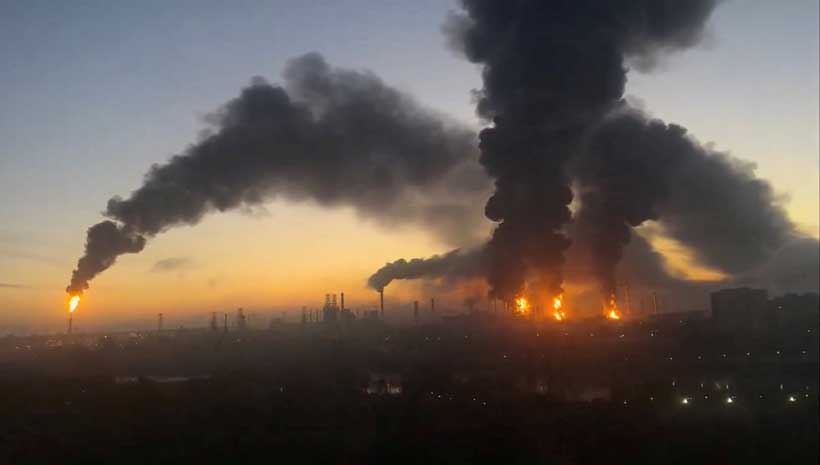
On Sunday, October 11, 2026, US President Donald Trump announced that a ceasefire in the energy sector between Russia and Ukraine had taken effect, with the agreement of both countries. President Trump made the announcement suddenly via his Truth Social platform, stating that an agreement to halt attacks on energy infrastructure between Russia and Ukraine had been implemented immediately and urging both sides not to violate it. Speaking to a group of journalists, President Trump added, I think Ukrainian President Zelensky should hold an election. He could have resolved this conflict many times already. He should hold an election. Trump’s announcement elicited mixed reactions. Ukrainian President Zelensky stated that the US announcement was news for him but indicated his country’s readiness to abide by the ceasefire if Moscow did the same. Meanwhile, Kyiv accused Russian forces of continuing to attack energy facilities despite the announcement. Here, US President Donald Trump criticized Ukrainian President Zelensky on Saturday, October 10, 2026, for launching new Ukrainian attacks on Russian oil refineries. This came just one day after the US temporarily lifted sanctions on Russian fuel following an agreement between Trump and his Russian counterpart, Vladimir Putin, to release Russian diesel fuel into the US and global markets. Following talks with Putin, the US president wrote, “Russia will immediately supply over 300,000 tons of diesel fuel to the US and global markets, and another 500,000 tons during November.” Ukrainian President Zelensky responded on Sunday, October 11, 2026, stating that Ukraine is ready to stop the attacks on Russian oil refineries if Moscow stops its attacks on Ukraine’s energy infrastructure.
Regarding China’s position on the energy sector ceasefire between Ukraine and Russia, Chinese political, diplomatic, and strategic circles welcomed the US decision to halt attacks on the energy sector between the two countries. China supports all efforts aimed at resolving the Ukrainian crisis and considers dialogue and negotiation the only path to peace. This was China’s first official comment on US President Donald Trump’s announcement of a ceasefire in the energy sector between Moscow and Kyiv. China’s official position on the energy truce between Russia and Ukraine is one of support for peace efforts. According to Chinese Foreign Ministry spokesperson Mao Ning, Beijing’s position on the Ukrainian crisis is consistent and clear, emphasizing China’s support for any step that contributes to de-escalation, promotes peace, and leads to a comprehensive political settlement. With China’s insistence on protecting vital infrastructure, this support aligns with the consistent principles Beijing has previously declared in its diplomatic documents. These documents clearly state the necessity of refraining from targeting civilian infrastructure and vital facilities, such as power plants and nuclear facilities, to prevent the exacerbation of humanitarian and economic disasters. This helps us understand China’s role in the current and future crisis between Russia and Ukraine. While China is not playing a direct or mediating role in the recent energy truce announced by Trump, it does have a pivotal, indirect role, which can be summarized as follows:
1) Continuous Diplomacy: Since the beginning of the conflict, China has put forward political initiatives, such as the 12-point document and the call to adhere to the principles of not expanding the scope of the fighting and not adding fuel to the fire. It has consistently urged, through its diplomatic channels, the participation of all relevant parties in peace negotiations. China maintains a moral and legal framework for resolving the Ukrainian-Russian crisis. Here, through its documents (such as the 12-point proposal for resolving the crisis), China presents a principled framework that rejects escalating the military conflict to include the destruction of civilian lives or threats to nuclear security, thus exerting continuous moral and political pressure on the parties to the conflict.
2) Economic and Political Leverage with Moscow: Given the close strategic partnership and strong economic ties between Beijing and Moscow, the international community and the European Union believe that China possesses unique leverage that it can use to urge Russia to move towards broader ceasefires. Especially given Beijing’s awareness that targeting energy facilities between Russia and Ukraine could lead to global economic crises and disrupted supply chains, which would conflict with its broader commercial and economic interests.
Stay ahead of the geopolitical week.
MD Briefing delivers expert analysis across five global fronts — the Indo-Pacific, energy, geoeconomics, European security, and the Middle East — every Monday morning. Free.
3) Maintaining Supply Chains: Beijing is deeply concerned with ensuring the stability of global energy supplies and supply chains. This is a key motivation for its support of any agreement that keeps the energy sector and oil or electricity facilities out of armed conflict. China consistently emphasizes its firm stance on the need to protect vital facilities and civilian infrastructure in the international conflict between Russia and Ukraine, a position clearly reflected in its diplomatic documents and its vision for resolving the Russian-Ukrainian crisis. This stance reflects Beijing’s strategy of attempting to maintain international stability and prevent major humanitarian or environmental disasters, such as those that could result from targeting nuclear reactors or main power grids.
4) The integration of China’s implicit role with international efforts: Although China may not be a direct party or mediator in specific understandings or energy truces between Russia and Ukraine proposed by other powers, such as the US administration, its declared positions align with and implicitly support these efforts. This is because China draws red lines that enjoy international consensus regarding the safety of nuclear and civilian facilities.
Accordingly, we understand China’s supportive stance towards all efforts aimed at resolving the Ukrainian crisis, as expressed in response to US President Donald Trump’s announcement of the implementation of an energy truce and a ban on targeting vital facilities between Moscow and Kyiv. The Chinese position was conveyed through statements by Foreign Ministry spokesperson Mao Ning, coinciding with ongoing diplomatic activity between Russia and Ukraine under Washington’s auspices. The Chinese Foreign Ministry emphasized that dialogue and negotiations are the only viable path to resolving the current crisis between Moscow and Kyiv and that Beijing consistently supports all efforts that contribute to de-escalation and the promotion of lasting peace. This stance came after Trump’s surprise announcement that Russia and Ukraine had reached a mutual agreement to immediately cease attacks on energy infrastructure and refineries, a move primarily aimed at calming global energy and fuel markets.
