


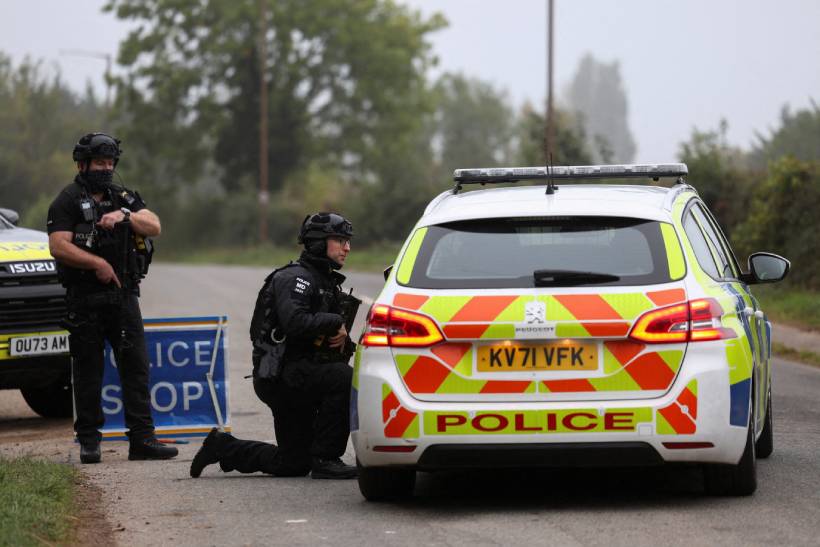
The arrests near RAF Fairford on September 27 are still surrounded by uncertainty, but the incident has already raised a wider question for Britain and other European countries that host American military forces. When a base on European soil is used for US operations somewhere else, the host country is not only offering logistical support. It can also end up carrying some of the risk that comes with those operations.
Police were first called after reports of suspicious vehicles near RAF Fairford in Gloucestershire, a base used by the US Air Force. Five British men in their twenties were arrested near the site. Police later said that no explosive devices had been found, although petrol was recovered from the vehicles. A 25-year-old dual British-Iranian national was arrested several days later, and a seventh man was arrested in London on October 6. All seven have since been released on bail while the investigation continues.
The question of who was behind the incident remains open. British counter-terrorism police have said they are looking at all possible angles, including foreign-state involvement. Iran is one obvious line of inquiry because the Islamic Revolutionary Guard Corps had already warned in July that bases used to launch attacks on Iran could be considered legitimate targets. Iran has denied involvement. Russian involvement has also reportedly been examined, and there is still no confirmed attribution. That uncertainty matters because the case is politically sensitive enough without treating suspicion as proof.
What makes Fairford especially interesting is what happened after the arrests. The United States removed its deployed B-1 bombers from the base and returned them to their home stations. President Donald Trump said the move was connected to a threat linked to Iran, while other US officials described the decision more cautiously and said the aircraft had been moved as a precaution. Either way, the episode showed how quickly Washington can reduce its exposure when the security situation around a base changes.
Stay ahead of the geopolitical week.
MD Briefing delivers expert analysis across five global fronts — the Indo-Pacific, energy, geoeconomics, European security, and the Middle East — every Monday morning. Free.
Britain cannot do the same with the place itself. RAF Fairford remains in Gloucestershire, and the surrounding area remains British territory. Once the base has been publicly connected to operations against Iran, that connection does not disappear immediately just because the aircraft have gone home. British authorities still have to protect the site and deal with any security consequences that follow.
This does not mean Britain had no say in the original decision. The UK government approved an American request to use British bases for specific and limited defensive operations against Iranian missile facilities. The Ministry of Defence has also said that requests to use UK bases are considered case by case. So the problem is not that the United States simply acted from British territory without permission.
The harder issue is that agreeing to one operation does not mean the host country controls everything that comes after it. Britain can define the use of Fairford as limited and defensive, but an adversary does not have to see it in the same way. If a foreign government views the base as part of an attack against it, then the legal or political limits agreed between London and Washington may matter much less from that government’s point of view.
There is also a question of democratic responsibility. The British government can approve the use of UK bases without Parliament holding a vote every time. There are practical reasons for this, especially when military decisions need to be made quickly. But the Fairford case shows why these decisions can reach beyond military planning. People living near the base may face increased security measures or become part of a wider confrontation even though the decision to allow the operation was made at government level and may have received limited public debate.
The same tension can be seen elsewhere in Europe. Portugal has faced legal and political questions over American use of Lajes Air Base in the Azores during the Iran conflict. Prosecutors opened an inquiry into the government’s authorisation, while Prime Minister Luis Montenegro defended the decision as lawful. Spain, France and Italy have also placed restrictions on some US military access connected to the war. European governments are therefore not all making the same calculation about how much risk they are willing to accept.
This matters because the US military presence in Europe is still extremely important. European governments rely heavily on American capabilities through NATO, especially as Russia remains a major security concern. Bases like Fairford are part of that relationship. At the same time, those bases can also be used for operations that go beyond the direct defence of Europe. That is where the arrangement becomes more complicated for the country hosting them.
The Fairford case does not prove that hosting US forces is a mistake, and it does not prove that Iran was behind the suspected plot. It shows something narrower but still important. A European government can agree to the use of its territory for a specific American operation, but it cannot decide how every outside actor will respond to that decision. If the threat changes, the United States can move aircraft and personnel relatively quickly. The host country is left managing the security problem on its own territory.
That is why the attribution should remain open while the broader issue does not depend on it. Whether the Fairford investigation eventually points to Iran, Russia or something else, the incident has shown that hosting foreign military power can bring risks that last longer than the operation itself. For European governments, the question is not simply whether American bases are useful. It is also how much exposure comes with allowing those bases to be used in conflicts that Europe does not fully control.
