


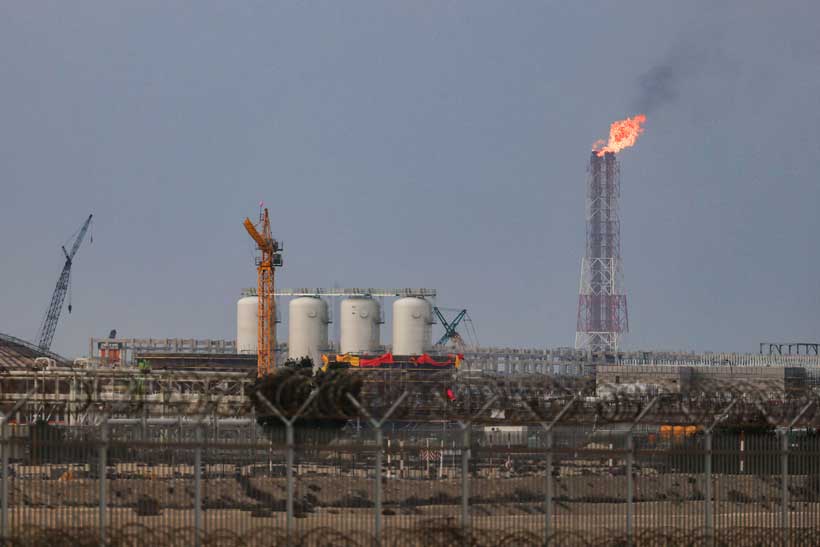
The recovery of Middle Eastern oil exports has done little to ease the disruption facing the global liquefied natural gas (LNG) market, as Qatar struggles to restore shipments amid continuing security risks in the Strait of Hormuz.
Qatar, the world’s second-largest LNG producer after the United States, accounts for roughly one-fifth of global export capacity, with annual capacity of nearly 80 million metric tons. The US-Israeli war with Iran has severely disrupted its energy industry, forcing shutdowns at its main LNG complex in Ras Laffan and exposing the vulnerability of Gulf energy exports to prolonged conflict.
Iranian missile attacks have also damaged infrastructure responsible for around 17% of Qatar’s export capacity. The resulting losses could cost the country tens of billions of dollars in annual revenue, while repairs may take years to complete.
The economic consequences are severe. The International Monetary Fund forecasts Qatar’s gross domestic product will contract by 8.6% in 2026, reversing pre-war expectations for growth of 6.1%.
Stay ahead of the geopolitical week.
MD Briefing delivers expert analysis across five global fronts — the Indo-Pacific, energy, geoeconomics, European security, and the Middle East — every Monday morning. Free.
Disruptions to Qatari LNG supplies, alongside reduced exports from the United Arab Emirates, have tightened global gas markets. A sharp increase in US LNG exports has provided some relief, with shipments rising by around 14% in 2026 from a year earlier to 123 million tons. However, the additional supply has not fully offset the losses from the Gulf.
Asia and Europe have been particularly exposed because of their reliance on imported LNG and limited alternatives for replacing disrupted shipments. LNG prices in both regions reached their highest levels since early 2023 in late September, nearly tripling from pre-war levels.
Even if the Strait of Hormuz reopens, Qatar’s recovery is unlikely to be immediate. The country’s tightly integrated production and export system faces logistical constraints that make LNG far more difficult to restore than crude oil shipments.
Why Oil Exports Are Recovering Faster Than LNG
The outlook for Middle Eastern crude exports has improved in recent weeks, as producers have increasingly resumed shipments through the Strait of Hormuz despite continuing security threats.
According to data analytics firm Kpler, crude shipments through the waterway rose in September to around 16 million barrels per day, approximately 80% of pre-war levels. Saudi Arabia, the UAE, Kuwait and Iraq have also increased domestic production as export conditions have improved.
LNG shipments, however, have remained severely constrained.
Qatar’s LNG exports reached 1.6 million tons in September, their highest level since the conflict began but still less than one-quarter of their pre-war average, according to Kpler. Around one-third of those shipments went to Kuwait, remaining within the Gulf, while the rest went to China, India and other Asian destinations.
The recovery could prove temporary. Qatar’s LNG exports in October are projected to fall to around 0.6 million tons, according to Kpler, amid renewed attacks on shipping. QatarEnergy has also extended force majeure notices, indicating that it remains unable to fulfil certain contractual deliveries to customers in Asia and Europe.
The difference between oil and gas exports reflects how their supply chains operate. Crude oil can be stored in large quantities, transported through alternative routes in some cases and supplied using a comparatively flexible shipping network. LNG requires specialised production facilities, temperature-controlled storage and dedicated carriers.
As a result, occasional safe passage through Hormuz is insufficient to restore Qatar’s export industry. Producers and shipping companies need confidence that vessels can repeatedly transit the waterway without facing unacceptable risks.
Qatar’s LNG Infrastructure Faces Complex Constraints
Qatar’s export system depends on 14 LNG production units, known as trains, supplied by natural gas extracted from the offshore North Field, the world’s largest natural gas reservoir, which Qatar shares with Iran.
Production has remained at minimal levels since the war began, supporting domestic demand and limited exports. Restoring output requires more than reopening the export terminal: gas production, processing, storage and shipping must all function together.
One complication is condensate, a light liquid hydrocarbon extracted alongside natural gas. Qatar must separate and export these liquids as part of its upstream production system. If condensate shipments cannot leave the Gulf reliably, storage constraints could eventually force producers to reduce gas output.
LNG storage presents another challenge. Qatar has limited capacity to hold large volumes of additional production onshore or aboard vessels while waiting for export routes to become available. Prolonged shipping delays can therefore disrupt operations even when global demand remains strong.
The availability of specialised LNG carriers is an additional constraint. Unlike crude oil tankers, LNG vessels operate within a more specialised shipping market, where capacity is less interchangeable and freight costs can be considerably higher. Shipowners may be reluctant to send expensive vessels through Hormuz if they risk being trapped inside the Gulf or damaged by attacks.
These constraints mean that a sustained recovery depends on reliable maritime access, functioning production infrastructure and a shipping industry willing to resume regular operations.
Qatar’s Expansion Plans Face a Security Test
The disruption comes at a critical point for Qatar, which is undertaking a major expansion of its LNG industry. The country plans to increase annual production capacity from nearly 80 million tons to 142 million tons by 2030, potentially raising its share of global LNG capacity to roughly one-quarter.
The expansion is intended to strengthen Qatar’s position in a market where demand for gas remains important to energy security, industrial production and electricity generation.
But additional production capacity offers limited economic value if exporters cannot reliably reach international customers. Continued insecurity in Hormuz could delay the commercial benefits of new facilities, complicate long-term supply contracts and encourage importers to diversify their energy sources.
The consequences extend beyond Qatar. Asian economies that rely heavily on Gulf LNG could face higher import costs and greater competition for alternative supplies. European buyers could also remain exposed to price volatility as they compete with Asian importers for cargoes from the United States and other producers.
For Qatar, the central challenge is therefore not simply restarting production but restoring confidence in the entire export chain.
A Lasting Recovery Depends on a Durable Regional Settlement
The future of Qatar’s LNG industry is increasingly tied to the security arrangements governing the Strait of Hormuz. A temporary reduction in hostilities or the passage of individual tankers may offer limited relief, but neither guarantees the predictable shipping conditions required for sustained exports.
A durable settlement involving Iran, the United States and regional powers would help reduce the risk of further attacks and give energy companies greater confidence to resume regular operations. Even then, damage to production facilities and disruptions to logistics could delay a return to pre-war supply levels.
The crisis also exposes a broader vulnerability in global energy markets: large investments in production capacity cannot guarantee energy security when exports depend on a single strategic maritime corridor.
Until Qatar can produce LNG at scale and ship it through Hormuz with confidence, the global gas market is likely to remain under pressure, and the country’s ambitious expansion programme will face an increasingly uncertain path.
With information from Reuters.
