


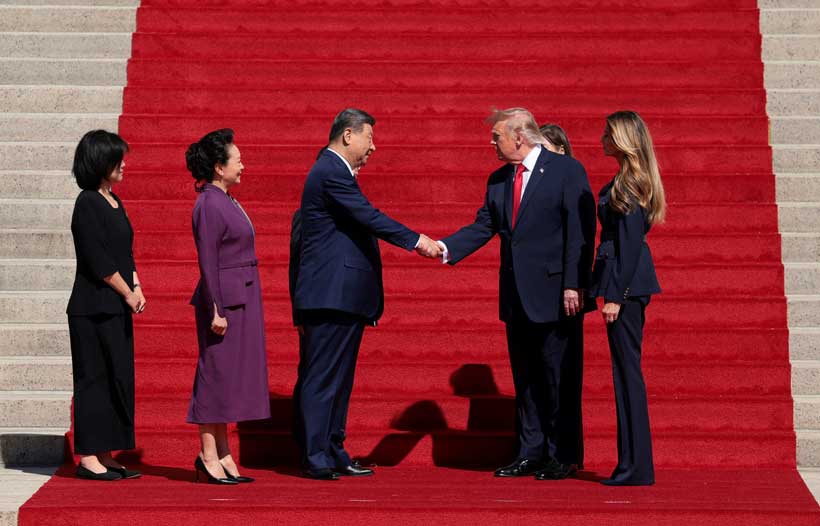
The Washington summit agreed on very little. What it confirmed matters more: the terms of America’s commitment to Taiwan are increasingly being set in leader-level bargaining with Beijing, not by repeal but by postponement.
By the usual measures, last week’s summit in Washington was a non-event. Xi Jinping’s first state visit to the United States in more than a decade ended after three days with no major public breakthroughs on trade, artificial intelligence, Iran or Taiwan. The one concrete deliverable, an extension of the trade truce to 10 January, was settled by Treasury Secretary Scott Bessent and Vice Premier He Lifeng on the eve of the leaders’ talks. Coverage has understandably settled on a verdict of fanfare over substance.
That verdict misses what the summit actually confirmed. The most consequential item on the table was never formally on the agenda: a roughly $14 billion arms package for Taiwan, cleared by Congress in January, which Donald Trump has held in abeyance since May and described as a “very good negotiating chip.” There was no sign the Washington summit moved it forward. That absence, rather than any announcement, is the story. The package has now sat through two leader-level summits, which tells us that a decision once handled inside a closed loop of the State Department, the Pentagon, Congress and Taipei has migrated onto the US-China summit calendar, where there is always another meeting to protect.
Nothing in American law or declared policy has changed. That is precisely why the shift deserves attention.
Stay ahead of the geopolitical week.
MD Briefing delivers expert analysis across five global fronts — the Indo-Pacific, energy, geoeconomics, European security, and the Middle East — every Monday morning. Free.
A package with three explanations
Consider how Washington has explained the delay. In May, after the Beijing summit, the President framed the package as leverage. A week later, acting Navy Secretary Hung Cao told a Senate subcommittee that the sale had been paused to conserve munitions for Operation Epic Fury, the war on Iran, while insisting stocks were plentiful and that sales would resume when the administration deemed it necessary. Then in July, Assistant Secretary of State Michael DeSombre testified that the package did not depend on negotiations with China and remained guided by the Six Assurances.
Each explanation may be partly true. Together, they are corrosive. A bargaining chip is useful only if its release is conditional on Beijing’s behaviour; a munitions pause is conditional on events in the Gulf; an arms sale governed by the Six Assurances is conditional on neither. An ally cannot plan procurement, training or force posture around a commitment whose logic changes depending on which official is testifying. Ambiguity about whether the United States would fight for Taiwan has been deliberate policy for decades. Ambiguity about whether it will deliver weapons Taiwan has already been cleared to buy is something new, and far harder to describe as strategic.
The munitions rationale deserves more scrutiny than it has received, because it points to a structural constraint rather than a tactical choice. If a war in the Gulf can pause the largest arms transfer in Taiwan’s history, then American stockpiles have become a rationed resource, allocated between theatres. That is a problem no summit can solve, and one Beijing can observe without needing to negotiate for it.
The Six Assurances: hollowed, not repealed
Among the Six Assurances conveyed to Taipei in 1982 is a pledge that Washington has not agreed to consult Beijing on arms sales to Taiwan. Its value lay less in legal force than in removing the subject from US-China diplomacy altogether: if Beijing could not negotiate over arms sales, it had little reason to try.
That wall has been breached in practice. After the Beijing summit, Trump said he had discussed the arms sales with Xi “in great detail.” That prompted Representative Raja Krishnamoorthi, sponsor of a bipartisan bill to codify the assurances, to warn that presidents of both parties had upheld the no-consultation principle for more than four decades. The Senate followed with S.Res. 754, a bipartisan resolution reaffirming the Taiwan Relations Act, the Three Communiqués and the Six Assurances as cornerstones of US policy.
These responses are revealing in what they cannot do. A resolution restates a principle; it does not compel a notification. The executive retains control over the timing of arms sales, and timing is exactly where the erosion is happening. No administration needs to renounce the Six Assurances if it can let the calendar do the work instead. A formal repeal would provoke backlash in Congress and a crisis in Taipei. A practice of consultation, reinforced with each deferred decision, provokes neither, and it grows harder to reverse the longer it runs.
Borrowing Beijing’s vocabulary
The framework under which this is unfolding has a name, and it was not coined in Washington. At the May summit the two leaders agreed to recast the relationship as one of “constructive strategic stability,” according to Xinhua. Xi elaborated the formula as a stability with cooperation as the mainstay, competition kept moderate and differences kept manageable, intended to guide relations for the next three years and beyond.
Language of this kind is not decoration. Whoever defines stability also defines what counts as destabilising. Inside Beijing’s formula, an arms sale to Taiwan is no longer the routine implementation of US law; it becomes a disturbance of an agreed equilibrium, something to be justified, weighed and perhaps deferred. Chinese analysts have been candid about the assessment underneath: one leading state think tank characterised the rivalry as having entered a phase of strategic stalemate, in which the priority is keeping the relationship from capsizing. Observers of Chinese state messaging noted that Beijing used the May visit to project the idea of an American change of heart.
Washington’s acceptance of the phrase may have looked like a cheap courtesy in exchange for trade concessions. But frameworks gain authority through repetition. If “constructive strategic stability” becomes the benchmark against which US decisions on Taiwan are judged, Beijing will have won something more durable than any single deferred package: a say in the definition of normal.
The summit calendar as a lever
The timing compounds the problem. This year’s leader-level diplomacy was designed as a sequence rather than a one-off, with four meetings in all: Beijing in May, Washington in September, the APEC summit in China in November and the G20 in Miami in December. The trade truce now expires on 10 January, weeks after the last of them. The US midterm elections fall in between, with the administration under pressure over a war with Iran that has pushed up fuel prices and is unpopular at home.
Every one of those dates offers a reason to wait. Notifying the Taiwan package before APEC risks souring the President’s trip to China; notifying it before Miami risks the G20; notifying it before January risks the truce. A decision that can be deferred to protect the next meeting can be deferred indefinitely. Beijing does not need to win the argument over arms sales. It only needs to keep the next summit valuable enough.
Taipei’s own contribution
It would be too simple to cast Taiwan purely as the object of great-power bargaining; its own politics have narrowed its options. President Lai Ching-te sought NT$1.25 trillion, about $40 billion, in special defence spending over eight years. After months of obstruction, the opposition-controlled legislature approved NT$780 billion in May. The cut fell heavily on domestic procurement: ruling-party lawmakers accused the opposition of excluding locally made systems, warning that a blockaded Taiwan could not sustain its fighting capacity on imports alone. Lai’s original bill had also been designed to fund US packages not yet notified to Congress.
The irony is hard to miss. Taiwan’s legislature concentrated its defence spending on American-sourced systems at the very moment Washington began treating those systems as either a bargaining chip or a scarce wartime resource. Meanwhile, the chair of the opposition Kuomintang travelled to Beijing to meet Xi in April and returned calling for cross-party dialogue. Whatever one makes of the KMT’s cross-strait strategy, the combined effect is a Taiwan whose defence planning depends more heavily on a supply line it does not control, while its domestic consensus on investing in its own resilience remains contested.
After the Washington summit, Deputy Foreign Minister François Wu asked publicly whether concessions on Taiwan would actually serve US interests, arguing that arming the island protects both its freedom and the semiconductor supply the world depends on. It was a sensible argument, framed in the transactional terms Washington now responds to. That Taipei feels compelled to make the case in those terms at all is itself a measure of how the relationship has changed.
What the allies are reading
The audience for all this reaches well beyond Taipei, and Tokyo has the most exposure. Prime Minister Sanae Takaichi told the Diet last November that a Chinese blockade of Taiwan could constitute a “survival-threatening situation” for Japan. It was the first time a Japanese leader tied a Taiwan contingency to collective self-defence. Relations with Beijing cooled sharply, and Trump has stayed largely silent on the dispute. Ahead of the Washington summit, Tokyo wanted Trump to stick to established diplomatic language and keep Taiwan off the centre of the agenda; senior ruling-party lawmakers said their biggest fear was a softer US stance traded for Chinese purchases that could be sold to voters before the midterms.
The lesson allies are drawing is not that Washington has abandoned Taiwan. It has not. It is that American commitments in Asia now carry a price that can be renegotiated at the leader level. A Japanese government that took real political risk to align itself publicly with Taiwan’s security has watched that alignment go largely unacknowledged, while Taiwan’s arms package is discussed with Beijing. Partners from Manila to Seoul will draw their own conclusions about the wisdom of getting out ahead of Washington.
The case for restraint, and its limits
There is a serious argument on the other side, and it deserves a fair hearing. The administration approved a record $11.1 billion package for Taiwan last December, and officials point out that Trump approved more arms sales to Taiwan in his first term than any predecessor. Holding a package is not cancelling it; after the May summit Trump said he had made no commitment either way. With the war against Iran unresolved and energy markets under strain, a period of calm with Beijing has genuine value. There is also no public sign that Washington formally accepted Xi’s request to adopt the “correct position” of opposing Taiwanese independence. Even some China hawks argued before the summit that it should be judged by implementation rather than announcements. By that standard, on paper at least, nothing has yet been conceded.
All of that can be true and still leave the core problem in place. Deterrence depends less on the size of any single package than on the predictability of the process that produces it. A commitment that is reaffirmed in testimony, suspended in practice and discussed with the very adversary it is meant to deter sends three signals at once. Beijing can choose to read whichever suits it. So can Taiwan’s opposition, and so can Tokyo.
What to watch
The coming months will show whether the Washington summit marked a pause or a pattern. Three indicators matter most. First, whether the $14 billion package is formally notified to Congress before Trump travels to China for APEC in November, or whether it slides again. Second, whether “constructive strategic stability” begins appearing in US official documents rather than only in Chinese readouts, which would signal that Washington has adopted Beijing’s framing as its own. Third, whether Congress moves beyond resolutions toward legislation that constrains executive discretion over timing, the one lever that actually matters.
None of these would amount to a dramatic rupture, and that is the point. The status quo in the Taiwan Strait is not being overturned by an announcement that could be condemned or a treaty that could be debated. It is being renegotiated quietly, through deferrals that each look reasonable on their own, on a schedule set by the next summit. By the time anyone declares that policy has changed, it may already have.
