


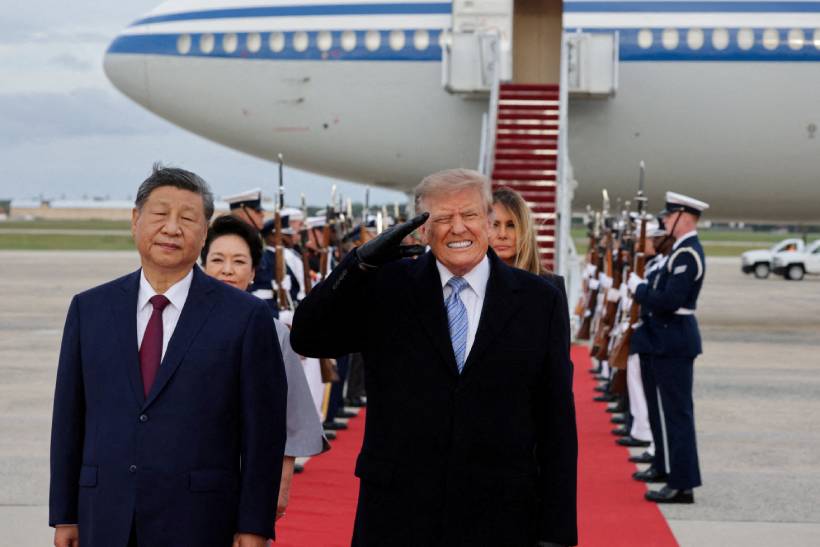
US President Donald Trump wanted his summit with Chinese President Xi Jinping in Washington last week to demonstrate the strength of their personal relationship and show that direct diplomacy could keep competition between the world’s two largest economies under control.
Yet the limited substantive outcomes from the meeting point to a different reality.
The summit produced agreements on tariffs and trade, but left major disagreements over investment, Taiwan, Iran and strategic competition unresolved. Rather than producing a breakthrough, the meeting appears to have reinforced a pattern in which Washington and Beijing manage their differences without resolving them.
For China, that may be sufficient. For Trump, however, the political value of the summit may depend on whether the temporary agreements translate into tangible economic gains before the US midterm elections.
Stay ahead of the geopolitical week.
MD Briefing delivers expert analysis across five global fronts — the Indo-Pacific, energy, geoeconomics, European security, and the Middle East — every Monday morning. Free.
A summit heavy on symbolism, light on breakthroughs
The meeting was notable for its ceremony.
Trump went out of his way to welcome Xi, including breaking protocol to greet him at the airport, something a US president had not done for a visiting world leader in 11 years.
At a lavish state banquet, Trump described his relationship with Xi in exceptionally warm terms, saying the two leaders had “never gotten along better.”
But the pageantry contrasted with the limited number of concrete agreements.
The two sides said they had reached consensus on lowering tariffs on about $60 billion worth of non-sensitive goods, although there was no timetable for implementing the reductions. A deadline for a broader trade agreement was also pushed into next year.
That gap between diplomatic presentation and substantive progress is important.
Craig Singleton, senior director at the Foundation for Defense of Democracies, described the relationship as a “managed stalemate,” arguing that the elaborate diplomacy is particularly visible because there is comparatively little substantive progress to demonstrate.
Drew Thompson, a senior fellow at the S. Rajaratnam School of International Studies, similarly said the summit created a positive political atmosphere without narrowing the underlying differences or reducing mutual suspicion.
Why the trade agreements matter
The economic arrangements nevertheless give both sides something to take home.
China has proposed reducing tariffs on several US agricultural products, including corn, wheat, dairy and meat. In return, Washington is expected to reduce tariffs on a range of Chinese imports, including toys, fireworks and Christmas decorations.
The agricultural measures are particularly relevant for Trump because US farmers are an important constituency for his Republican Party ahead of the midterm elections.
But the details also reveal the limits of the agreement.
Soybeans, one of the United States’ major agricultural exports to China, were not included in Beijing’s proposed tariff reductions. That leaves an important part of the agricultural relationship exposed to any future deterioration in US-China ties.
China’s broader economic position also gives Beijing leverage in negotiations. Its dominant position in the production and processing of rare earths and other critical minerals gives it influence over industries ranging from technology and automobiles to defence.
At the same time, China’s trade with the rest of the world has continued to expand despite Trump’s tariff policies.
This means that Beijing has economic tools of its own and does not necessarily need to offer major concessions simply to preserve the relationship.
Why the investment question remains unresolved
Investment was another area where the summit revealed the difficulty of translating political agreements into economic cooperation.
The absence of a Chinese delegation of chief executives accompanying Xi highlighted continued concerns surrounding Chinese investment in the United States.
The two governments had previously announced plans for a two-way investment framework, but persistent US concerns over Chinese technology, national security and economic influence could make such an arrangement difficult to implement.
This is significant because the broader US-China competition is no longer limited to tariffs.
The relationship increasingly involves technology, investment, critical minerals, supply chains and access to strategic industries. Even when the two governments reduce tariffs on selected goods, those deeper areas of competition remain.
Taiwan exposes the limits of the truce
The most consequential disagreements remain outside the immediate trade negotiations.
Taiwan is one of them.
China considers Taiwan part of its territory and opposes US arms sales and other forms of support for the island. Washington maintains an important security relationship with Taiwan while deliberately preserving ambiguity over the circumstances in which it would intervene militarily.
Trump largely avoided discussing Taiwan publicly during the latest summit.
That represented a contrast with his May meeting with Xi, when he described a pending $14 billion US arms package for Taiwan as a potential “negotiating chip” with Beijing.
The absence of a major public confrontation over Taiwan may help preserve the current diplomatic atmosphere, but it does not resolve the underlying disagreement.
Jeremy Chan, a senior analyst at Eurasia Group and former US diplomat in China, argued that repeated high-level meetings could give Beijing time to manage or delay US actions it opposes, including arms sales to Taiwan.
That interpretation reflects one of the central tensions in the current relationship: diplomatic engagement can reduce the immediate risk of confrontation, but it can also give both sides more time to pursue their own interests without resolving the strategic disputes underneath.
Iran adds another layer of competition
The summit also produced little evidence that China was prepared to give Trump what he wanted on Iran.
Washington has sought Chinese cooperation as it deals with the war in Iran, but Beijing has continued to defend positions that conflict with US policy.
Shortly after Xi left Washington, Chinese Vice President Han Zheng criticised US positions on Iran and Cuba during a United Nations General Assembly meeting in New York.
That response suggests that the summit did not fundamentally alter China’s broader foreign policy positions.
The same pattern can be seen across other disputes: cooperation is possible where the interests of Washington and Beijing overlap, but neither side appears prepared to sacrifice its wider strategic priorities to sustain the diplomatic momentum.
What the summit reveals about US-China competition
The most important feature of the meeting may therefore be what it did not change.
Neither Washington nor Beijing appears interested in allowing economic competition to develop into an uncontrolled confrontation. At the same time, neither side has shown a willingness to make the kinds of concessions that would fundamentally alter the relationship.
That produces a form of managed competition.
Trade can be stabilised without ending the rivalry. Leaders can exchange public praise while their governments continue competing over technology and critical minerals. Tariffs can be reduced on selected products while restrictions remain elsewhere. Washington and Beijing can expand diplomatic contact while continuing to disagree over Taiwan and other geopolitical issues.
The summit therefore matters less as a breakthrough than as evidence of how the relationship is increasingly being managed.
What comes next?
The immediate test will be whether the agreements announced at the summit are actually implemented.
The proposed tariff reductions will need to move from political commitments to concrete policy. The two countries will also need to determine whether the broader trade agreement can be concluded next year.
Agricultural purchases will be closely watched, particularly because soybeans remain outside China’s proposed tariff reductions.
Investment will present another challenge. The absence of a substantial Chinese business delegation underlines the continuing obstacles to deeper economic integration, particularly in areas where national security concerns overlap with commercial interests.
Taiwan will remain an even more sensitive issue. US arms sales and China’s response could test the stability created by the summit, particularly if Washington takes steps Beijing considers unacceptable.
The same applies to Iran and other areas where US and Chinese foreign policy interests diverge.
For now, Trump and Xi have created another period of diplomatic stability without resolving the fundamental disputes between their countries. The summit may have reduced immediate tensions, but the deeper competition over trade, technology, strategic resources and regional security remains intact.
The question is therefore not whether Washington and Beijing can meet and reach limited agreements. They clearly can.
The larger test is whether repeated diplomacy can eventually produce substantive compromises, or whether the US-China relationship will remain a managed stalemate in which both sides cooperate selectively while preparing for continued strategic competition.
With information from Reuters.
