


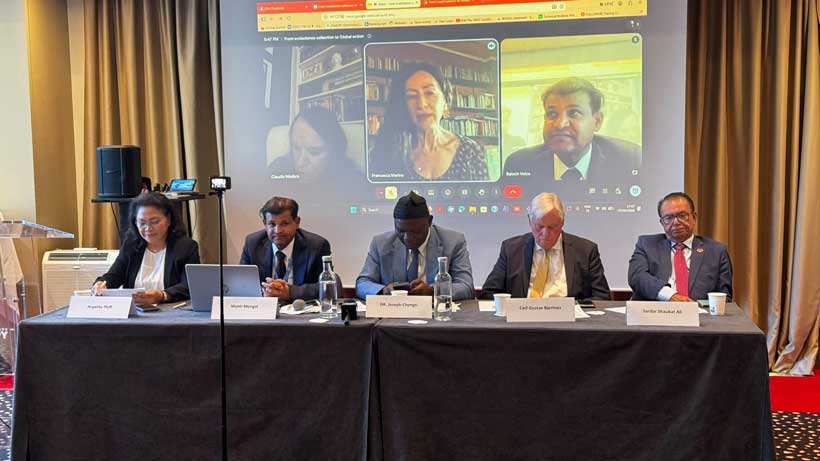
Speakers at a human rights conference in Geneva on Friday called on the United Nations and the Organisation for the Prohibition of Chemical Weapons (OPCW) to send an independent mission to investigate allegations that Sudan’s army used chlorine weapons in its war against the Rapid Support Forces (RSF).
The conference which was held on the sidelines of the 63rd session of the UN Human Rights Council on 25 September, was organized by the Paris Integration Forum (PIF), a Paris-based center focused on human rights in the Middle East and geopolitical shifts within the region.
The event titled “From Local Evidence to Global Action: Connecting Community Realities to Human Rights Policies,” brought together rights defenders, academics and journalists from several countries.
Claudia Wädlich, a German lawyer and politician, said the US allegations that the army used chemical weapons in 2024 must be taken seriously, adding that Sudan’s ratification of the Chemical Weapons Convention in 1999 means any use of chemical weapons by its army would be a criminal offence if officially proven. She urged the Sudanese army to allow testing of soil, water and buried bodies at the locations named in the reports.
Stay ahead of the geopolitical week.
MD Briefing delivers expert analysis across five global fronts — the Indo-Pacific, energy, geoeconomics, European security, and the Middle East — every Monday morning. Free.
Claudia appealed to the UN and the OPCW to dispatch an independent investigative mission to Sudan.
“The chlorgas supply chain should be traced from export to the end-use including those shipped to conflict zones,” she said.
Bjertnes Carl-Gustav, head of the “Seed-Africa” organization, described the allegations as a dangerous escalation that adds to the suffering of civilians.
“Chemical warfare is not just another battlefield tactic. It attacks human dignity, weakens international standards built over generations and increases the risk of imitation and retaliation,” he said.
Carl-Gustav called for an independent UN commission which he said the Sudanese army should accept without conditions.
“Sudan’s civilians need more than mere expressions of concern. They need verification, justice and sustained international action,” he said.
The Washington Post and The New York Times published separate investigations on 5 September into what they described as a secret Sudanese army programme to build, test and stockpile chlorine-filled bombs. The Post reported that Middle Eastern security officials supplied the documents, videos and messages it reviewed.
Messages cited by the Washington Post indicated that as many as 290 chemical munitions had been stockpiled at Merowe Air Base and that 106 had been used. The Times reported that messages involving army chief Gen. Abdel Fattah al-Burhan suggest he knew of the programme. Sudan’s military has described the allegations as baseless, Gulf News reported.
The US government first accused Sudan’s government in May 2025 of using chemical weapons in 2024. The US State Department imposed additional sanctions on Sudan under the Chemical and Biological Weapons Control and Warfare Elimination Act of 1991, according to a notice the Federal Register published on 20 July 2026.
Participants at the conference also called for international legislation to restrain rights violations and protect potential victims.
The conference also drew attention to the enforced disappearances and extrajudicial killings in Kashmir.
Exiled Pakistani politician and rights activist, Sardar Shaukat Ali Kashmiri, called for independent investigations into extrajudicial killings, arbitrary detentions, disappearances in Pakistan-occupied Jammu and Kashmir (PoJK) and Pakistan-occupied Gilgit-Baltistan (PoGB).
“The Council must act now to safeguard the lives and fundamental rights of millions of Kashmiris,” he said. “Peaceful dissent is not terrorism and demanding rights is not a crime.” He called on Pakistan to end the use of force against peaceful protesters and release people he described as arbitrarily detained.
Kashmiri is chairman of the United Kashmir People’s National Party (UKPNP), which advocates a united and independent Jammu and Kashmir. He has lived in exile in Switzerland since April 1999.
