


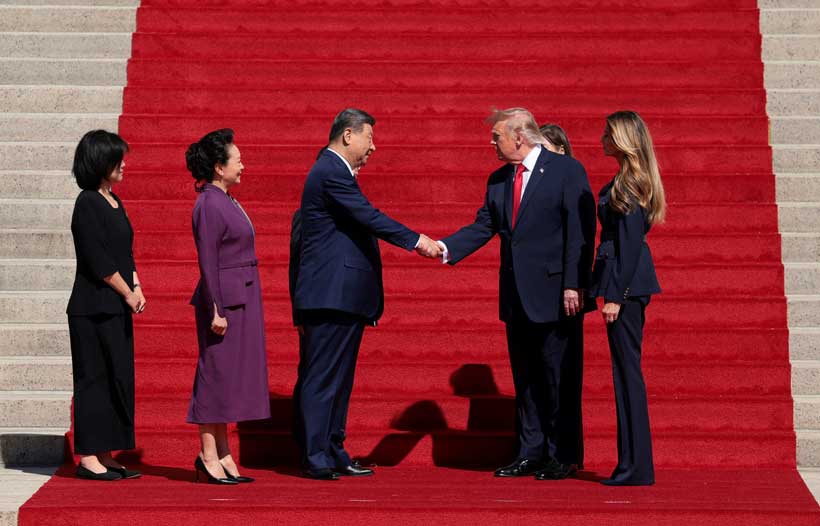
Chinese President Xi Jinping’s visit to the United States in September 2026 will contribute to managing economic and geopolitical differences between the world’s two largest powers, indirectly impacting the security of Egypt and the Middle East by seeking to contain major regional hotspots. In this context, President Xi Jinping’s visit to the United States and his meeting with President Donald Trump represent a step toward conflict management and a temporary economic truce between the two sides, which will indirectly benefit Egypt’s regional and economic security by stabilizing energy markets and averting open conflicts. Especially with Chinese President Xi Jinping’s emphasis in one of his political speeches addressed to the United States and major powers, stating, “Problems are not solved by the language of force, and security is not sustained with a zero-sum mentality.” Although the path of dialogue may be long and even fraught with setbacks, its repercussions are less, and its result is more lasting. Therefore, the various conflicting parties must launch dialogue to find the greatest common denominator and focus efforts on pushing for a political solution. Indeed, that was the essence of the message that President Xi wanted to convey during his visit to Washington. In this context, we can understand the impact of President Xi Jinping’s visit to Washington on the security of Egypt, the Middle East, and Africa through the following:
– First: The repercussions of Chinese President Xi Jinping’s visit to the United States on Middle East security
President Xi Jinping’s proposal for a comprehensive security concept in the Middle East, embodied in common, comprehensive, cooperative, and sustainable security, dates back to when he launched this initiative to maintain Middle East security in 2014. Since then, China has continued to employ measures to demonstrate its strong commitment to security and stability in the Middle East. During his meeting with President Trump, President Xi Jinping expressed his country’s hope that Washington and Tehran would return to dialogue and negotiation to resolve crises peacefully and achieve comprehensive security in the Middle East. He emphasized Beijing’s readiness to play a constructive role in easing regional tensions and respecting the sovereignty of nations. From this, we can deduce the impact of President Xi Jinping’s visit to Washington on Middle East security, as follows:
– Managing Regional Escalation: The American and Chinese sides discussed the crises and tensions with Iran, reducing the likelihood of a large-scale military confrontation that threatens the region’s stability. This was confirmed by US President Trump, who stated that the talks with the Chinese side addressed the war in Iran and the repercussions of the slowdown in shipping traffic through the Strait of Hormuz on global energy prices, amid expectations of positive outcomes regarding the reopening of the waterways.
Stay ahead of the geopolitical week.
MD Briefing delivers expert analysis across five global fronts — the Indo-Pacific, energy, geoeconomics, European security, and the Middle East — every Monday morning. Free.
– Protecting Energy and Trade Routes: Beijing and Washington share an interest in ensuring the security of navigation in the Red Sea and the Strait of Hormuz and preventing disruption to global trade. During his visit to Washington, President Xi sought to secure navigation and energy security, as China is well aware that any escalation in the Middle East or the Gulf threatens global energy security and vital shipping lanes, a matter that intersects with Egypt’s vital interests and the security of the Suez Canal.
– Securing Energy Interests and Supply Chains: Through Trump’s reception of Xi, Washington sought to urge China to exert economic and political pressure to contain the Iranian crisis. This would positively impact the stability of global oil markets and reduce transportation costs, which have burdened the American and global economies. It’s worth noting that the economic truce and de-escalation between Washington and Beijing during President Xi’s visit will alleviate pressure on the global economy and supply chains, thus helping Egypt, the region, and the Gulf states to stabilize their development plans and strategic partnerships with Beijing.
– Rejecting Foreign Interference: China called on the United States to promote self-sufficiency in the Middle East and reject interventions that fuel conflicts, aligning with Egypt’s position in this regard, which supports the national sovereignty of states.
– Second: The Impact of Chinese President Xi Jinping’s Visit to the United States on Egypt’s Strategic Security
Egypt will benefit from the truce between Washington and Beijing to achieve geopolitical balance and manage tensions, which will positively impact its security. The two superpowers’ efforts to avoid direct confrontations reduce the likelihood of regional crises escalating into major military conflicts that would harm Egypt’s regional stability. This will bolster Egypt’s decision-making independence, allowing it to maintain a policy of strategic equilibrium and diversify its partnerships among major powers without compromising its strategic relationship with the United States through its partnership with China. The following implications for Egypt will arise from President Xi’s visit to the United States:
– Expanding Egypt’s Room for Maneuvering: The détente between Washington and Beijing allows Egypt to strengthen its advanced economic and technological partnerships with China without suffocating American pressure on its traditional relations.
– Economic Integration Between President Xi’s Visit to Cairo and Washington: The summit’s repercussions are complementary. The international relations between Presidents Xi and Trump, coupled with the investment momentum generated by Chinese President Xi Jinping’s visit to Cairo in early September 2026, support the localization of industries and debt relief.
– Third: Will President Xi Jinping’s visit to Washington have repercussions for the Horn of Africa and the Grand Ethiopian Renaissance Dam (GERD)?
Chinese President Xi Jinping’s visits and actions (including his diplomatic interactions with Washington and Cairo) indirectly affect the GERD issue and the Horn of Africa through economic influence, debt, and the balance of power between China and the United States. However, understanding the nature of China’s policy of diplomatic neutrality is crucial, as China maintains its economic and developmental approach in Africa while avoiding direct involvement in sensitive political conflicts. Furthermore, President Xi’s visit to Washington is unlikely to lead to a fundamental shift in China’s position on the GERD. Beijing consistently supports peaceful, negotiated solutions among the Nile Basin countries and promotes joint technical cooperation without taking sides. Finally, the implications of Chinese influence on the Grand Ethiopian Renaissance Dam (GERD) and the Horn of Africa are highlighted through:
– Economic and financial influence: China possesses real tools of influence in the GERD system through its ability to intervene in financing, equipment, power transmission networks, and operation.
– Addressing Ethiopia’s debt: Ethiopia reached agreements with China to address and restructure its enormous debt, giving Beijing additional economic leverage over Addis Ababa.
– Balancing the Egyptian position: Egypt thanked China in its high-level talks for its balanced stance on the GERD issue, as Cairo seeks to diversify its strategic partnerships between Washington and Beijing.
– US-China competition: These developments coincide with Washington’s attempts to strengthen its military and security presence in Ethiopia and the Horn of Africa to counterbalance the growing Chinese and Russian influence on the African continent.
Accordingly, we understand that Chinese President Xi Jinping’s visit to Washington contributes to restoring stability to the Middle East and helps to calm regional and global conflicts and tensions, especially after the Iran-Iraq War. President Xi Jinping’s visit to Washington demonstrates that China has become a pivotal player on the international stage with its foreign policy based on peace and development. Promoting global development has become a primary objective of Chinese diplomacy, with its policy focused on promoting and explaining the significance of the Chinese Dream for the World, which is based on peace, development, cooperation, and win-win outcomes. Therefore, China has engaged in building new international relations centered on cooperation and win-win outcomes within the framework of peace and development, aiming to achieve a global goal it consistently advocates in international forums, a goal adopted by the United Nations: Realizing a Community with a Shared Future for Mankind.
