


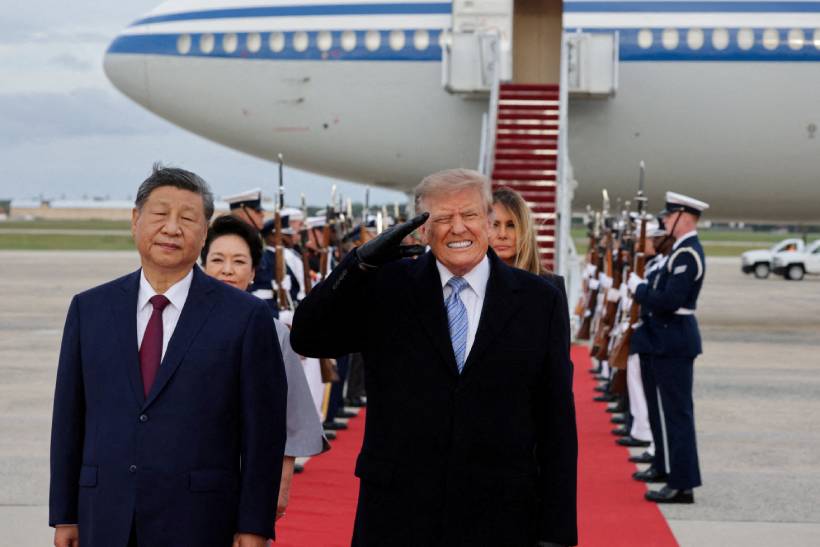
A tarmac welcome, a paused Taiwan arms package and a trade truce that conveniently outlasts the midterms. Trump’s White House summit with Xi Jinping will produce few agreements, but it reveals exactly who is setting the terms.
On a blustery Wednesday evening at Joint Base Andrews, an American president stood at the foot of an aircraft staircase and waited for the leader of China. It was the first time in eleven years that a US president had personally received a foreign leader at the base. The last was Barack Obama, and his guest was Pope Francis. Four months earlier in Beijing, Xi Jinping had pointedly declined to extend Donald Trump the same courtesy.
That asymmetry is the real story of today’s summit. By Thursday morning the machinery of American pageantry was running at full throttle: an arrival ceremony in the Grand Foyer, a Rose Garden military review involving 479 service members and a flyover by a B-2 bomber and four F-22s, talks in the Oval Office, and an East Room state dinner whose guest list, from Musk and Bezos to Huang, Altman, Pichai and Cook, reads like a roll call of American technological power. Whatever the official readouts eventually claim, almost no serious analyst expects breakthroughs. But the absence of substance is not the absence of consequence. Summits are also theatre, and in theatre, who bows to whom is the plot.
The choreography is the argument
Stay ahead of the geopolitical week.
MD Briefing delivers expert analysis across five global fronts — the Indo-Pacific, energy, geoeconomics, European security, and the Middle East — every Monday morning. Free.
Trump has extended tarmac honours to only one other leader: Vladimir Putin, in Anchorage, in August 2025. Earlier presidents reserved the gesture for close allies and popes, not for rivals actively challenging American security. Columbia University’s Julian Gewirtz observed that he never expects to see Trump greet Canada’s Mark Carney on a tarmac, and this in a week when Washington’s trade war with Canada is intensifying. Allies receive tariffs; rivals receive red carpets.
The venue choices cut the same way. Xi skipped the opening of the UN General Assembly this week, a short flight from Washington, after attending the Shanghai Cooperation Organization summit in Kyrgyzstan and the BRICS summit in New Delhi earlier this month. He showed up at the multilateral forums where China helps write the agenda, stayed away from the one where it does not, and came to Washington for a stage built for two.
The deference is not only ceremonial. In May, Washington signed on to Xi’s formulation of a “constructive relationship of strategic stability”, phrasing drafted in Beijing that American administrations have historically refused to adopt, precisely because accepting China’s vocabulary means accepting China’s definitions. Trump may regard such labels as free giveaways. Beijing does not. Every future US arms sale to Taiwan can now be cast as a betrayal of a relationship Washington itself agreed to describe in Chinese terms.
The chip on the table
That brings the summit to its most dangerous fault line. A $14 billion arms package for Taiwan, covering missiles, drone defences and air defence systems, has sat in limbo since spring, and Trump has called it a “very good negotiating chip”. Reuters reports that Xi intends to press for a halt to the sales, possibly during Friday’s tour of the National Archives, and that Beijing is dangling help on Iran in return.
Since 1982, one of the Six Assurances Washington gave Taipei has been that it would not consult Beijing on arms sales to the island. Treating those sales as an item in a bilateral negotiation hollows out that commitment, whether or not any formal decision is ever announced. A scholar at a think tank tied to the Chinese state told NBC that the pause alone had already been “quite good for China”. The pause, not a cancellation, is precisely the point. A weapons package permanently under review deters no one, reassures no one, and costs Beijing nothing.
Taipei insists it remains confident the sales will go ahead. China’s ambassador in Washington, writing in the People’s Daily on the eve of the visit, listed Taiwan among Beijing’s red lines. Both positions cannot stay comfortable for long.
Iran: the war that rewrote the ledger
The deeper shift in leverage comes from the Gulf. The American and Israeli war on Iran and the closure of the Strait of Hormuz have driven American fuel prices to historic highs and tied down US military power far from the Pacific, exposing how quickly expensive advanced munitions are depleted. China, which bought more than 80 percent of Iran’s oil exports before the US naval blockade, is reportedly finding quiet ways around it, and it can afford patience: over 65 percent of new cars sold in China last month were electric. Washington’s sanctions drive against Iran’s financial partners has meanwhile conspicuously spared Beijing, and Trump brushed aside reports that China had supplied Iran with satellite imagery, saying Xi had behaved reasonably well.
This is how a rival becomes an indispensable interlocutor. China does not need to win the Iran war; it needs only to let the United States keep fighting it. Small wonder that a Chinese think tank released a report this year titled “Thank Trump”.
Two leaders, two clocks
Then there is time, the most underrated variable in this relationship. On the eve of the visit, Treasury Secretary Scott Bessent announced that the Busan trade truce, due to expire on 10 November, would be extended to 10 January. Note the dates. The midterm elections are less than six weeks away; the new deadline falls safely beyond them. Trump needs visible wins such as Boeing orders, farm purchases and tariff relief before voters decide. Xi, by contrast, returns home to begin preparing for a Party Congress, on a timetable measured in Party Congresses rather than news cycles. One leader is racing a calendar; the other is managing one. It is why CSIS’s Scott Kennedy predicted an underwhelming summit whose meagre deliverables would work “mainly to China’s advantage”.
The case against the obvious verdict
And yet the easy conclusion, that Washington has been outmanoeuvred and Beijing is ascendant, deserves resistance. Xi arrives carrying serious economic troubles of his own, and the chief executives at tonight’s dinner are unlikely to take home looser export controls; people familiar with US planning expect those to stay firm. Talk of an AI incident hotline modelled on Cold War crisis lines, floated by Secretary of State Marco Rubio, reflects a genuine shared interest in avoiding catastrophe, however modest the first step. And the sheer tempo of contact is itself without precedent: Beijing in May, Washington now, Shenzhen in November and the G20 in Miami in December. Holding a rivalry of this magnitude in check is no small thing. Talking, as Churchill argued, remains better than fighting.
But stability is not the same as parity. The question is not whether the truce holds; it is which side is converting the truce into advantage. On the evidence of this week, Beijing is converting faster.
Former Deputy Secretary of State Kurt Campbell likened the encounter to ancient “single combat”, with two champions measuring each other on behalf of their civilisations. But single combat was decided by who struck first. This contest is being decided by who can afford to wait. On Friday, the two leaders will stand together before the Declaration of Independence, a document written by men who understood that deference, once conceded, hardens into a claim. Xi Jinping understands that too. The pageantry was neve
