


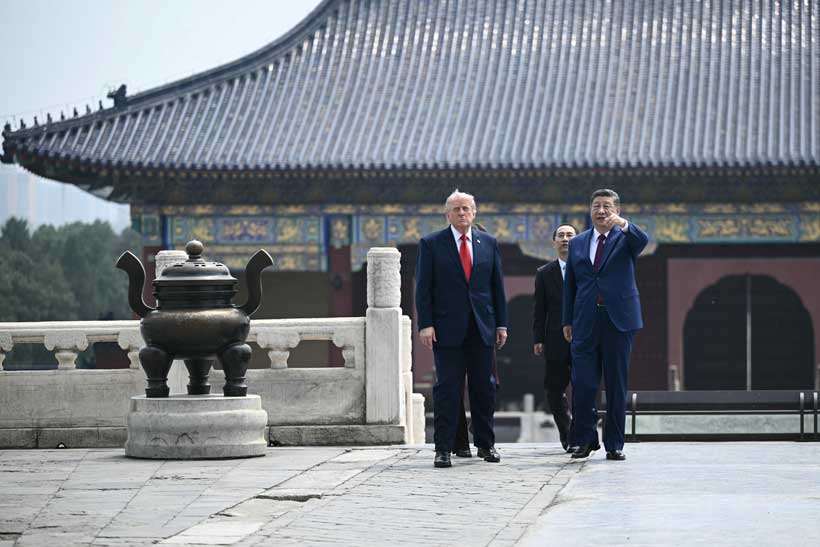
The United States and China are moving toward another high level meeting after months of tariff escalation, retaliation and negotiations that pushed the world’s two largest economies toward a deeper trade confrontation.
US President Donald Trump is set to host Chinese President Xi Jinping at the White House on September 24. The talks are expected to focus on preserving a fragile trade truce that is due to expire in November, although neither side has signaled expectations of a major breakthrough.
The latest meeting comes after a turbulent period in US China economic relations, marked by tariffs reaching triple digit levels, restrictions on strategic exports and repeated efforts to prevent the dispute from escalating further.
The trade conflict intensified soon after Trump returned to office.
Stay ahead of the geopolitical week.
MD Briefing delivers expert analysis across five global fronts — the Indo-Pacific, energy, geoeconomics, European security, and the Middle East — every Monday morning. Free.
How the trade war escalated
In February 2025, Trump imposed a 10% tariff on Chinese goods, citing concerns over fentanyl and immigration. Beijing responded with tariffs on US coal, liquefied natural gas, crude oil and automobiles, while restricting exports of five metals important to defense and clean energy industries.
In March, Washington doubled its fentanyl related tariffs on Chinese imports to 20%. China responded with tariffs of between 10% and 15% on US agricultural products, affecting around $21 billion in exports.
The confrontation escalated sharply in April after Trump announced his so called “Liberation Day” tariffs. China initially faced a 34% US tariff, effective April 9, before successive rounds of retaliation pushed tariffs on both sides as high as 125%.
Beijing also tightened controls on rare earth exports and warned Chinese citizens about travel to the United States, adding pressure beyond conventional tariffs.
The escalation eventually forced both governments back to the negotiating table.
From escalation to a temporary pause
In May 2025, US and Chinese negotiators reached an agreement in Geneva for a 90 day pause. Washington reduced its tariffs on Chinese goods to 30% from 145%, while Beijing lowered its tariffs on US products to 10% from 125%.
The arrangement was later extended for another 90 days in August.
The truce remained vulnerable, however. In October, China expanded its rare earth export controls. Trump responded with an additional 100% tariff and export controls affecting critical software, while also threatening restrictions involving Boeing parts.
Later that month, Trump and Xi reached a broader trade truce following talks in South Korea.
Under the agreement, Trump agreed to reduce some tariffs while Beijing pledged action against fentanyl precursor exports, resumed purchases of US soybeans and paused its expanded rare earth restrictions.
A more managed relationship
The confrontation entered a different phase in 2026.
In February, the US Supreme Court ruled against Trump’s emergency tariffs, striking down the China related fentanyl tariffs and the reciprocal tariff regime. Trump subsequently introduced a temporary 10% global duty under a different legal authority.
Three months later, Trump traveled to Beijing for a summit with Xi. The two governments announced plans to establish new Boards of Trade and Investment, while China agreed to purchases of Boeing aircraft and US agricultural products.
But tensions over trade and supply chains did not disappear.
In July, Washington imposed new 12.5% tariffs on goods from 60 trading partners, including China, citing allegations that those countries had failed to curb imports produced through forced labor.
What comes next?
Xi’s September 24 visit to the White House will test whether the two governments can extend the current truce beyond November.
The immediate challenge is not simply the level of tariffs. The dispute now covers strategic supply chains, rare earths, technology, agricultural purchases, aircraft and export controls, making the relationship considerably broader than the tariff confrontation that began in early 2025.
For Washington, maintaining pressure on China while avoiding another rapid escalation remains a central challenge. For Beijing, preserving access to major export markets while protecting its leverage over critical minerals and strategic supply chains is equally important.
The September meeting therefore comes less as an attempt to resolve every disagreement than as another effort to manage an economic relationship that has become increasingly defined by competition, retaliation and negotiated pauses.
With information from Reuters.
