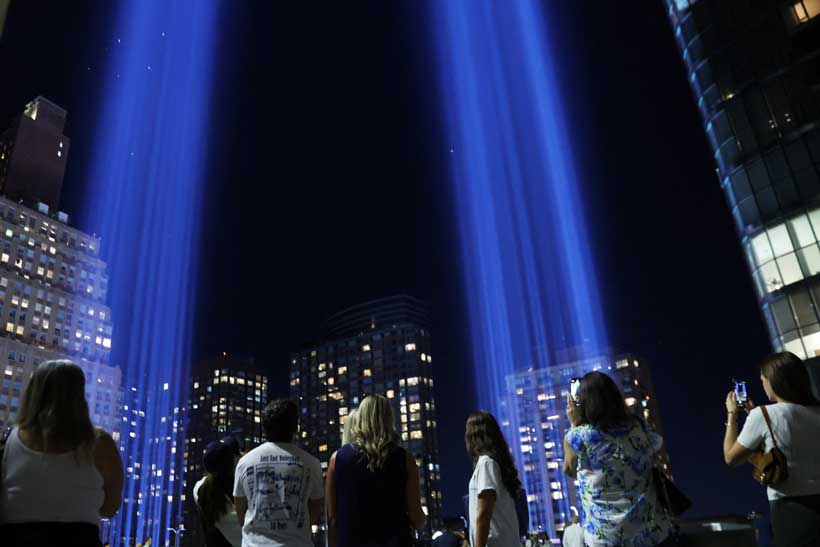
Twenty-five years after September 11, the Twin Towers are gone from New York’s skyline, Osama bin Laden has been dead for more than fifteen years, and American troops have been out of Afghanistan since 2021. Yet the war that began that morning has not entirely ended. Its most durable legacy is not a battlefield, a regime toppled, or even an authorization still on the books. It is a way of thinking: war transformed from an exceptional instrument used against a defined enemy into a permanent framework for managing insecurity.
That transformation began with September 11’s singular place in American political memory. The attacks created a legitimate emergency. They also became more than an event: a standing reference point for what might happen if government failed to anticipate the next threat. In a 2026 Pew Research Center survey, 83 percent of Americans born before 2001 still recalled where they were when they heard the news. Memories that powerful do not merely preserve the past; they structure how societies imagine future danger.
President George W. Bush captured the new logic in his September 20, 2001, address to Congress. America’s war, he said, began with al Qaeda but would not end there; it would continue until every terrorist group of global reach had been found, stopped, and defeated. It began with a concrete enemy, yet enlarged retaliation for one attack into a campaign against a category of adversary, with neither a single battlefield nor a quick conclusion.
Wars rarely conform to theory, yet they usually answer four questions: Who is the enemy? Where is the battlefield? What political result should force achieve? What condition ends the conflict? The War on Terror destabilized every answer. Terrorism was not a state, an army, or one ideology, but a method used by changing organizations. A war against it could acquire new enemies without a new declaration, move between theaters without crossing a conceptual border, and outlive its original architects.
Stay ahead of the geopolitical week.
MD Briefing delivers expert analysis across five global fronts — the Indo-Pacific, energy, geoeconomics, European security, and the Middle East — every Monday morning. Free.
The critical change was not simply that the battlefield expanded. It was that the purpose of war expanded from defeating those who had attacked the United States to eliminating the conditions from which another attack might emerge. When war is directed not only against an existing enemy but also against the circumstances that could produce future insecurity, its boundaries become almost unlimited.
The institutional architecture reflected this shift. The 2001 Authorization for Use of Military Force authorized “necessary and appropriate force” against those responsible for September 11 and those who harbored them. It named neither a country nor an expiration date. “Associated forces” later extended its application beyond Afghanistan. A Congressional Research Service analysis traced related operations or deployments across Pakistan, Yemen, Somalia, Libya, and Syria, including against organizations that did not exist in 2001.
The deeper doctrine appeared in the 2002 National Security Strategy. Facing terrorist networks, hostile states, and weapons of mass destruction, it argued, the United States could no longer rely on a reactive posture or the traditional understanding of imminence. It might have to act preemptively amid uncertainty. The strategy warned that preemption must not become a pretext for aggression. The dilemma was genuine: waiting for certainty against a covert enemy can mean waiting until after catastrophe.
But the reversal was profound. Uncertainty, once a reason to hesitate before war, could become a reason to begin it. The old sequence was threat, then response. The new sequence was a possible threat, followed by action intended to prevent it from becoming real.
This logic changed political incentives as much as military planning. A president who attacks a potential danger and suffers no subsequent attack can claim prevention worked; the counterfactual cannot be disproved. A president who exercises restraint and is later surprised must explain why warnings went unanswered. The costs of excessive action accumulate slowly; the cost of inaction can arrive in a single televised morning. Military action thus became a visible demonstration of seriousness, while accepting uncertainty could be portrayed as negligence.
The result is a structural bias toward force. If no attack follows intervention, the intervention is validated. If an attack does occur, the conclusion may be that the government did not go far enough. Success becomes difficult to distinguish from the absence of events, while failure always supplies an argument for renewed action. Under those conditions, war ceases to be a bounded effort to obtain a political result. It becomes an open-ended form of risk management.
That framework is transferable. After Hamas’s October 7, 2023, attack, Israel faced its own security shock. Prime Minister Benjamin Netanyahu defined the war’s objective as destroying Hamas’s military and governing capabilities. The analogy is not between the legitimacy, scale, or history of the two cases. It concerns strategic reasoning: after a mass-casualty terrorist attack, defeating the attackers can appear insufficient; victory becomes preventing the organization, or anything resembling it, from regenerating the threat.
Yet regeneration is a future condition, not a target that can be conclusively destroyed today. Force can kill leaders, dismantle units, seize territory, and eliminate weapons. It cannot prove that no successor network will form. A CSIS analysis of what “destroying Hamas” could mean showed how removing territorial control, breaking organizational capacity, and eradicating an ideology produce very different wars and endpoints. A RAND study of 648 terrorist groups found that policing, intelligence, and political processes ended far more groups than military force did.
This does not make military action futile. Some threats must be met by force, and some organizations can be rendered less capable and less dangerous. The problem comes when destroying a measurable capability is confused with abolishing the possibility of future danger. The first can be a military objective. The second is a permanent aspiration—and, therefore, a permanent warrant for action.
The strategic environment has moved beyond the one that produced the War on Terror. In a 2026 Reuters/Ipsos poll, Americans identified domestic terrorism as a larger threat to their safety than foreign terrorism. Enemies and theaters have changed, but the post-9/11 architecture remains available. Its scale is visible in Brown University’s estimate of post-9/11 war costs approaching $8 trillion. The more consequential legacy, however, may be a conflict without a defensible stopping rule.
Escaping that logic does not require denying terrorism, renouncing prevention, or waiting passively for attack. It requires recovering the discipline that makes strategy possible. Before force is authorized, leaders should identify the enemy, the geographic scope, the attainable political objective, and the conditions for termination. They should distinguish a threat that must be destroyed from a risk that must be managed by intelligence, policing, diplomacy, deterrence, or resilience. Above all, they should state how much residual uncertainty a free society is prepared to tolerate, because no military campaign can reduce risk to zero.
The central question after September 11 is therefore larger than whether particular wars were won or lost. It is whether democratic states can use extraordinary force against extraordinary threats without making war their ordinary method of governing insecurity. The War on Terror survived its original enemy because the fear of the next attack became a self-renewing war aim. The task now is not to forget September 11, but to remember that an emergency without an endpoint eventually becomes a system.